

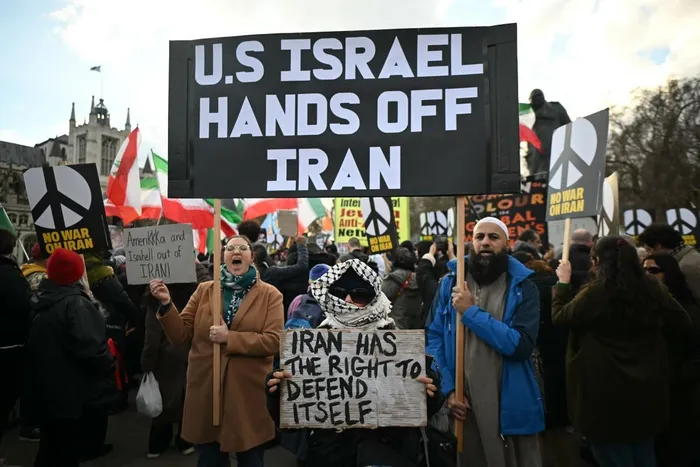
Political economist Nco Dube explores the historical lessons of imperialism and the futility of military intervention in achieving true liberation, focusing on the ongoing tensions between the West and Iran. People hold placards during a protest against the US-Israeli attacks on Iran, in Parliament Square in central London, on February 28, 2026.
Image: Justin Tallis | AFP
History does not whisper. It shouts. It shouts across centuries, across continents, across the ruins of empires that once believed themselves eternal. It shouts a lesson power refuses to learn: no amount of force, war, occupation, colonisation, or mass killing has ever extinguished a people’s hunger for freedom, liberty, and dignity. Not once. Not ever. And yet here we are again, watching the United States and Israel rain violence on Iran, cloaking naked aggression in the familiar language of fear, salvation, and security.
The pretexts are depressingly familiar. We are told this is about nuclear weapons. We are told it is about freeing Iranians from the oppressive theocratic rule of the Ayatollahs. We are now told it is about destroying Iranian ballistic missile capabilities. Each justification is presented as urgent and moral. Each collapses under scrutiny.
The Hackneyed Nuclear Narrative
Together they form a theatre of imperial arrogance that history has already judged.
The nuclear argument is the oldest lie in the imperial handbook. Iran’s nuclear programme has been framed as an existential threat for decades, repeated so often that it has acquired the illusion of truth through repetition.
Yet the facts are stubborn. Iran was party to a negotiated agreement that placed strict limits on its nuclear activities and subjected them to international inspection. That agreement worked. It was not Iran that abandoned it. It was Washington.
Israel, meanwhile, maintains its own undeclared nuclear arsenal, protected by Western silence and diplomatic indulgence. This is not non-proliferation. It is selective enforcement. It is power deciding who may possess deterrence and who must remain permanently exposed.
Then comes the language of liberation. We are told that bombs will free Iranians from clerical rule. That missiles will deliver democracy. That the assassination of Ayatollah Ali Khomeini is a form of humanitarian intervention. This is perhaps the most cynical of all the justifications, because it insults both history and intelligence.
The Middle East is littered with the wreckage of Western liberation projects. Iran itself knows this story intimately. In 1953, a democratically elected prime minister was overthrown because he dared to nationalise oil. What followed was not freedom, but decades of dictatorship under the Shah that was enforced by repression and torture, all underwritten by Western support. The revolution that toppled the Shah did not emerge from nowhere. It was born of betrayal.
Liberation By Bomb?
Iraq was promised democracy in 2003. What it received was invasion, occupation, sectarian bloodshed, and the destruction of its social fabric. Libya was bombed in 2011 in the name of protecting civilians and now exists as a fractured state where militias rule and human beings are traded like commodities. Afghanistan endured twenty years of occupation, only to see the very forces the West claimed to be fighting return to power. These are not unfortunate exceptions. They are the pattern.
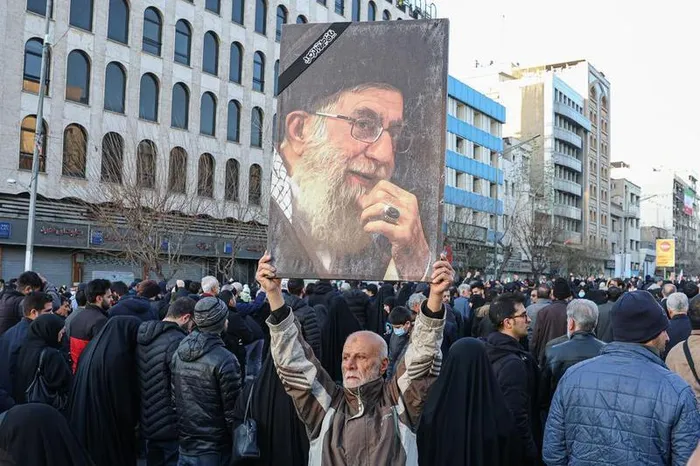
People gather in the capital city of Iran, Tehran, to mourn the death of Muslim Republic's Supreme Leader Ayatollah Ali Khamenei who died in an airstrike launched by Israel with support from the US.
Image: Xinhua
The newest pretext, the destruction of Iran’s ballistic missile capabilities, follows the same logic. Missiles are presented as an abstract threat, stripped of context. What is never acknowledged is why states like Iran invest in deterrence in the first place. They do so because they live in a region where borders are violated with impunity, where sanctions are weaponised, where leaders are assassinated, and where sovereignty is treated as conditional. Destroying missile sites does not remove insecurity. It deepens it. It signals that only those aligned with empire are allowed the means to defend themselves.
This is how imperial projects operate. They identify a threat. They inflate it. They moralise it. Then they unleash violence and call it necessity. What they never do is reckon with consequences.
Force can topple governments, but it cannot manufacture legitimacy. It can kill leaders, but it cannot kill ideas. It can occupy territory, but it cannot occupy the human spirit. In fact, violence almost always produces the opposite effect. It hardens identity. It radicalises populations. It turns grievances into movements and movements into legacies.
South Africans understand this dynamic viscerally. We were told apartheid was necessary for stability. We were told repression was required to prevent chaos. We were told liberation movements were terrorists. None of it was true. The more brutal the system became, the more determined the resistance grew. The state had guns, prisons, and laws. The people had something stronger. They had the certainty that dignity is not negotiable. That certainty outlasted the regime.
The Illusion of Moral Force
The same dynamic is at play in Iran. External attacks do not weaken authoritarianism. They strengthen it. They allow hardliners to cloak themselves in the language of sovereignty and resistance. They silence internal dissent by framing it as collaboration. They turn legitimate grievances into secondary concerns in the face of foreign aggression. If the stated goal is to empower the Iranian people, bombing them is a strange way to go about it.
The human cost of these campaigns is always sanitised. We hear about targets neutralised and capabilities degraded. We do not hear about families torn apart, hospitals overwhelmed, or children growing up under the constant hum of drones. These are not unfortunate side effects. They are predictable outcomes of a strategy that treats entire societies as expendable. Empire speaks in abstractions. Ordinary people pay in blood.
Hovering over all of this is a bitter irony that would be laughable if it were not so grotesque. Donald Trump, now once again at the centre of American power, has made no secret of his obsession with the Nobel Peace Prize. He has complained openly that he deserves it, citing his role in various diplomatic initiatives.
The irony is staggering. A man who tore up a functioning nuclear agreement, escalated sanctions that punished civilians, and now presides over renewed military aggression, presents himself as a peacemaker denied recognition. It is a perfect metaphor for imperial self-delusion. Violence is reframed as virtue. Destruction is marketed as stability. War is sold as peace.
The Limits of Empire
This obsession matters because it reveals something deeper about how power sees itself. Empire does not merely want dominance. It wants applause. It wants moral validation. It wants to be celebrated for acts that leave entire regions destabilised. The Nobel fixation is not a personal quirk. It is a symptom of a system that cannot distinguish between force and legitimacy.
History offers no shortage of warnings. The British Empire believed it would rule forever. It collapsed under the weight of colonial resistance. The Soviet Union marched into Afghanistan convinced of its inevitability and left diminished. The United States has spent decades projecting power across the Middle East, only to find itself trapped in cycles of conflict that drain resources and credibility. Empires do not fall because they are weak. They fall because they refuse to recognise their limits.
Iran, for all its internal contradictions and struggles, has demonstrated resilience. It has endured sanctions designed to break its economy, assassinations aimed at decapitating its leadership, cyberattacks intended to cripple its infrastructure, and now open military assault. Yet it remains standing. Not because it is invincible, but because its people understand something empires never do. Survival is not only about power. It is about purpose.
None of this is an endorsement of repression or theocracy. It is a rejection of the lie that freedom can be delivered by foreign bombs. Real liberation is contested and internal. It emerges from struggle, debate, and collective action. It cannot be imposed by those whose primary interest is control. The Iranian people, like all people, have the right to determine their own future without external coercion.
A Different Path
Alternatives exist. Diplomacy works when pursued in good faith. Agreements can be negotiated, verified, and enforced. Regional security frameworks can be built that recognise the legitimate concerns of all parties. Economic engagement can create incentives for reform. None of these paths are easy. All require humility. Empire prefers force because force is simple. It is also catastrophic.
What we are witnessing is not strength. It is desperation. It is the flailing of a system that cannot imagine a world in which it does not dominate. The language of nuclear threats, liberation, and missile destruction is a cover for a deeper fear: that power is slipping, that the old order is unsustainable, that people awakened to their dignity cannot be put back to sleep.
No empire has ever succeeded in extinguishing the love of freedom. Not Rome. Not Britain. Not apartheid South Africa. Not the Soviet Union. Not the United States. The methods change. The rhetoric evolves. The outcome remains the same. Violence begets resistance. Oppression breeds defiance. Dignity survives.
The attacks on Iran will not bring peace. They will not bring democracy. They will not bring security. They will deepen wounds, entrench divisions, and sow the seeds of future conflict. History will record them not as acts of courage, but as failures of imagination.
The human spirit is stubborn. It refuses to be conquered. It bends, it breaks, it rebuilds. Empires come and go. The desire for freedom endures. That is the lesson written in the ruins of history. It is being written again today. The only question is how many more lives will be sacrificed before power finally learns what history has been trying to teach all along.
(Dube is a noted political economist, businessperson, and social commentator on Ukhozi FM. His views don't not necessarily reflect those of the Sunday Tribune or IOL. For more of his views visit: http://www.ncodube.blog)
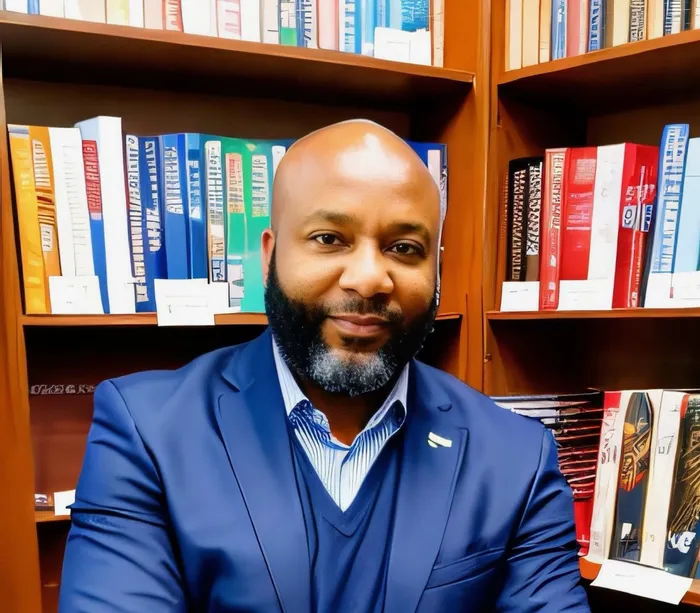
Nco Dube is a political economist, businessman and social commentator
Image: Supplied