

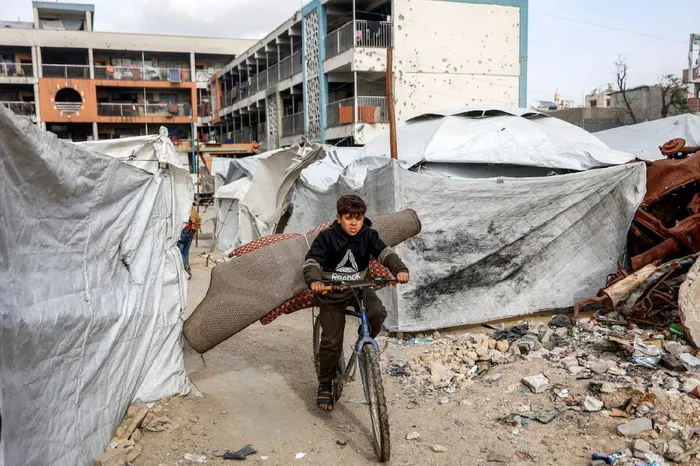
A BOY rides a bicycle loaded with carpets and mats past tent shelters at a makeshift camp for people displaced by conflict in Al-Rimal school run by the United Nations Relief and Works Agency for Palestine Refugees in the northern Gaza Strip. More than 75 000 Palestinians have been killed by Israel yet the Western media treats the dead like meaningless statistics, argues the writer.
Image: OMAR AL-QATTAA AFP
In war, not all lives are equal. Not in the headlines. Not in the breaking news alerts. Not in the algorithms that decide what trends and what disappears.
The world has normalised a grotesque moral hierarchy in which Western lives are named, photographed, mourned, and sanctified, while those from the global south are reduced to figures on a screen, stripped of identity, and quietly erased. This is not an accident. It is not bias in the abstract. It is a system of valuation rooted in race, power, and geopolitical alignment.
In Gaza, more than 75,000 Palestinians have been murdered by Israel. Seventy five thousand lives extinguished. Seventy five thousand families shattered. Seventy five thousand stories cut short. And yet, in much of Western media, this staggering human catastrophe is rendered as a background statistic, a rolling ticker, a disputed number prefaced with suspicion.
Palestinian deaths are routinely framed as “according to Hamas-run health authorities,” as though the act of counting the dead itself is a political provocation. Their names are rarely spoken. Their faces are rarely shown. Their lives are rarely explored beyond the moment of their destruction.
Contrast this with how Israeli victims are treated. When Israelis are killed, the coverage is immediate and intimate. Names are published. Childhood photos are shared. Interviews with grieving relatives dominate the airwaves.
Their humanity is foregrounded, their pain centred, their loss treated as self-evident and unquestionable. There is no caveat. No sceptical framing. No demand for independent verification before empathy is extended. Their deaths are real by default. Palestinian deaths must be proven.
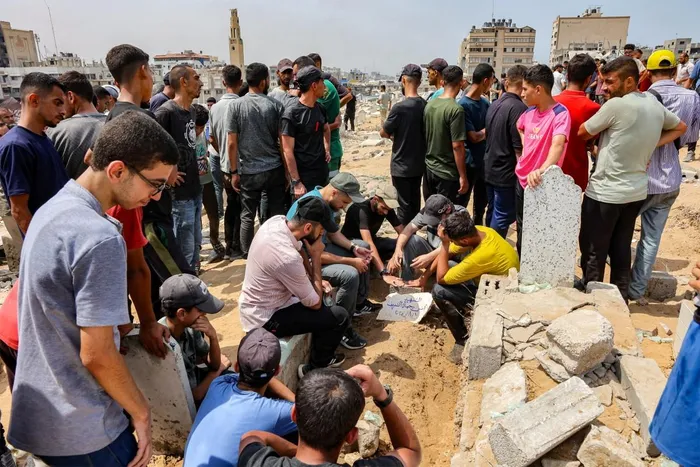
Mourners sit around the grave of Al Jazeera correspondent Anas al-Sharif at the Sheikh Radwan cemetery. He was killed alongside other journalists in an overnight Israeli strike on their tent in Gaza City. Many journalists have died along with civilians in the Israel war against Palestine.
Image: Omar Al-Qattaa/ AFP
This asymmetry is not confined to Gaza. It repeats itself with chilling consistency across the region. In Lebanon, Israeli airstrikes on civilian areas are reported as “responses” or “retaliation.” The language is passive, evasive, and sanitised. Buildings are “hit.” Civilians are “caught in the crossfire.”
Deaths are “unconfirmed.” Responsibility dissolves into fog. The victims remain nameless, faceless, and distant. There are no profiles, no obituaries, no sustained attention to the lives erased beneath the rubble.
When Israel and the United States launched strikes on Iran from last Saturday 28 February 2026, killing the Iranian Head of State, other senior figures and civilians (including at least 165 at a girl’s school) alike, the reporting followed the same script. The action was described as “targeted,” “strategic,” and “defensive.”
The justification was front-loaded. The victims were background noise. Their identities were withheld. The means of their deaths were obscured. The moral weight of the act was diluted by language designed to reassure Western audiences that this violence was necessary, rational, and regrettable but unavoidable.
Yet when violence touches Western targets, the tone shifts instantly. An attack on a Western embassy, a Western soldier, or a Western civilian is reported decisively and without ambiguity. The perpetrator is named. The act is described clearly.
The outrage is immediate and global. There is no speculation about whether the victims “count.” There is no hedging language. There is no reluctance to assign blame. Western suffering is treated as a moral absolute. Non-Western suffering is treated as a geopolitical inconvenience.
This is not merely a failure of journalism. It is a form of complicity. Western media does not simply report events. It frames them. It selects which lives are worthy of attention and which can be collapsed into abstraction.
It chooses language that humanises some and dehumanises others. Israeli civilians are “murdered.” Iranians are “killed.” Israeli homes are “targeted.” Lebanese homes are “hit.” Israeli soldiers “defend.” Palestinian fighters “terrorise.” Even when the facts are identical, the moral framing is not.
Social media platforms amplify this hierarchy. Posts mourning Western victims are boosted, shared, and algorithmically rewarded. Posts documenting Iranian suffering are flagged, throttled, or removed.
Images of dead Palestinian children are deemed “sensitive content,” while images of Israeli grief circulate freely. The result is a digital ecosystem in which empathy is racialised and outrage is selectively distributed.
AI platforms, often presented as neutral tools of information, are not immune to this bias. They are trained on datasets dominated by Western media sources. They inherit the assumptions, omissions, and prejudices embedded in those sources.
When asked about Western victims, they respond with clarity and detail. When asked about victims from the global south, they hedge, qualify, and defer. The language of uncertainty becomes a proxy for doubt about the value of non-Western life.
This unequal weighting of human cost is not accidental. It is structural. It reflects a world order in which power determines whose suffering matters.
Western governments shape narratives through funding, access, and pressure. Media institutions internalise these priorities, often unconsciously. Journalists who challenge the dominant framing are marginalised.
Outlets that centre Palestinian, Lebanese, or Iranian humanity are dismissed as biased or partisan. Even liberal publications that pride themselves on nuance often retreat into false equivalence, framing genocide as “conflict” and occupation as “complexity.”
The result is a moral landscape in which mass death can be normalised as long as it happens to the right people, in the right places, at the hands of the right actors. Seventy five thousand Palestinians murdered becomes a statistic to be debated. One Western life lost becomes a tragedy to be mourned. This is not just hypocrisy. It is a profound ethical failure.
South Africans know this logic well. Under apartheid, Black lives were treated as expendable, their deaths justified in the name of “security” and “order.” The state spoke in abstractions. The victims were numbers.
The resistance was criminalised. The humanity of the oppressed was denied until it could no longer be ignored. History judged that system harshly. It will judge this one no differently.
The victims of Gaza, Lebanon, Iran, and countless other theatres of Western-backed violence are not collateral damage. They are not footnotes. They are not disputed figures. They are human beings with names, families, histories, and futures that were violently stolen.
To deny them recognition is to participate in their erasure. To accept unequal mourning is to accept a world in which humanity itself is conditional.
The price of a life should not depend on race, ethnicity, or geopolitical alignment. A child killed in Gaza is no less human than a child killed in Tel Aviv.
A family buried in Beirut is no less worthy of grief than a family mourned in Paris or London. Until our media, our platforms, and our technologies reflect this basic truth, they remain complicit in a crime that history will not forget.
The question is not whether this system will be judged. It will. The question is who will have the courage to challenge it while it is still unfolding.
(Dube is a noted political economist, businessperson, and social commentator on Ukhozi FM and in various newspapers. For further reading and perspectives, visit: http://www.ncodube.blog)
For more thought-provoking opinions click the link below:
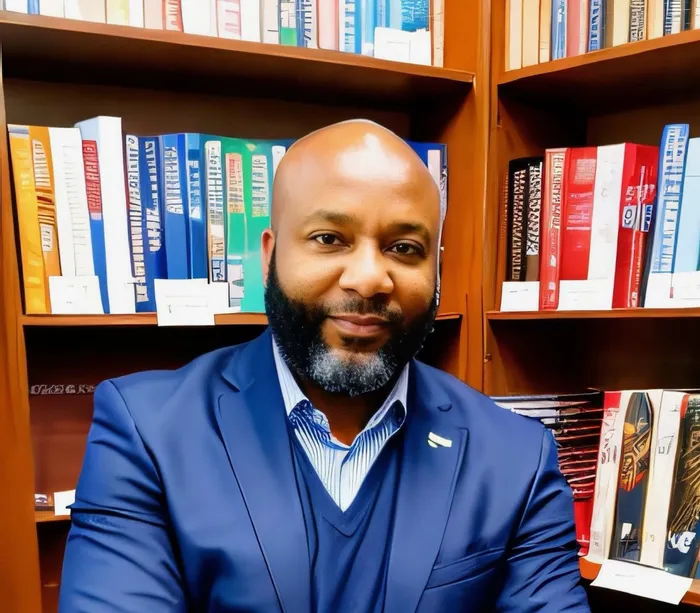
Nco Dube is a political economist, businessman and social commentator
Image: Supplied