
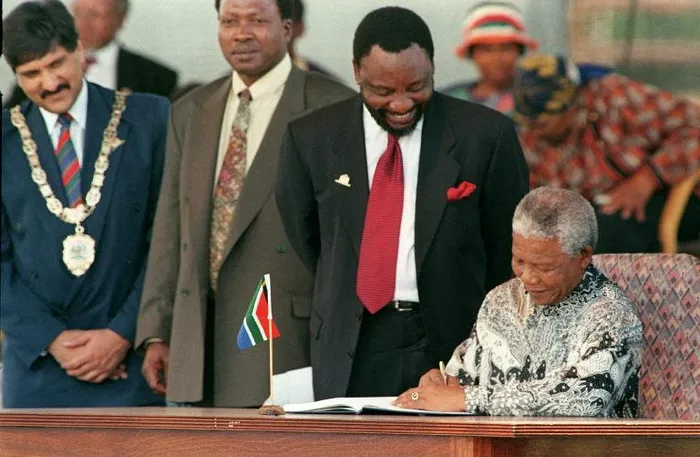
Then President Nelson Mandela, observed by current President Cyril Ramaphosa, signs the country's new Constitution at the Sharpeville stadium near Vereeniging 10 December 1996. March 21 is observed as Human Rights Day to commemorate the 1960 Sharpeville massacre.
Image: AFP
South Africa’s transition to democracy brought a glimmer of hope to many South Africans who had languished under the ruthless apartheid regime for decades. Following President FW de Klerk’s historic announcement that political prisoners would be released from jail and their liberation movements unbanned, the country was poised for better things.
The Groote Schuur Minute of 2 May 1990 and the Pretoria Minute of 6 August 1990 paved the way for the Convention for a Democratic South Africa (CODESA). The 1993 Interim Constitution laid the foundation for the first democratic election in April 1994. The Constitution of the Republic of South Africa was adopted as Act 108 of 1996, marking its thirtieth anniversary in 2026.
In 1995, March 21, which was known as Sharpeville Day following the massacre of 69 innocent black South Africans who died in Sharpeville protesting the carrying of passes, became known as ‘Human Rights Day’ in the spirit of reconciliation.
In 1994, Dingane’s Day or the Day of the Vow, which marked the defeat of the Zulu army under King Dingane in eNcome (Blood River) on December 16, 1838, became Reconciliation Day. June 16, which marked the Soweto uprisings, became National Youth Day.
With all these milestones, the question remains: what does Human Rights Month mean to ordinary South Africans? Is it enough to hold gatherings where politicians make endless speeches to brag about the rights which South Africans now have? Do ordinary people enjoy the same rights as their political elite and those who have money?
Section 9(1) of the Constitution states that “everyone is equal before the law and has the right to equal protection and benefit of the law.” This looks good on paper, but the reality shows something else. Poor South Africans cannot afford lawyers.
Once corruption is factored in, those who have money bribe their way out. The glimpses of what we have heard from the Madlanga Commission and the parliamentary ad hoc committee demonstrate that equality before the law remains a far-fetched dream.
Chapter 9 institutions are presented in the constitution as institutions to support constitutional democracy. Ideally, these institutions should be the vanguard of human rights. They should interpret and apply the law objectively. Sadly, this is not the case.
The Public Protector is one of these institutions that should protect the public in a nonpartisan manner. However, there have been complaints that incumbents serve certain people and not others. At times, they are co-opted to advance political agendas.
The removal of Advocate Busisiwe Mkhwebane soon after she had made a public pronouncement that she had received a complaint about the Phala Phala saga involving President Cyril Ramaphosa is one example. She was immediately suspended.
Since there were no terms of reference on how to remove a Public Protector from office, these were quickly put together. As the inquiry continued, she needed legal representation. But because her case was politically motivated, her plea was dismissed. She was eventually removed from office.
In this case alone, were human rights protected? Was the constitution adhered to, or was something untoward done which trampled on the rights of others to save those who have power derived from money and/or politics?
The South African Human Rights Commission (SAHRC) has three constitutional obligations: (a) to promote respect for human rights and a culture of human rights; (b) to promote the protection, development, and attainment of human rights, and (c) to monitor and assess the observance of human rights in the Republic.
This sounds promising. However, there are many factors which prevent this institution from carrying out its constitutional mandate. Among them is the fact that it struggles with financial constraints. These constraints significantly reduce the unit’s operational capacity. When that happens, those whose human rights would have been protected are left stranded.
Flowing from reconciliation, which was rushed to move to the current political dispensation, racial intolerance remains rampant. As such, the SAHRC finds itself flooded with too many complaints which have racial inclinations. As these cases remain unresolved, the victims cannot get justice, and their human rights are violated.
Another concerning issue is that this Chapter 9 institution does not have prosecutorial powers. Once it has processed a matter, it makes recommendations that must be implemented by relevant government units. If those units prioritise their normal cases and ignore the SAHRC’s recommendations, the implementation of those recommendations either takes a long time or does not happen at all.
To crown it all, political connections and brown envelopes result in many of the recommendations made by this institution being shelved under the carpet. Meanwhile, those victims who were supposed to get justice never got it. By implication, their human rights are ignored at best and violated at worst.
Generally, the following issues reduce the chances of many South Africans having their human rights protected. These include, but are not limited to, being exposed to criminal activities that go unpunished for various reasons, lack of service delivery – including basic services such as electricity and water, and socio-economic inequalities whose roots can be traced to the apartheid era.
The uncontrolled scourge of gender-based violence (GBV) has been another prominent factor in the violation of human rights. This has attracted the attention of the national government. Consequently, in 2025, it prompted President Ramaphosa to invoke Section 23 of the Disaster Management Act to declare it a national disaster.
Ideally, this declaration should trigger rapid responses and re-channelling of funds to enable those responsible to intervene. Such intervention should include building more shelters, training more counsellors, and strengthening the entire justice system so that GBV cases can be concluded speedily.
Ironically, some perpetrators get bail under very dubious circumstances and go out to commit more such crimes. In the process, they violate their victims’ human rights.
Put succinctly, systems are in place to protect people’s human rights. However, ordinary South Africans feel excluded from such protection. Without money or political power, their human rights are trampled upon. Therefore, they have very little to celebrate.
* Prof. Bheki Mngomezulu is Director of the Centre for the Advancement of Non-Racialism and Democracy at Nelson Mandela University.
** The views expressed do not necessarily reflect the views of IOL or Independent Media.