

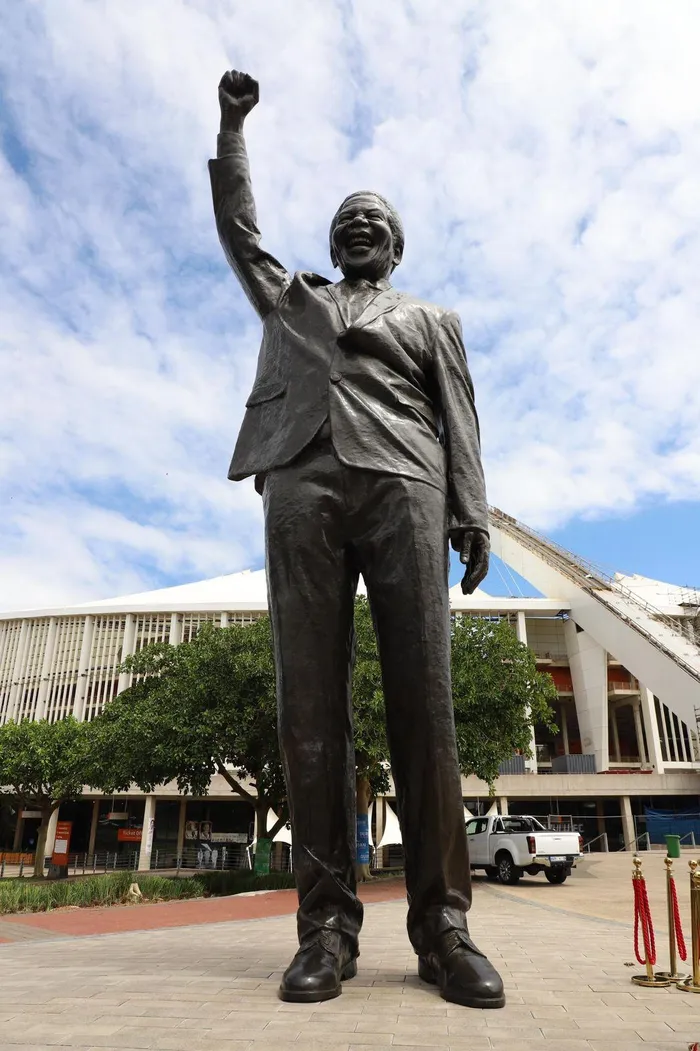
A 10-metre-tall bronze statue of South Africa's first democraticaly elected president Nelson Mandela with the iconic Moses Mabhida Stadium in the background, was unveiled sparking debate over municipal priorities. Political economist Nco Dube posits that the anger is less about the statues themselves and more about declining trust in government.
Image: THULI DLAMINI
They arrived draped in plastic, then unveiled in bronze. Nelson Mandela now stands at the Moses Mabhida Stadium, Oliver Tambo along Durban's beachfront. Two towering figures of our liberation history, placed at sites meant to signal pride, memory, and continuity. Instead, their unveiling has provoked irritation, anger, and a deep national sigh.
The backlash has been swift and, in some quarters, unforgiving. But to reduce this moment to a debate about statues is to miss the point entirely. What South Africans are reacting to is not bronze and stone, but a broken relationship between the governed and those who govern.
Let us be clear from the outset. South Africans are not hostile to history. We are not a people allergic to memory, nor are we dismissive of the symbolic power of monuments. On the contrary, we understand their value instinctively.
Cities are shaped not only by roads and pipes, but by meaning. The Eiffel Tower is not merely steel. The Statue of Liberty is not just copper. These structures anchor identity, tell stories, and project aspiration. Mandela and Tambo, as architects of our freedom, deserve to be honoured in public space.
But context is everything. And in eThekwini, context is unforgiving.
Durban is a city in distress. Water outages are routine. Sewage spills into rivers and the ocean with alarming regularity. Roads crumble. Stormwater systems fail. Communities live with the daily indignity of unreliable basic services.
Against this backdrop, a R20 million statue project does not read as cultural investment. It reads as misplaced priority. Not because art is unimportant, but because governance is failing at the most elemental level.
This is where the ANC and its defenders have misjudged the moment. Faced with public criticism, the response has been defensive, even pedagogical. We have been told that statues attract tourists, that they preserve history, that they uplift cities.
All of this may be true in the abstract. But delivered in this moment, in this tone, it has sounded condescending, as though the public simply does not understand what is good for them.
The problem is not ignorance. It is trust.
For three decades, the ANC has governed South Africa with a moral authority inherited from the struggle. That authority has been steadily eroded by corruption, mismanagement, cadre deployment, and a persistent failure to deliver on the promise of a dignified life for all.
The social contract, the implicit agreement that citizens will endure hardship today in exchange for a better tomorrow, has frayed, and in many places, snapped entirely.
When trust collapses, symbolism becomes suspect. Every ribbon cutting is interrogated. Every expenditure is scrutinised. Every gesture is weighed against lived reality. This may appear disproportionate, even unfair.
But it is entirely rational. A government that has squandered credibility cannot expect generosity of interpretation.
In this climate, statues are no longer neutral. They become political statements, whether intended or not. And the statement many South Africans hear is this: we can still afford grandeur, even as you struggle with the basics.
That is not what Mandela or Tambo stood for. Their legacy was not spectacle, but service. Not monumentality, but moral clarity.
There is a painful irony here. The ANC invokes Mandela and Tambo to defend the statues, yet it is precisely their values that sharpen the critique. Mandela spoke relentlessly about accountability, humility, and servant leadership.
Tambo believed in institutions that worked, not personalities that loomed. To honour them meaningfully would be to build cities that function, municipalities that care, and governments that listen.
Instead, what we have witnessed is a party talking past the public. The insistence that criticism of the statues is an attack on history is a misreading of the national mood.
South Africans are capable of holding two ideas at once: that our heroes deserve honour, and that our cities deserve competence. These are not competing demands. They are complementary ones.
The deeper issue is that the ANC no longer controls the narrative terrain. Once, it could frame debates, set moral terms, and expect deference.
Today, it operates in a sceptical public sphere shaped by disappointment and fatigue. In such a space, even well intentioned projects are filtered through a lens of suspicion.
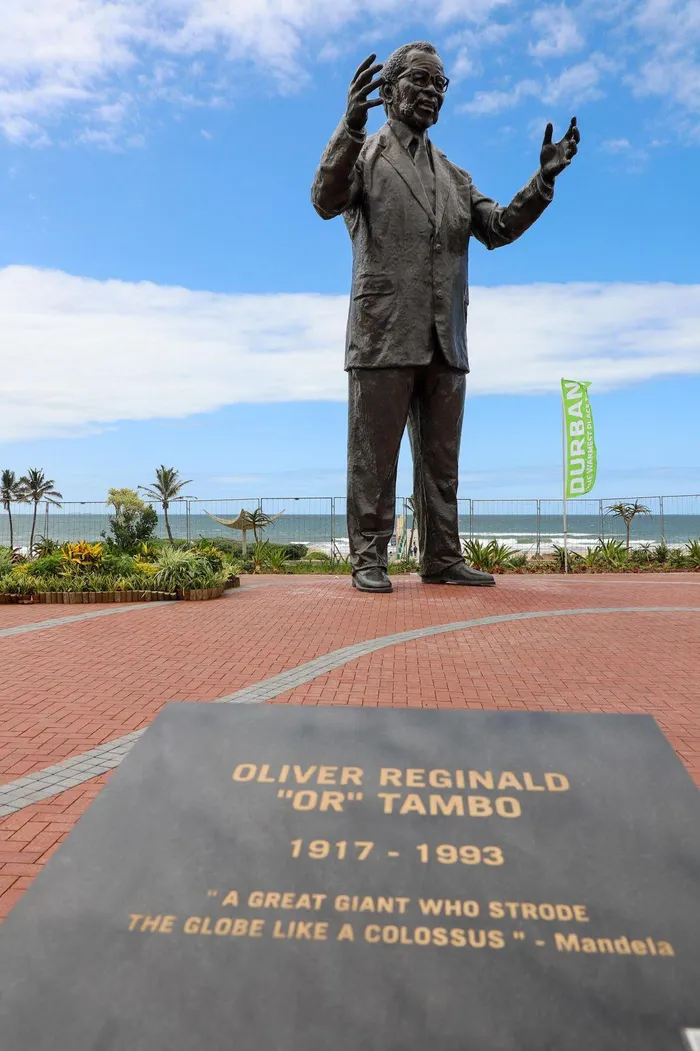
The statue of the late ANC President Oliver Reginald Tambo along Africa’s longest promenade in Durban was unveiled on Tuesday amid public outcry over the multimillion-rand project. Residents’ associations have voiced concerns about spending priorities in the eThekwini Metropolitan Municipality, the province’s only metropolitan municipality.
Image: THULI DLAMINI
This is not unique to Durban. Across the country, symbolic politics has outpaced material improvement. Grand announcements coexist with failing infrastructure.
Vision statements float above communities still waiting for water, electricity, and safety. The gap between rhetoric and reality has become too wide to ignore.
What the statues episode reveals is not hostility to heritage, but a demand for sequencing. Fix the pipes, then build the monuments. Restore trust, then ask for patience. Demonstrate competence, then invite celebration. Without this order, symbolism collapses under the weight of unmet needs.
There is also a generational dimension to this moment. Younger South Africans, in particular, do not experience the ANC as a liberation movement, but as a governing party, one that has presided over unemployment, inequality, and declining public services.
For them, struggle icons are revered, but not as shields against accountability. They ask a simple question: what does this honour mean in my daily life?
The answer, at present, is unclear.
None of this requires abandoning public art or historical commemoration. It requires political humility. A willingness to say: we hear you. We understand the frustration. We accept that timing matters. It requires leaders who can read the room, not lecture it.
The tragedy is that Mandela and Tambo could have been unifying figures in this moment. Instead, they have been drawn into a proxy battle over governance failure.
That is not their fault. It is the consequence of a party that has not yet reckoned fully with its loss of moral capital.
Until that reckoning happens, every statue will be contested, every symbol questioned, every gesture doubted. Not because South Africans are cynical by nature, but because they have learned, painfully, that symbolism without substance is hollow.
The bronze will endure. The question is whether the trust ever will.
(Dube is a noted political economist, businessperson, and social commentator on Ukhozi FM. His views do not necessarily reflect those of the Sunday Tribune or IOL)
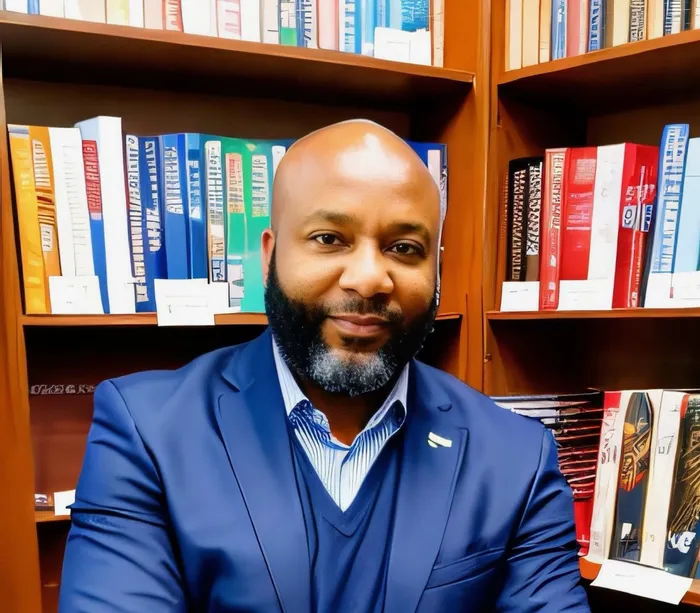
Nco Dube is a political economist, businessman and social commentator
Image: Supplied