
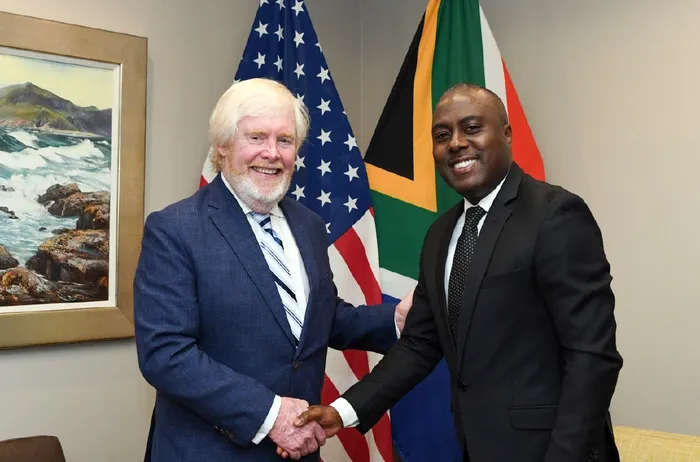
Deputy Director-General (DDG), Clayson Monyela, Acting Chief of State Protocol, receiving copies of Letters of Credence from Brent Bozell III, United States Ambassador to South Africa. It did not take too long for Bozell's mask to slip as he exposed that he is in South Africa to dictate US policy on a sovereign country and in the process disregard court ruling's on the political slogan of "Kill the boer".
Image: DIRCO
It did not take long for the mask to slip.
At his first public address in the Western Cape, the new United States ambassador to South Africa, Brent Bozell III, walked onto the stage not as a diplomat seeking to build a relationship, but as a man arriving to discipline a wayward state.
He did not bother with the usual courtesies. He did not attempt to understand the wider audience of South Africa but only the room he was speaking into. He came armed with irritation, impatience, and a list of demands.
Washington, he declared, was losing patience with Pretoria. There were five non‑negotiable instructions that South Africa was expected to comply with. He did not like the ANC insulting his president.
He did not like this country sending condolences to Iran after the assassination of that country’s Supreme Leader by Israel and the United States. He did not care what our courts said. “Kill the Boer,” he insisted, was hate speech, and that was the end of the matter.
This was not diplomacy. It was a scolding delivered with the confidence of someone who believes he is speaking downward.
The arrogance was expected. The brazenness was not.
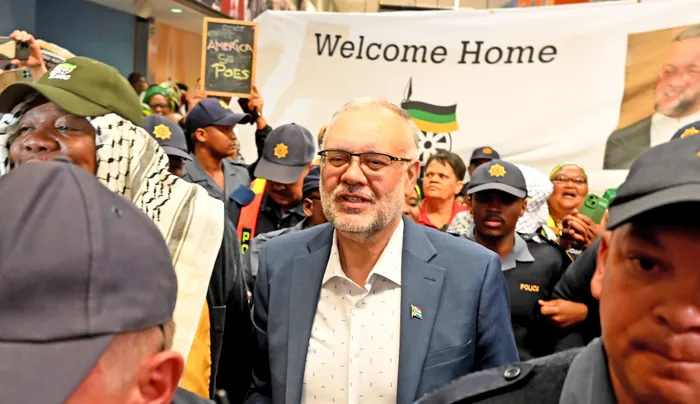
Former South African ambassador to the US Ibrahim Rasool arriving at the Cape Town International Airport, after US President Donald Trump administration summarily dismissed him over the comments he made against the current government of that country. In contrast South Africa has chosen a far more diplomatic approach in dealing with US ambassador to South Africa Brent Bozell III who has done far worse than Rasool, argues the writer.
Image: AYANDA NDAMANE Independent Newspapers
Bozell’s record is not a mystery. He is an ultra‑right media activist who has spent decades attacking the very idea of a multiracial democracy. He has expressed sympathy for apartheid. He has described the ANC as a terrorist organisation.
He has embraced the false and inflammatory narrative of a white genocide in South Africa, a story that survives only because it is politically useful to certain factions abroad. His hostility to the South African government predates his appointment. His worldview is not hidden. It is documented.
But even with all of that, the country was not prepared for the sheer ease with which he delivered his lecture. On South African soil. To South Africans.
As if sovereignty were a courtesy extended by Washington rather than a constitutional fact earned through struggle, sacrifice, and the moral authority of a people who refused to bow to a racist state.
This was not a slip of the tongue. It was a posture. And it was deliberate.
Diplomacy, at its most basic, is the art of restraint. It is the discipline of knowing where your authority ends. A foreign ambassador does not arrive in a host country to issue demands. He does not instruct the governing party on how to speak about a foreign president. H
e does not dictate which condolences are acceptable. He does not dismiss the rulings of the host country’s courts because they are inconvenient to his politics.
That is not diplomacy. It is intrusion dressed up as impatience.
And South Africans recognised it instantly.
The uproar was immediate and deafening. Across political lines, across ideological divides, across communities, the reaction was the same: this was disrespect. This was arrogance. This was a man who had mistaken his posting for a colonial assignment.
Pretoria responded with speed and clarity. The ambassador was summoned for a dèmarche. The line was drawn. The message was delivered.
But crucially, there was no expulsion. No dramatic rupture. No attempt to mirror Washington’s earlier behaviour.
And that choice matters.
South Africa’s ambassador to the United States, Ebrahim Rasool, was expelled for doing far less. He criticised President Donald Trump. Correctly. Calmly. Analytically. There was no warning. No engagement. No proportionality. Just the door.
Here, by contrast, a foreign ambassador publicly dismissed our courts, questioned our politics, and our foreign policy choices, and South Africa responded like a state that understands consequence. Firmly. Quietly. Without panic. Without theatrics.
This was not weakness. It was adulthood.
The contrast is instructive. One side behaves like a superpower unused to being challenged. The other behaves like a constitutional democracy that knows shouting is not the same as strength.
And this is the part that must be said plainly. Bozell’s behaviour was not an accident. It was not a misreading of the room. It was not a cultural misunderstanding.
It was a deliberate attempt to set the tone of the relationship. To establish dominance early. To test whether South Africa would accept a subordinate role.
He miscalculated.
South Africa is not a perfect country. It is not a wealthy country. But it is a country with a long memory and a deep understanding of power.
It knows what it means to be dictated to. It knows what it means to be patronised. And it knows how to respond without losing its head.
What this episode exposes is not just the temperament of one ambassador, but a broader decay in how the US under President Trump now practise diplomacy. Ambassadors are no longer always emissaries. Some are sent as ideological enforcers.
As culture‑war foot soldiers. As content generators for audiences back home. Their job is not to build relationships, but to perform toughness for domestic political consumption.
It plays well on television. It poisons relationships.
South Africa’s task now is not to escalate. It is to hold the line. To insist, calmly and repeatedly, that our courts are sovereign. That our political parties speak for themselves.
That our foreign policy is not subject to approval by visiting officials. That our constitutional order is not up for negotiation.
Engagement must continue. But it must be bounded. Respect must be demanded, not begged for.
There is a lazy idea doing the rounds that restraint equals submission. It does not. Submission is silence without strategy. Restraint, when paired with clarity, is something else entirely.
A country that knows who it is does not need to shout. It needs patience. It needs leverage. It needs to choose its battles carefully.
In a world where power increasingly mistakes volume for authority, South Africa’s response to this moment stands out. It shows a country that understands the difference between being defiant and being effective.
It shows a government that knows how to defend sovereignty without burning the house down. It shows a maturity that is rare in global politics today.
Power is loud. Diplomatic maturity is quiet.
And in this moment, South Africa sounded like the adult in a room full of infantile tantrums.
(Dube is a noted political economist, businessperson, and social commentator on Ukhozi FM. His views don't necessarily reflect those of the Sunday Tribune or IOL. For further reading and perspectives, visit: http://www.ncodube.blog)
For more thought-provoking opinions click the link below:
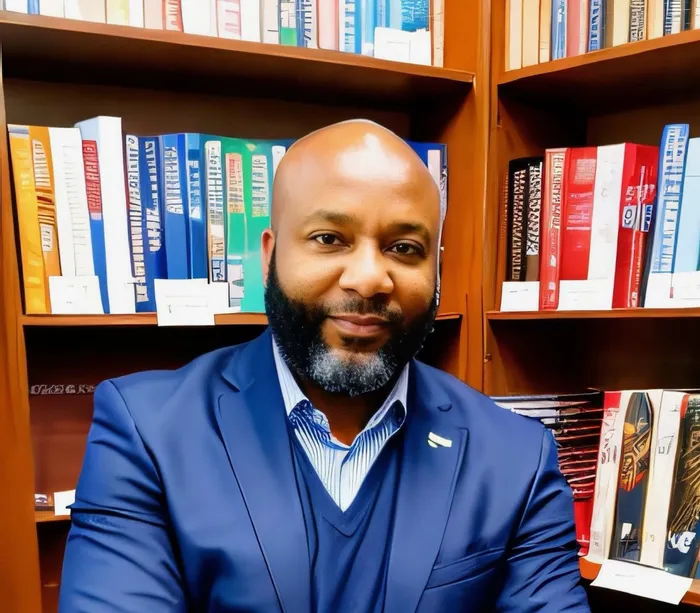
Nco Dube is a political economist, businessman and social commentator
Image: Supplied