

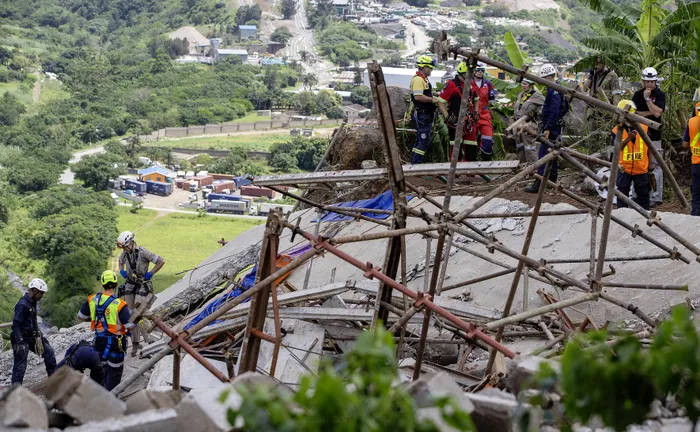
Preliminary findings showed substandard concrete and structural failures in the four-storey Verulam building collapse. Authorities are investigating potential criminal negligence and regulatory breaches. The writer argues that the requirement to submit building plans is not red tape but ensures that the proposed structure meets the technical and environmental conditions necessary for long-term safety and functionality.
Image: LEON LESTRADE Independent Newspapers
In South Africa, the National Building Regulations (NBR) are not simply bureaucratic hurdles or items on an administrative checklist.
They are the backbone of a safe, orderly and sustainable built environment — a framework that protects lives, ensures structural integrity and preserves the character and functionality of communities.
Yet many property owners underestimate the importance of compliance, often proceeding with construction without approved building plans. In municipalities like eThekwini, where rapid urban growth places significant pressure on infrastructure and governance, strict adherence to the NBR is not optional; it is essential.
At its core, the NBR exists to ensure that every building constructed in the country meets minimum standards relating to safety, stability, fire protection, ventilation, accessibility, energy usage and more. Every wall, roof, foundation and alteration affects not only the property owner but also neighbours, neighbourhoods and the city’s capacity to deliver services.
Non-compliant structures may undermine stormwater systems, disrupt sewer lines, overload electrical networks or block access for emergency services. In coastal cities like Durban, compliance is even more crucial because buildings must withstand high rainfall, humidity, coastal winds and soil conditions that vary dramatically across the municipality.
The National Building Regulations (NBR) provide the legal and technical framework that ensures buildings are safe, habitable and compatible with local planning requirements. Yet, in eThekwini, recent incidents highlight a pattern of non-compliance that has led to loss of life, financial damage, legal disputes and a growing burden on municipal enforcement structures.
A recent example includes the temple that collapsed in Verulam in December 2025. This reinforces an urgent message: compliance with the NBR is not optional — it is fundamental to public safety. Thus, the requirement to submit building plans is not red tape; it is a safeguard. It ensures that qualified professionals — architects, engineers, planners and building inspectors — collectively evaluate whether a proposed structure meets the technical and environmental conditions necessary for long-term safety and functionality.
The eThekwini Municipality follows a clear and structured process for building plan submissions, aligned with the National Building Regulations and Building Standards Act (Act 103 of 1977). Understanding this process not only speeds up approval but also prevents costly delays later. Building plans must be prepared by a registered draughtsperson, architect or structural engineer, depending on the nature of the work.
These professionals ensure the drawings comply with the SANS 10400 specifications that accompany the NBR. A complete submission includes architectural drawings, site development plans, structural designs (where required), zoning certificates, land use permissions if deviations exist, forms completed by competent persons (SANS 10400-A), and payment of the relevant building plan scrutiny fees.
Missing documents are among the most common reasons for delayed approvals. In eThekwini, plans are submitted through the municipality’s electronic plan submission portal, depending on the category of development. Once submitted, the plans undergo internal circulation to various departments, including Land Use Management, Water & Sanitation, Electricity, Fire & Emergency Services, Development Planning and others. Their inputs ensure the proposed development meets infrastructure, safety and land-use requirements.

The Tongaat Mall inquiry team doing a walk about into the site where the mall collapsed in 2013, resulting in two fatilities and serious injuries to 29 workers. A large concrete slab and supporting columns collapsed. Poor construction methods and concrete that was significantly weaker than specified strength, ignoring compliance orders, and lack of supervision were some of the findings by the comission of inquiry. The writer propose a strict compliance that is necessary to ensure saftety of structures in the long-term.
Image: Independent Newspapers Archives
Only once all departments sign off will the Municipality issue an approval letter and construction permit. Building may legally begin only after this point. Municipal building inspectors must conduct inspections at key stages — foundations, slabs, roofs and final compliance — before issuing an Occupancy Certificate.
This process ensures that developments integrate into the city safely, sustainably and in line with long-term planning principles. Constructing without approved plans is a legal offence in terms of the National Building Regulations and the Municipal By-laws. Property owners often believe that “small” alterations don’t require approval, but carports, boundary walls, decks, internal structural changes and extensions almost always do.
The implications are serious and may cost more in the long run. The Municipality may issue fines, stop-work orders or, in severe cases, require that illegal structures be demolished at the owner’s cost. This is not uncommon — particularly where structures pose safety risks or contravene zoning laws.
Unapproved buildings may lack proper foundations, drainage, ventilation or structural reinforcement — placing occupants at significant physical risk. Illegal alterations may obstruct servitudes or municipal infrastructure, leading to interventions or penalties from the Municipality. Insurance companies routinely reject claims for fire, flood or structural damage if a building or extension was constructed without approved plans.
Property owners may suffer catastrophic financial loss as a result. Conveyancers are also obligated to request building plans during a property transfer. Illegal structures can delay sales, reduce property value or result in costly remedial work before transfer.
Compliance with the National Building Regulations is ultimately an investment in safety, legality and long-term property value. In a city like eThekwini, where infrastructure resilience and sustainable development are top priorities, the building plan process is a vital tool for ensuring that growth happens responsibly and equitably.
Property owners who follow the correct process not only protect themselves but also contribute to a safer, more functional and better-managed city. The cost of compliance is always far lower than the cost of non-compliance — financially, legally and socially.
(Ndebele is the Acting Director: Spatial Planning and Land Use Management in eThekwini Municipality.)

Sbu Ndebele, Acting Director of Spatial Planning and Land Use Management, eThekwini Municipality.
Image: Supplied