
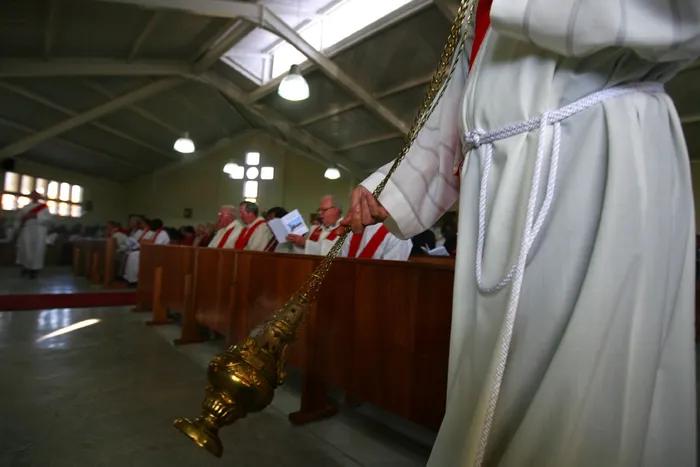
A deacon distributes incense during the blessing and consecration of Saints Cosmas and Damian Catholic Church in Cosmo City north of Johannesburg. The burning of incense, a resin-based liturgical tool representing prayers rising to heaven, not too dissimilar to how some African communities use impepho (African sage/Helichrysum) for spiritual cleansing and communicating.
Image: Independent Newspapers Archives
The issue of syncretism within the Roman Catholic Church in KwaZulu-Natal has recently caused tensions in two Durban parishes led by different priests.
What might ordinarily have remained a theological discussion escalated into public uproar last September when the head of the Catholic Church Archdiocese of Durban, Archbishop Mandla Jwara, together with eight KwaZulu-Natal bishops, issued a pastoral letter condemning syncretism among the clergy and laity.
The pastoral letter addressed practices such as the use of coloured water, consulting traditional healers, fortune tellers and traditional dancing (ukusina) in certain contexts.
Archbishop Jwara later clarified that the church was not opposed to ancestral veneration, acknowledging that in African culture ancestors are regarded as intermediaries that intercede on behalf of the living rather than deities.
Historical Context
Yet this clarification contrasts with some scholarly perspectives that emphasise the importance of inculturation: the church's effort to embrace the cultural realities of its faithful rather than alienate them.
For decades, the Catholic Church has sought to integrate cultural traditions in Africa, Asia, and Latin America, recognising that faith cannot flourish if it dismisses, in total, practices that shape the spiritual lives of congregants.
This raises an important question: what might the long-term future of the church look like if it maintains strict Eurocentric norms while rejecting practices many see as compatible with Catholic doctrine in Africa, Latin America and elsewhere?
Many Africans view ancestors as spiritual guardians, closer to guardian angels than objects of worship. Indigenous communities historically recognised a supreme creator, long before the arrival of missionaries with their Bibles and the gospel in these shores, and similar beliefs continue to coexist alongside Catholic practice.
Christianity itself has evolved through cultural adaptation over centuries, integrating European traditions with local contexts.
At the same time, the church's concern for doctrinal clarity is legitimate. Critics note that syncretism can sometimes blur theological lines, and clergy may struggle to serve multiple spiritual frameworks. Institutional authority and doctrinal consistency remain important to the church's mission.
Yet it is worth questioning whether the framing of long-standing African practices as inherently incompatible with Christianity risks alienating the faithful. Or to take the conversation to the edge, ask the question that, does the total condemnation of African traditions and customs within Catholicism not parrot colonial views that subjugated Africans that was meant to strip them of their identity and therefore their culture, lived experience and their beliefs?
Historical and cultural context suggests that worship and culture have always evolved together. Past reforms, such as celebrating Mass in African languages as opposed to Latin and reorienting liturgical practices like priests conducting homilies with their backs to the congregation, demonstrate that adaptation is possible without compromising core beliefs.
Current Controversy
The Southern African Catholic Bishops' Conference established a task team on ubungoma (divination) in the tail end of the 2010s to study these issues.
The process is ongoing, and it may be prudent for the church to consider its findings before drawing definitive conclusions that have the potential to polarise the believers of undiluted Catholicism and those who support the fusion of both.
Ultimately, the current debate should not be about uncritical acceptance of syncretism but about engaging thoughtfully with cultural practices while maintaining theological integrity. Both culture and institutionalised worship are human constructs, and like all human institutions, they must evolve with time.
However, there is also a strong view that when expressions of faith appear to move beyond the teachings of the church, the institution has a responsibility to reaffirm its doctrinal boundaries. Yet history suggests that moments of tension have often served as turning points for reflection within the Catholic Church.
The reforms that followed the Second Vatican Council in the 1960s ushered in sweeping but gradually implemented changes, from the modernisation of the liturgy to a more open engagement with other religions and cultures. In Africa and South Africa in particular, similar shifts unfolded over time.
By the 1980s, the once-dominant European hymn tradition had begun to blend with indigenous African musical forms, introducing new rhythms and languages into Catholic worship while still operating within the church's liturgical framework.
Today, these changes are visible in many parishes. Choirs sing with local cadence, organs and pianos accompany the liturgy, and congregants often rise with a gentle sway or restrained dance, a carefully measured expression of joy.
It is sometimes as if the movement itself is self-aware, moderated so as not to stray into gestures that some might interpret as crossing the line between cultural celebration and religious devotion.
Role of Clergy
Seen in this light, the current debate around syncretism may also present an opportunity for dialogue between those who champion cultural expression and those who emphasise doctrinal clarity.
The church’s long history shows a recurring pattern of reform and resistance, each era negotiating anew the space between tradition and change.
However, the laity and clergy have different roles. Clergy are bound by Church doctrines, where blending practices is strictly forbidden.
The challenge now is to find a path that honours cultural heritage without compromising core teachings, a balance that may well determine how deeply Catholicism continues to resonate across Africa and elsewhere.