
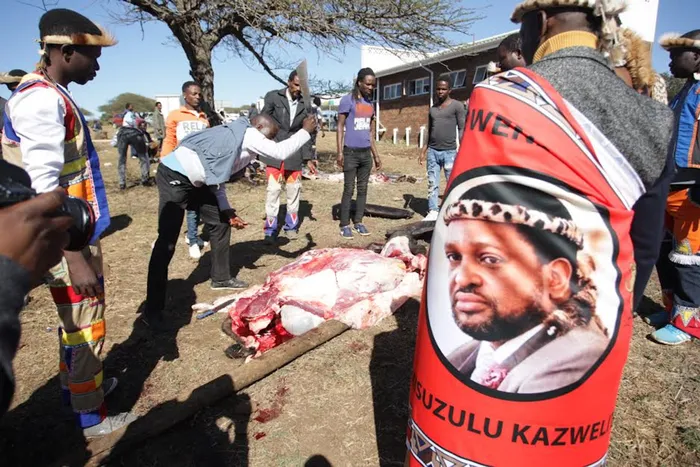
SLAUGHTERING is very important in many African cultures. The Zulu nation which is a large section of the Catholic Church faithful according to the writer should be afforded the right to observe its cultural practices. This file picture was taken at the Zulu royal palace in preparation for the entry of King Misuzulu into the kraal.
Image: Independent Newspapers Archives
There's a big issue silently brewing down in Durban, KwaZulu-Natal, regarding the Archdiocese of Durban putting certain priests on sabbatical.
This follows allegations that they deviated from the religious norms of the Catholic faith (catechism). I'm trying to be as simple as I can possibly be with this issue.
I had to look up syncretism. I will simply describe it as mixology. That is, mixing revered institutional practices of the Catholic Church with revered cultural practices of the local people, in this case, amaZulu.
Apparently there are Catholic priests who practise, allow, or engage in cultural practices such as ubungoma (divination) to be an integral part of parishioners' comprehensive faith.
Such Catholic priests themselves are blessed with the gift of ubungoma. From what I gather, they've been equally successful in their blended approach to heal, preach, save, and connect parishioners with God and their ancestors.
There's harmony all around. However, the Catholics are having none of it. They insist that you either follow Christ or else engage in your cultural practices away from the Church.
The Archbishop of Durban, along with eight KwaZulu-Natal bishops, is objecting to the spilling of blood; burning of impepho (African sage) for cultural rituals; use of coloured water in 2-litre Coke bottles (ok, I exaggerate); interceding with ancestors and connecting with the departed; and many other practices they've deemed unacceptable in the Catholic Church.
Here's where my confusion (not suppression of faith) begins:
1. In the Catholic Church, they use incense as a religious ritual.
2. Catholics drink the blood of Christ and devour his body. In another world this would be considered cannibalistic or 'ubuzimuzimu' in Zulu.
3. Catholics talk about the "Lamb of God" (isn't that livestock for the goat and cattle-rearing indigenous people of Africa?).
4. Catholics pray consistently for the departed (just as Africans and amaZulu venerate ancestors).
5. Catholics use holy water to bless, cast out evil (remember exorcism), etc. (Coca-Cola bottled water could be an equivalent, multicoloured or not).
6. Catholic priests function as intermediaries between heaven and us earthlings. What if the same becomes of their (Catholic) priests who are able to cross over to the cultural wing and connect with other cultural and spiritual beings?
7. Saints (holy men and women) in the Catholic Church were once human beings like the rest of us. Yet, due to their divinity and holiness, they graduated into sainthood, and Catholics pray to them. Ancestors too were once human; I'm not sure about the holiness part. Maybe it explains why we don't have Zulu saints, like a St Dumisani from Mahlabathini.
8. Slaughtering should not be a foreign concept to Catholics. How else would you devour the Lamb of God without having slaughtered it? Zulus slaughter too and have lambs as livestock.
I will stop here before I get excommunicated from the Church. What I did here is what in education is called 'teaching across the curriculum'. Maybe the Catholic Church should start thinking about a blended approach to Christianity.
The current stance in the Durban Archdiocese has elements of rigidity, colonialism, and imposition of values that say, "We are here to lead you away from being pagans into becoming modernised Christians."
Christianity is diverse and complex.
I am not fighting. I was reflecting, making silly comparative analyses that are necessary.
I remain a Catholic with a variety of viewpoints about faith. | Xolani Majola Pinetown
For more thought-provoking opinions click on the link below: