

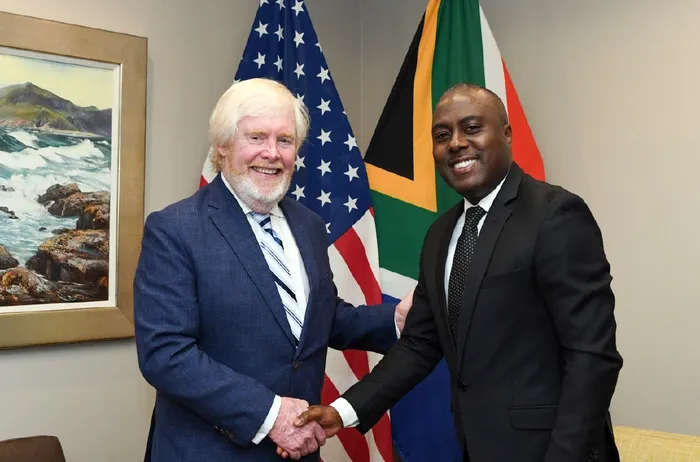
Department of International Relations and Cooperation (Dirco) Deputy Director-General (DDG) Clayson Monyela (right) receiving Letters of Credence from L Brent Bozell III, United States Ambassador to South Africa on February 23 in Pretoria. By publicly attacking our laws and demanding policy changes that align with Washington’s preferences, Bozell breached this tenet of his office, says the writer.
Image: DIRCO
Dr. Reneva Fourie
It is a matter of profound national shame that a man with the historical fingerprints of apartheid upon his conscience was ever permitted to present his credentials in Pretoria.
Yet the swift response of South Africa’s Minister of International Relations and Cooperation Ronald Lamola to the recent provocations of US Ambassador Leo Brent Bozell III offers a glimmer of hope that this administration still possesses the spine to defend the sovereignty of its people.
The events of Tuesday, 10 March, at a BizNews conference in Hermanus will be recorded in the annals of our diplomatic history not as a discourse on trade but as a calculated act of ideological aggression. Ambassador Bozell, emboldened by the platform afforded to him as the keynote speaker, chose to abuse the hospitality of our country.
He stood before an audience and dared to prescribe the public policies of a free and democratic South Africa. Rather than fulfilling the fundamental duty of a diplomat to build constructive relations between countries, Bozell chose to publicly criticise South Africa’s domestic policies and foreign relations, issuing warnings that the United States was losing patience with Pretoria.
This was not diplomacy. This was a reprimand from a man who believes he stands on a moral pinnacle, looking down on South Africa and its people.
To understand the effrontery of this performance, one must confront the irony of the man delivering it. Research into the background of Leo Brent Bozell III reveals a history that should have disqualified him from any role representing a country that claims to value equality. In the 1980s, at the height of the global struggle against the apartheid regime, Bozell was involved in efforts to oppose the anti-apartheid movement.
As part of the National Conservative Political Action Committee (NCPAC), among others, he stood with segregationist voices in the United States who sought to deny legitimacy to the representatives of the South African people, aligning himself with those who wished to preserve the system of racial oppression that our forebears fought and died to dismantle.
Despite this record, our government, perhaps in a gesture of magnanimity, accepted his appointment as ambassador. It was a decision made in the hope of fostering relations. That courtesy has been repaid with contempt.
Ambassador Bozell has now confirmed that he has never shed the sentiments of his past. He has proven that he is incapable of viewing South Africa through any lens other than that of a Cold War warrior longing for the days of white minority rule. On Tuesday, he abused his diplomatic privilege to act on those sentiments.
The Vienna Convention on Diplomatic Relations of 1961 is explicit in its expectations. While it grants diplomats immunity, it also imposes a duty to respect the laws of the receiving state and to refrain from interfering in its internal affairs. By publicly attacking our laws and demanding policy changes that align with Washington’s preferences, Bozell breached this tenet of his office.
We must contrast this behaviour with the treatment of our own diplomats. Ambassador Ebrahim Rassool was declared persona non grata by the United States for comments far less incendiary than those uttered by Bozell in Hermanus.
The double standard is glaring, and it insults our national dignity. In South Africa, any engagement by a foreign diplomat is regarded as an official act. When Bozell speaks, the United States speaks. What we heard on Tuesday was a voice of hostility, not partnership.
To compound this insult, the ambassador has chosen to surround himself with disgruntled fringe elements, rather than prioritising constructive dialogue with the elected government and the broad spectrum of South African civil society.
His courtship of groups like Solidarity, an organisation that recently handed him a report attacking transformation policies, is a transparent attempt to weaponise a small minority against the elected government. Solidarity speaks for only a fraction of South Africans, yet Bozell elevates their grievances into a diplomatic issue, confirming that his mission is to amplify division rather than unity.
Questions must also be asked about the gathering that hosted this incident.
BizNews, which promoted Helen Zille as an opening speaker, alongside other Democratic Alliance figures and ActionSA leader Herman Mashaba, provides a clue to the ambassador’s intentions. This was not a neutral economic forum but a meeting that largely reflected opposition politics, frequented by those who shared the ambassador’s sentiments.
The platform allowed those who have lost elections to assert influence through foreign support. The presence of the United States ambassador at such an event during a tense international climate is more than careless diplomacy – it is a provocation.
The wider context cannot be ignored. Bozell arrives in South Africa amid a US foreign policy record widely criticised across the global south. It occurs at a time when Washington has enabled devastation in Gaza, where tens of thousands have died, and over a million have been displaced.
Washington has simultaneously pursued confrontational policies toward Venezuela, continued to threaten Cuba and is advancing full-scale military aggression toward Iran. With its destructive impunity unchallenged, the ideological confidence of Washington has become emboldened, and its advocates speak more openly about reshaping the politics of other countries.
One narrative repeatedly invoked in this context is the claim of a so-called white genocide in South Africa. The allegation circulates widely in far-right media despite having been repeatedly debunked by credible research and rejected by South African authorities.
Yet the story persists because it serves a political purpose. By portraying the democratic government of South Africa as hostile to minorities, it attempts to legitimise external pressure and intervention towards regime change.
Therefore, Minister Ronald Lamola deserves applause for issuing a demarche to Bozell and eliciting an apology, however feeble. When a diplomat abandons international norms and attempts to interfere in the internal affairs of the host country, a firm response is not only justified but necessary.
South Africans will not tolerate efforts to sow division or undermine our democratic institutions. We, the people of this country, will determine its future, not some foreign ambassador.
* Dr Reneva Fourie is a policy analyst specialising in governance, development and security.
** The views expressed do not necessarily reflect the views of IOL or Independent Media.