

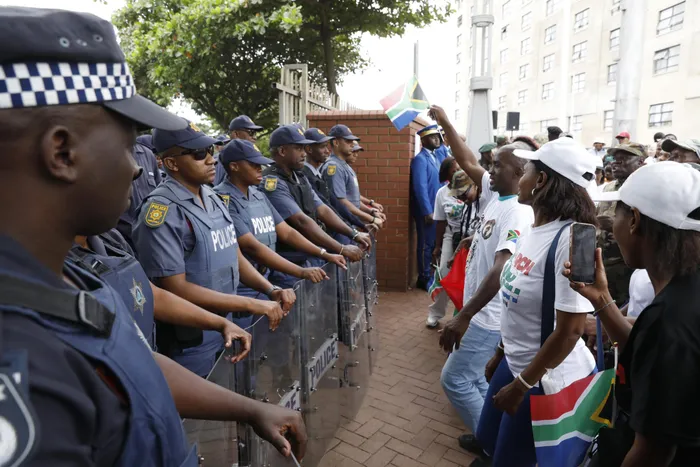
The admissions crisis at Addington Primary School, at Durban's South Beach was a prolonged standoff between members of anti-illegal immigration civic group March and March (MAM) who were joined in support by uMkhonto weSizwe Party, ActionSA, and Labour Civic Organisation (LACO) over claims that the school was prioritising children of undocumented immigrants over locals.
Image: DOCTOR NGCOBO Independent Newspapers
A year ago in Durban, what began as a protest born out of frustration became something far bigger than any of us anticipated. The movement now known as March and March (MAM) was formed out of a growing sense of desperation among ordinary citizens who increasingly felt like foreigners in their own city.
The tipping point was not one single incident but a pattern that had become impossible to ignore: the normalisation of unregulated street trading, hijacked buildings, and the open drug trade in areas such as the Point precinct, in Durban's South Beach.
At the same time, municipal bylaws appeared to exist only on paper. Authorities looked the other way while residents and small businesses watched their communities change in ways that felt lawless and unmanaged.
That was when we decided enough was enough.
What started as a call to march during one month of the year quickly transformed into something more permanent. Today, MAM is no longer simply about protest. It has evolved into a civic watchdog movement. We do not only march in the streets; we monitor, document and report violations. In some cases, we assist in lawful citizen arrests under Section 42 of the Criminal Procedure Act when authorities fail to act.
Most importantly, we continue to pressure the state to fulfil its constitutional mandate.
From “March in March” to March and March
We started with a march on March 24, 2025, calling it "March in March." After the overwhelming response and support made it clear this couldn't be a one-off protest, it evolved into "March and March." The change in name reflects a deeper shift in philosophy. The struggle for lawful order and economic fairness is not a sprint. It is a marathon.
"March and March" represents a continuous movement: marching in the streets but also marching into boardrooms, police stations and government offices. In the beginning, our approach was largely observational. Today, it is interventionist.
We believe that when the state fails to regulate, citizens have the right and responsibility to organise and demand compliance with the law.
Policy, Not Just Protest
Demonstrations may be the most visible part of our work, but they are only the surface of a much larger effort to push for structural change.
Among the policy proposals we advocate are:
A "South Africans First" labour framework: This would require a minimum 60% employment quota for South African citizens in sectors such as hospitality, retail and private security.
Biometric verification in employment: The databases of the Department of Home Affairs and the Department of Labour must integrate so that no one can be employed without a verified and valid work permit.
Reserved sectors for citizens: Small-scale township retail, such as spaza shops, and e-hailing services should be designated as reserved sectors to protect South Africans trying to survive in the informal economy.
A comprehensive asylum audit: All refugee and asylum permits issued in the last decade should undergo a full administrative audit to identify fraudulent documentation.
The Constitutional Debate
Critics often argue that prioritising citizens contradicts the Constitution. We disagree.
The Constitution's use of the word "everyone" guarantees universal human rights such as dignity and life. But rights relating to work, trade and residence are not unconditional. They are governed by immigration law and national regulation.
A state’s first social contract is with its citizens. Ensuring that citizens come first in employment opportunities, access to healthcare and housing access is not unconstitutional, it is the fundamental function of a sovereign state.
Border Management Is Not a Taboo
No country can maintain stability without effective border management.
Our proposal is straightforward: strengthen the Border Management Authority with real enforcement powers and deploy a specialised border guard supported by modern technology, such as drone surveillance.
We also advocate the establishment of high-security processing zones at official entry points to ensure that immigration procedures are orderly, legal and transparent.
Strengthening borders is a matter of national security, not a rejection of human rights.
Protection Livelihoods
Another area where regulation is urgently needed is in sectors such as e-hailing and delivery services (like 60Sixty).
The rapid displacement of local workers in these sectors is not accidental. It is often driven by corporations seeking the cheapest possible labour. This creates a system where undocumented or vulnerable workers are exploited while South Africans struggle to find work.
We believe in strict vicarious liability. Parent companies must be legally responsible for everyone operating under their platforms or banners. If corporations face significant penalties for employing undocumented labour, the incentive for exploitation will disappear.
Racial Bias and Xenophobia Claims
MAM has often been accused of xenophobia. These accusations ignore the broader reality we confront.
Our focus is determined by what communities are experiencing on the ground. We have explicitly addressed drug trafficking hubs and exploitative sweatshops regardless of the owner's origin. In many townships and urban informal economies, the displacement of South African traders is most visibly linked to migrants from elsewhere on the African continent.
Acknowledging this reality is not "xenophobia". It is responding to the concerns of citizens.
At the same time, we oppose all forms of illicit activity regardless of who is involved, whether it involves Eastern European mafias, Chinese sweatshops or African syndicates. Crime is crime, and illegal business practices must be confronted wherever they occur.
Why We Are Not Becoming a Political Party
With a combined following approaching one million people, many have asked whether MAM should transform into a political party because we are seen as an honest and non-partisan voice.
We have no intention of doing so.
Entering electoral politics would trap us in "coalition politics," "parliamentary red tape," and internal battles that often silence many public movements. Instead, we believe our strength lies in remaining outside government as a pressure point, a civic force that pushes whichever party that holds power to act in the interests of citizens.
We are the conscience and the voice of the street, not the compromise of the caucus.
A Personal Turning Point
My departure from Vuma FM was not a coincidence. Speaking openly about illegal migration and border control came with consequences.
Cancel culture, which dominates modern media environments makes it difficult for voices challenging the status quo to remain within corporate structures. It was politically motivated by corporate interests that fear the "South Africans First" narrative. Professionally, it was a turning point, in many ways, it freed me to lead this movement without the corporate muzzle.
The overwhelming public support we have received since then has confirmed that many South Africans feel the same concerns but often fear speaking openly. I have no regrets; the support has far outweighed the loss of a corporate salary.
The Next Five Years
What does success look like?
It is a South Africa where the Immigration Act is respected and enforced.
A country where cities and towns are clean and safe, where bylaws are applied consistently, and where citizens do not feel pushed aside in their own communities.
MAM will not dissolve; it will evolve into permanence. As long as systemic regulatory oversight collapses in our country, citizens will stand up, organise, and march and march... until our goals are achieved.
(Ngobese-Zuma is a businesswoman and the founder of the anti-illegal immigration movement March and March (MAM). Her views do not necessarily reflect those of the Sunday Tribune or IOL.)

The founder of anti-illegal immigration movement, March and March, Jacinta Ngobese-Zuma says as long as there is systematic collapse of regulatory oversight, the civic organisation will remain operational. On Tuesday, March 24, will mark a year since the movement was formed, with Wednesday set for a wide-ranging protest in the Durban CBD.
Image: Supplied