

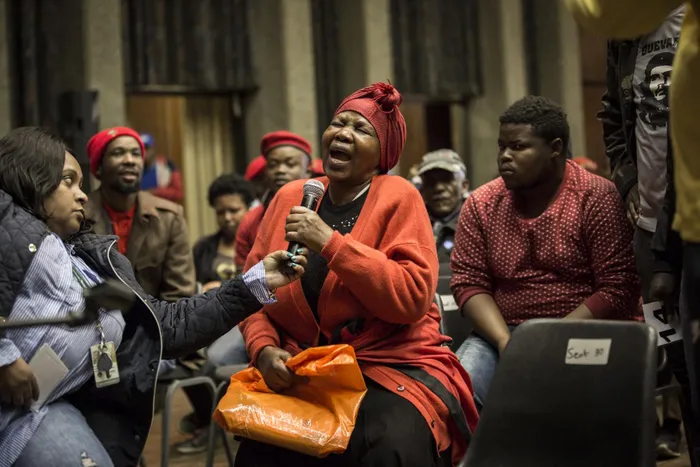
Roselina Seaga making an impassioned plea for the amendment of Section 25 of the Constitution regarding expropriation of land without compensation at the Sedibeng Town Hall in Vereeniging, on July 27, 2018. Although the Constitution states that we are all equal before the law, the reality paints a totally different picture, says the writer.
Image: AFP
Prof. Bheki Mngomezulu
On December 10, 1996, then President Nelson Mandela, who had assumed office on May 10, 1994, signed the Constitution of the Republic of South Africa (Act 108 of 1996) into law. This was the first post-apartheid Constitution.
The signing of the Constitution was linked to two historically important events. This was not a coincidence. Instead, it was a very deliberate and conscious decision that was taken by the political leadership.
Firstly, the event took place in Sharpeville in Soweto. This is one of the historical sites in South African history where 69 black people succumbed to the bullets of the apartheid operatives who shot at them as they protested the carrying of passes.
Secondly, the date coincided with International Human Rights Day. The symbolism was that through this Constitution, South Africa was embarking on a new political path whereby human rights would be respected by the new political leadership. By extension, all South Africans were expected to respect the rights of others in their own spaces. The Constitution came into effect on February 4, 1997.
The year 2026 thus marks thirty years since the country’s Constitution was signed into law. This affords us as a nation the opportunity to reflect on the road we have travelled thus far in the protection of human rights. Importantly, this is also an opportune moment for us to ask ourselves very pertinent and sometimes uncomfortable questions about the positive and negative impact of this Constitution on the lives of ordinary South Africans across ethnic and racial lines.
Within this context, the question could be phrased as follows: What have been the achievements of the South African Constitution in the past thirty years? To answer this question properly and objectively, we must consider what is on paper and what affects people directly.
On paper, a lot has been achieved in this country since 1996. For example, we have Chapter 2, which focuses on the Bill of Rights. These include equality before the law, human dignity, the right to life, freedom and security of the person, the right to privacy, freedom of expression, the right to form a political party, the right to an environment that is not harmful, the right to have access to adequate housing, health care, food, and social security, among others.
Moreover, Chapter 9 has resulted in the establishment of various institutions whose mandate is to strengthen constitutional democracy in the country to benefit everyone.
These two chapters create the impression that South Africa has achieved a lot in the past thirty years and that the human rights of all South Africans are protected. Importantly, these two chapters create the impression that South Africans across all races, ethnic groups and classes now enjoy the same rights. In that sense, the picture that is painted is that South Africans have a lot to celebrate after thirty years since the country’s Constitution was enacted.
However, when looking at the reality on the ground, a different picture is painted. As was the case before 1994, previously disadvantaged communities are once again on the receiving end. A new addition is that the black elite have moved up the social ladder, leaving the multitudes of black communities still languishing in poverty.
Therefore, race, gender, and class remain the key variables that determine if someone has enough reasons to celebrate the Constitution or not. Each of these will be explained below.
Racial intolerance remains a challenge in South Africa. This problem is not solely confined to the farms where black workers complain about racial oppression at the hands of their employers. Incidents of racial clashes are reported in the work environment, academic institutions at all levels, as well as within and among political parties. Sadly, even the country’s judiciary is not immune to incidents of racial clashes.
This demonstrates a deep-rooted problem that works against social cohesion and nation-building. Victims of racial discrimination and/or oppression have their constitutionally protected human rights infringed upon.
Gender discrimination, gender oppression, and gender-based violence (GBV) play a major role in the infringement of human rights. Whenever people are discriminated against or oppressed because of their gender, their human rights are violated.
Those who become victims of gender-based violence have their human rights adversely affected. For example, a woman who is raped feels violated.
A woman who is beaten by a man or a man who is beaten by a woman feels less protected by the Constitution, more especially when no legal action is taken against the perpetrator due to various reasons.
Class is used to violate human rights both overtly and covertly. Some within the political elite have the tendency to abuse their higher social status to infringe upon other people’s human rights.
Although the Constitution states that we are all equal before the law, the reality paints a totally different picture. Those who rank high in the social hierarchy enjoy more or better human rights compared to those who rank low.
Ideally, the courts and Chapter 9 institutions should constantly protect those who cannot protect themselves. Unfortunately, people in the higher class sometimes have influence even on these institutions.
They use their influence and power derived from money and political office to dictate the outcome of any investigation or to prevent such an investigation from being carried out in the first place. Whenever this happens, the Constitution fails to protect the victims.
Thirty years since the Constitution was initially adopted, one would have thought that the protection of human rights would be something that all South Africans value and cherish. Unfortunately, this is not the case.
If the Constitution were upheld and respected by all South Africans institutions, such as the South African Human Rights Commission (SAHRC), it would not be flooded with so many cases of human rights violations.
If gender equality as contemplated in the constitution was exercised, institutions such as the Commission for Gender Equality (CGE) would not be dealing with so many cases of GBV.
* Prof. Bheki Mngomezulu is Director of the Centre for the Advancement of Non-Racialism and Democracy at Nelson Mandela University.
** The views expressed do not necessarily reflect the views of IOL or Independent Media.