

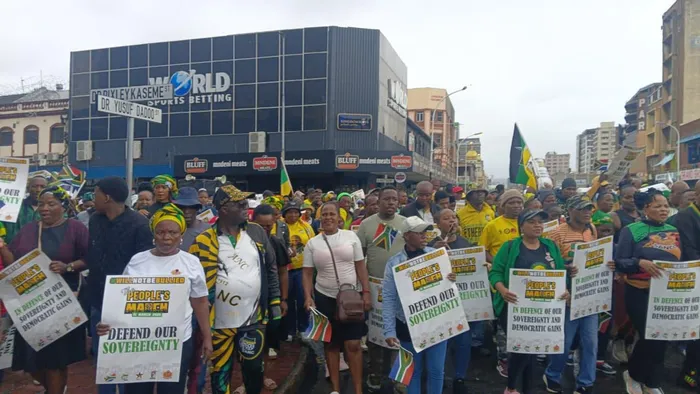
Amid a wave of social media criticism of the absurdity of the ANC's nationwide People's March on Human Rights Day over the weekend, the writer pushes back against what he calls shallow and misleading online analysis and ositions the march as a powerful statement on anti-imperialism, global justice, and South Africa’s independent foreign policy.
Image: SIPHO JACK
There exists a peculiar breed within South Africa’s political discourse, the social media politician. This is the kind that rises each morning, logs in, and promptly mistakes a data bundle for a doctorate in geopolitics.
Armed with nothing more than a cracked screen and unearned confidence, they dissect complex international relations with the casual certainty of someone haggling over prices at a spaza shop. It might be amusing were it not so profoundly misleading.
Over the weekend, these self-appointed keyboard analysts turned their attention to the People’s March, held in conjunction with Human Rights Day, a solemn commemoration rooted in the tragic memory of the Sharpeville Massacre of 1960, where 69 unarmed protesters were brutally killed by the apartheid regime.
Yet, with remarkable audacity and little understanding, they sought to dismiss the significance of this moment, undermining the African National Congress (ANC), its Alliance partners, and the progressive forces that mobilised for the occasion.
Let us be unequivocal, the People’s March was no trivial gathering. It was a powerful and deliberate demonstration that South Africans remain resolute in their opposition to imperialism, steadfast in defending national sovereignty, and unyielding in the face of coercion from powerful global actors, including the United States.
In a time marked by increasing geopolitical tensions, from trade pressures to scrutiny over South Africa’s independent foreign policy, such a demonstration cannot be reduced to hashtags and half-formed opinions.
South Africa’s principled position on global justice, including its unwavering support for the Palestinian people and its legal recourse at the International Court of Justice, is not accidental. It reflects a deep and historic commitment to human rights, one that extends beyond our borders.
That this stance unsettles powerful allies of Israel, particularly the United States, is neither surprising nor regrettable. It is, in fact, a testament to South Africa’s moral clarity on the global stage.
Instead of engaging with these realities in any meaningful way, some commentators have resorted to circulating blurred, questionable images, alleging, without evidence, that the march was dominated by foreign nationals. This is not analysis; it is intellectual indolence masquerading as insight.
The so-called “evidence” itself borders on the absurd. Grainy and indistinct, the image in question could easily be mistaken for a relic from a bygone digital era. More importantly, the outrage it seeks to provoke is fundamentally misplaced. This was, by definition, a People’s March, inclusive, diverse, and reflective of the society we inhabit.
South Africa is home to individuals from across the globe, including countries such as Iran, Venezuela, and Cuba, nations that have themselves endured sustained pressure and intervention from dominant global powers. These individuals are not strangers to our reality.
They live among us, contribute to our economy, and participate in our social fabric. There exists no credible evidence to suggest that those depicted are undocumented or unlawfully present. To suggest otherwise, without proof, is reckless.
One must therefore ask, even if such claims were true, what precisely is the grievance? That people who live within our borders chose to stand in solidarity with a cause rooted in justice and sovereignty? There is nothing untoward in that. On the contrary, it affirms the very spirit of international solidarity that once sustained our own liberation struggle, a struggle that benefited immeasurably from global support.
What is truly alarming is not the presence of diversity within the march, but the rise of shallow, reactionary thinking masquerading as political consciousness. This eagerness to divide, to label, and to exclude reveals a troubling intellectual poverty. The claim that the march was “overrun by foreigners” is not only baseless; it is a desperate attempt to distort reality.
One may be adept at crafting provocative posts on Facebook, Twitter, or Threads, but such superficial engagement does not equate to an understanding of sovereignty, imperialism, or global justice. South Africans have never succumbed to bullying, not under apartheid, and certainly not in the current global order. The People’s March stood as a reaffirmation of that enduring defiance. No amount of pixelated propaganda will alter this truth.
At its core, the ANC remains the most enduring and credible response to the challenges confronting South Africa. It is a movement forged in sacrifice, grounded in truth, and guided by a principled commitment to justice and liberation. No other political formation has demonstrated such consistency in standing with the people.
While individuals entrusted with responsibility may falter, the ANC has consistently shown its capacity to confront wrongdoing, to correct its course, and to uphold accountability. It cannot be reduced to the errors of a few. Rather, it continues to advance a programme of unity and renewal, anchored in its historic mission.
In the realm of global politics, the ANC remains far ahead of its counterparts, guided by a clear understanding of its responsibility to defend the dignity and sovereignty of the people. It is therefore deeply regrettable that some political actors rushed to celebrate the re-election of Donald Trump, a figure whose conduct raises serious concerns regarding justice, equality, and international cooperation.
Those within formations such as the MKP would do well to reflect on the implications of such alignments.The ANC carries a historic responsibility to confront any force that threatens the well-being of South Africans, both domestically and globally. It remains steadfast in fulfilling that mandate. The People’s March was not merely justified, it was a resounding success, a necessary reminder to the world that South Africa will stand firm in defence of its sovereignty, its principles, and its people.
(Memela is a former ANC provincial spokesperson, journalist and government spokesperson. His views do not necessarily reflect those of the Sunday Tribune or IOL)
For more thought-provoking opinions, please click on the link below:
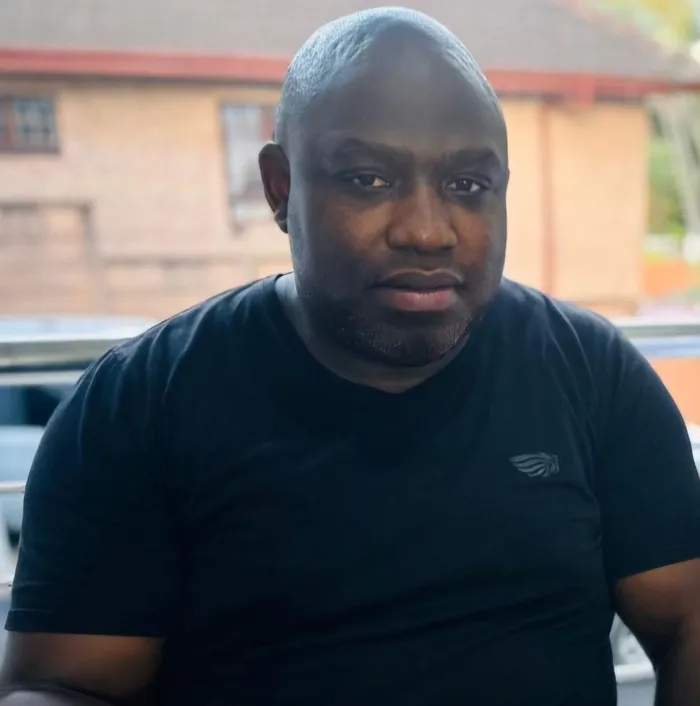
MHLABUNZIMA MEMELA
Image: SUPPLIED