

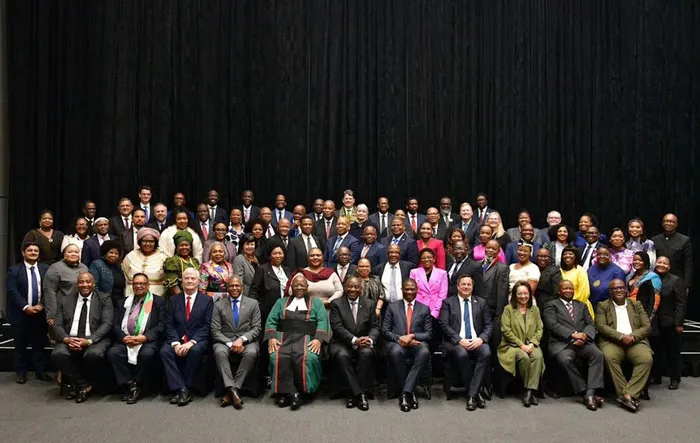
THE Government of National Unity (GNU) cabinet is so bloated that its total members can't easily fit in one picture frame. Despite its considerable size, it is guzzling salaries and has many unnecessary portfolios that are inefficient, argues the Policy Officer at Free Market Foundation who proposes that it should be trimmed down from 32 portfolios to ten.
Image: GCIS
Earlier in January, President Cyril Ramaphosa approved salary increases for South Africa’s ministers, deputy ministers and members of Parliament. Ministers will now earn around R2.79 million a year and ordinary MPs more than R1.3 million.
This is a self-serving decision that flies in the face of millions of struggling South Africans and overburdened taxpayers. It highlights the problem of the country's costly and unnecessarily bloated executive.
At a time when the government should be demonstrating its commitment to effective, disciplined governance by tightening the belt and freeing up more resources for critical services, it has chosen to guzzle those resources in an unnecessarily bloated executive.
It has chosen to increase the pay of millionaire politicians while South Africans continue to battle a myriad of socio-economic challenges.
A Bloated Executive
The country's executive is unnecessarily bloated. It consists of several portfolios that serve as little more than an employment agency for politicians, wasting hundreds of millions every year without adding real value for citizens.
Some of these portfolios include Small Business Development, Tourism, Science and Innovation, and Women, Youth and Persons with Disabilities – all of which can be abolished, with their functions ceasing to exist and the private sector stepping in.
Others include Electricity and Energy, Water and Sanitation, and Transport, which could be fully absorbed into other portfolios, thereby saving hundreds of millions each year. It goes without saying that an under-resourced country like South Africa, with a very limited tax base, cannot afford to guzzle resources on wasteful perks for politicians.
Every cent that is directed to the executive must count and contribute real value to governance. As part of its Liberty First policy agenda, the Free Market Foundation (FMF) has consistently called for a significant reduction in the size of the executive.
The Constitution only mandates the existence of the following portfolios: President, Deputy President, Finance, Cooperative Governance, Justice, Defence, and Police. While additional portfolios may be required for practical purposes, those that are discretionary should be kept to a minimum.
FMF's Proposal: from 32 to 10 portfolios
It is the FMF's proposal that the current executive be reduced from 32 portfolios to 10. If adopted, this proposal would create an executive with the following portfolios: Presidency, Finance, Defence, Justice, Home Affairs, International Relations, Public Service, Public Works, Cooperative Governance, and Social Development.
The current portfolios of Electricity and Energy, Water and Sanitation, and Transport would be absorbed into Public Works, which would also include aspects of the Agriculture, Land Reform, and Rural Development, as well as Forestry, Fisheries, and the Environment portfolios.
The Presidency would administer both the offices of Deputy and Deputy President. Defence would incorporate the apparatuses currently under State Security. Home Affairs would encompass both Police and Correctional Services, eliminating the standalone Departments of Police and of Correctional Services.
International Relations would incorporate aspects of the current Trade, Industry, and Competition portfolio, particularly those relating to international trade, with the existing Department of Trade, Industry, and Competition being dissolved. Public Service would include the existing portfolio of Planning, Monitoring, and Evaluation.
Under Social Development, the Departments of Basic Education, Higher Education, Health, and Human Settlements would be dissolved, with the new department administering a comprehensive voucher programme that would pay for the basic education, healthcare, and housing needs of indigent citizens.
Similarly, the Department of Labour and Employment would be dissolved, with its necessary regulatory functions absorbed by Social Development, along with relevant aspects of the Forestry, Fisheries, and the Environment.
Any remaining functions of the dissolved portfolios that are essential to the government’s constitutional obligations – such as aspects of Agriculture, Land Reform, Rural Development, and Labour and Employment – would be transferred to provincial and municipal governments.
This proposal does not threaten the provision of public services or the enjoyment of constitutional rights. Rather, it creates the conditions for fiscally disciplined governance that prioritises cost efficiency and effectiveness over wasteful, patronage-driven politics that disregards the plight of ordinary South Africans.
It also creates the conditions for a reduced tax burden, enabling overburdened citizens and businesses to retain more disposable income that can be deployed productively into an ailing economy.
A leaner, more focused executive is necessary for governance that prioritises cost efficiency, delivers essential services effectively, and supports productive economic activity.
(Zulu holds a BSocSci in Political Studies from the University of Pretoria and is a Policy Officer at the Free Market Foundation. His views do not necessarily reflect those of the Sunday Tribune or IOL)
For more thought-provoking opinions, click on the link below:

AYANDA Sakhile Zulu, is a Policy Officer at the Free Market Foundation.
Image: Supplied