

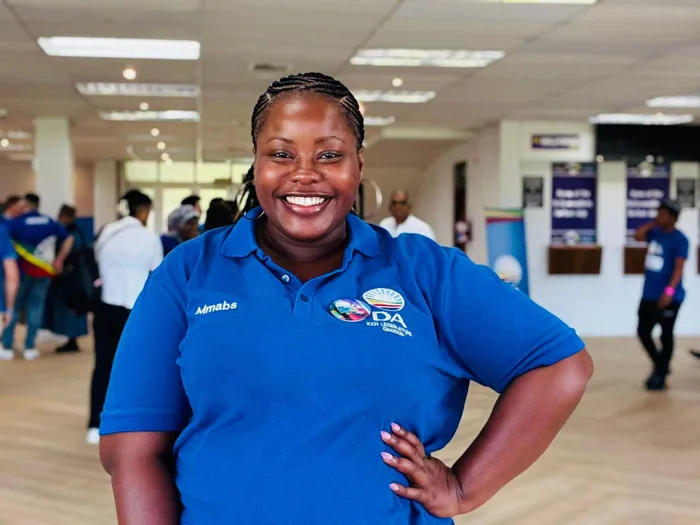
MPL Mmabatho Tembe is the DA KZN Legislature Caucus chairperson.
Image: Supplied
"Each time a woman stands up for herself, without knowing it possibly, without claiming it, she stands up for all women."
“I’m grateful to be a woman. I must have done something great in another life.” — Maya Angelou
These powerful words by Maya Angelou carry deep significance. As a celebrated poet, author, and civil rights activist, she devoted much of her life to advocating for dignity, equality, and empowerment, particularly for women and marginalized communities. Through her writing and activism, she reminded the world that the courage of one woman to claim her voice strengthens the collective struggle of women everywhere.
It is therefore fitting that, after recently marking International Women’s Day, we reflect not only on the progress that has been made, but also on the work that still lies ahead in advancing the empowerment of women.
More than three decades have passed since the historic Beijing Declaration and Platform for Action, where more than 150 nations across the world pledged to advance gender equality and strengthen the empowerment of women. Despite this global commitment, disparities in access to financial services based on gender continue to exist.
In South Africa, women’s ability to participate fully in the economy remains stubbornly uneven. This is particularly concerning when we consider that Imbokodo - the women of our nation - make up just over half of our population. Their exclusion from meaningful economic participation is therefore not a marginal issue; it is a national development challenge.
The consequences of this inequality are most visible in rural areas, informal settlements, and low-income households, where women often bear the brunt of systemic exclusion. Many women in these communities face limited access to financial services, restricted economic opportunities, and structural barriers that prevent them from building sustainable livelihoods.
Women’s financial inclusion is not merely a social aspiration; it is an economic necessity. No economy can claim to be resilient or truly progressive while half of its population remains excluded from full participation in financial systems. Yet the reality before us remains deeply concerning. More than 700 million women across the world remain excluded from any form of formal financial support or financial institutions.
These figures are not abstract statistics. They represent millions of women whose economic potential remains untapped. In South Africa, women remain disproportionately affected by unemployment and financial exclusion – and when women are excluded from the economy, families struggle, communities weaken and national growth is constrained.
The pace of change has simply been too slow. Women’s financial inclusion must advance at a far more rapid rate if we are serious about building an inclusive economy. Incremental progress is no longer sufficient when millions of women remain economically marginalised. One of the most persistent barriers is discriminatory practice, particularly when it comes to property ownership. In many instances, women do not enjoy the same access to property rights as men. Yet property is often required as collateral to access credit. The result is a cycle of exclusion that forces many women to remain on the margins of economic participation while financial power continues to concentrate elsewhere.
This is precisely where the role of legislation becomes central. Parliament has both the authority and the responsibility to ensure that our laws dismantle barriers rather than reinforce them. Progressive legislation must guarantee equal rights to property ownership, protect women from financial discrimination, and ensure fair access to credit and financial services.
However, legislation alone will not transform the economic realities faced by women. Government must introduce targeted incentives that empower women to start businesses, expand enterprises, and create employment opportunities for other women. This includes expanding access to SMME funding, strengthening business development support, providing tax incentives for women-owned businesses, and ensuring that women entrepreneurs have fair access to government procurement opportunities.
Practical examples remind us of what is possible when women are given access to opportunities. A powerful example is Boitumelo Ntsoane, an entrepreneur from a township who has transformed local challenges into innovation. Born in Atteridgeville, she established On Point Healthcare, a 100% black woman-owned company delivering affordable, preventative healthcare to underserved communities through mobile clinics.
Beginning with just a single medical centre in Pretoria West, Boitumelo developed a model that integrates pharmaceutical services, medical practitioners, and allied health services. This approach enabled the expansion into mobile clinics serving schools and underserved areas. With support from small-scale funding and enterprise initiatives, she has converted her initiative into a sustainable enterprise. In 2015, she was recognized as the first recipient of the Fairlady Women of the Future Award. Her journey demonstrates the transformative power of financial inclusion. When women gain access to financial resources, they transform households, strengthen communities, and contribute to economic growth.
It is equally important to implement initiatives that create opportunities for women in sectors that have historically excluded them. In this regard, the SheBuilds Women’s Advisory Body - a new initiative spearheaded by KwaZulu-Natal’s Department of Public Works and Infrastructure (DPWI) under the leadership of MEC Martin Meyer – must be welcomed.
This initiative aims to address the challenges faced by women in the construction sector, enabling them to participate meaningfully in infrastructure development. Such programmes are crucial because they challenge long-standing gender stereotypes in industries such as construction. They affirm that women are not only participants in economic development but also vital contributors to our nation's infrastructure and future.
This approach is also supported by international experience. At a recent gathering hosted by UN Women Africa, financial inclusion emerged as a central pillar in advancing women’s empowerment. The gathering highlighted how targeted financial inclusion programmes can transform the lives of women while strengthening entire communities.
We simply cannot ignore the reality that the majority of the unemployed in our country are women. If we are serious about reducing unemployment, then empowering women to become entrepreneurs must form part of the solution. When women establish businesses, they do not only create income for themselves; they create employment opportunities for others and stimulate local economic activity.
There is another dimension that deserves attention: the realities faced by single mothers. Across our communities, single mothers carry the immense responsibility of raising families while facing limited employment opportunities and restricted access to financial resources. Programmes that engage with single mothers consistently highlight barriers such as lack of access to capital, limited skills development opportunities, and the challenge of balancing economic survival with childcare responsibilities.
If we are serious about inclusive economic growth, then our policies must intentionally address these realities. Targeted support for single mothers must include access to entrepreneurial training, financial assistance, childcare support, and pathways into sustainable economic participation.
The empowerment of women is not an act of charity. It is a strategic economic decision that strengthens our nation. When women are financially empowered, they invest in their families, uplift their communities, and contribute meaningfully to economic growth. As we mark International Women’s Day, government must move beyond symbolic recognition. What is required now is decisive legislative action, targeted incentives, and deliberate policy interventions to ensure that women’s financial inclusion advances rapidly and that economic empowerment becomes a lived reality for women across our country.
The following Op-ed piece was originally delivered in the form of a Debate in the KZN Legislature on March 26 by MPL Mmabatho Tembe who is the DA KZN Legislature Caucus chairperson.
The views expressed do not represent those of the Sunday Tribune or IOL