

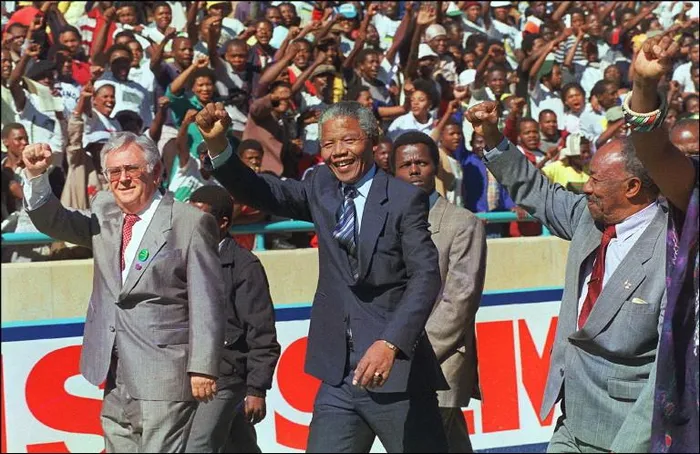
(From left) South African Communist Party (SACP) leader Joe Slovo, African National Congress President Nelson Mandela and ANC Secretary-General Alfred Nzo salute supporters at the first rally since the unbanning of the liberation movements held in Soweto on May 6, 1990. Some ANC leaders were careless with their public statements. They demonstrated that they did not value the SACP, says the writer.
Image: AFP
Prof. Bheki Mngomezulu
The decision taken by the South African Communist Party (SACP) to contest the 2026 Local Government Election (LGE) alone has tested the leadership prowess of the ANC, which is the leader of the Tripartite Alliance.
Indeed, the SACP’s decision raises questions. Among them is whether the SACP has the numbers to enable it to contest the election independently. Secondly, will this decision work while the SACP remains part of the Alliance?
Thirdly, does the SACP expect the ANC to keep its leaders currently serving in the multiparty coalition led by the ANC?
Fourthly, is the SACP testing the waters in preparation for the 2029 general election?
Fifthly and lastly, was the SACP’s decision an epitome of the party’s loss of confidence in the ANC or in Ramaphosa, who currently leads the Alliance? All these are very pertinent questions.
But the focus should not be on the SACP. The ANC is at the centre of the SACP’s decision. For years, the SACP has been complaining about being undermined by its alliance partner. The main question becomes: what has the ANC done to respond to the SACP’s concerns?
While this question is important, there are more pressing questions that have been triggered by the SACP’s decision. Has the ANC genuinely engaged the SACP since it decided to contest the LGE alone, or has it shown dishonesty and disrespect to the SACP because it is an insignificant partner with few numbers?
Following the historic 2024 general election, which did not produce a winner, did Ramaphosa and the ANC leadership accord the SACP dignity and respect when planning how it would constitute government following the ANC’s dismal performance, or did it give the DA more respect than its Alliance partner?
As coalition discussions began after the 2024 general election, the DA received more airtime and was entertained by the ANC as if no government could be constituted without the DA. This amounted to the ANC’s misreading of the political mood in the country and lack of visionary leadership.
The ANC had several options at its disposal.
The option of a grand alliance between the ANC and the DA was nullified by resentment from the other two Alliance partners – Cosatu and the SACP.
The second option was for the ANC to humble itself and forge relations with the newly formed MPK, which obtained 15%. The two parties would have met the 50-plus-one threshold, making 55%. This option was made difficult by the political feud and trust deficit between the two parties.
What also made it difficult for this option to work was the lack of political maturity among some in the ANC who openly vilified their former president, Jacob Zuma, who formally launched the MKP on 16 December 2023.
The third option available to the ANC was to bring together leftist parties such as the EFF, MKP, PAC, and the SACP. The EFF would have been amenable to this idea because its condition for agreeing to any form of a coalition government was that neither the DA nor the Freedom Front Plus (FF+) should be part of it. The ANC did not seize this opportunity.
The fourth option was for the ANC to form a Government of National Unity (GNU) comprising the top four political parties: ANC, DA, MKP, and EFF. When the EFF expressed its disapproval of the DA being part of any coalition, the GNU would still have worked with the three political parties, excluding the DA. The ANC was not persuaded by such an idea.
Instead, the ANC took the fifth option of forming a multiparty coalition government, not a GNU. Even parties that have one or two seats in the National Assembly were invited to join this multiparty coalition. This is what eventually happened.
When the ANC concluded on this option, the SACP felt ostracised and undermined. It did not come as a surprise in December 2024 when the SACP’s Fifth Special National Congress received and discussed the report from the party’s Central Committee on the proposal to contest the 2026 LGE independently.
In short, with all the questions posed at the beginning of this article, the SACP’s decision could have been avoided if the ANC had shown astute leadership and respect for the Alliance partners.
Even after the SACP had formally decided to contest the 2026 LGE independently, the ANC could have made it possible for the two parties to find each other. Instead, some of the ANC leaders were careless with their public statements. They demonstrated that they did not value the SACP and that they were not worried about its decision to contest the upcoming LGE alone.
All they were interested in was to tell the SACP that they might not be welcome to ANC discussions in preparation for the LGE. Indeed, the ANC had the right to exclude the SACP if it felt that the party had assumed the opposition tag and thus could not be privy to the ANC’s election strategies. But visionary leaders would have done this through private discussions out of respect.
The adversarial public statements by ANC leaders trigger several questions. Firstly, can the ANC’s public spat be interpreted as an act of desperation? Does the ANC work on the assumption that its relationship with the SACP is irretrievable? What about the SACP’s public statement that its decision to contest the 2026 LGE does not mean its total exit from the Tripartite Alliance?
If the SACP supports the ANC in the 2029 general election, what will be the level of trust between the two parties? Will the ANC leaders who have vilified the SACP rescind their public statements?
The ANC and the SACP need each other more than ever before. Previously, the ANC was guaranteed victory in every election. This is no longer the case. Its support has waned. The number of political parties has increased exponentially. Voter apathy is on the rise. Given these realities, leadership dexterity is of the essence.
* Prof. Bheki Mngomezulu is Director of the Centre for the Advancement of Non-Racialism and Democracy at Nelson Mandela University.
** The views expressed do not necessarily reflect the views of IOL or Independent Media.