

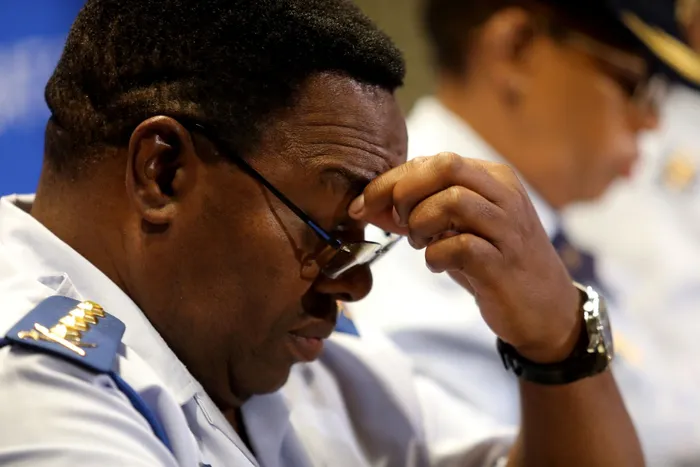
National Police Commissioner General Fannie Masemola at media briefing held in Pretoria on February 02. The prosecution of Masemola for dereliction of duty in relation to PFMA compliance is both significant and instructive. It signals a potential shift in the accountability landscape, says the writer.
Image: Oupa Mokoena/Independent Media
Dr. Reneva Fourie
The persistent governance crisis in South Africa’s public sector has long been seen as a political problem, with elected officials typically cast as the main agents of corruption and maladministration.
However, recent findings in the Auditor-General’s Consolidated General Report on National and Provincial Audit Outcomes for 2024–25 point to a broader, systemic failure rooted in the state's administrative machinery.
This requires greater attention to the role of technocrats – especially accounting officers and senior officials responsible for financial oversight and compliance – in discussions of accountability.
The AG’s report presents a sobering picture of stagnation and regression in public financial management. Only 151 clean audits were recorded among 417 auditees, with 266 entities responsible for 88 per cent of the R2.21 trillion expenditure budget and continuing to lack the institutional capability to produce credible financial and performance reports or to ensure compliance with legislation.
Audit outcome regressions affected 45 auditees overseeing a combined budget of R523.42 billion. The most common outcome remained ‘unqualified audits with findings’ at 161 auditees, many of whom achieved it only after correcting material misstatements identified during the audit.
A total of 224 auditees, or 58 per cent, had material findings on compliance with key legislation, while 252 auditees or 60 per cent, incurred irregular expenditure amounting to R42.58 billion, primarily driven by procurement and contract management failures.
Fruitless and wasteful expenditure reached R1.42 billion, with high-impact auditees responsible for 84 per cent of this amount. In addition, 159 auditees or 41 per cent submitted financial statements containing material misstatements and over half of the performance reports required corrections to become useful and reliable.
Infrastructure projects faced average delays of 41 months; 89% of 152 projects visited had problems. 140 auditees (43%) did not comply with consequence management laws. Material irregularities were found in 203 auditees; 38 were resolved, but 105 remained unresolved for over a year. There are weaknesses in cybersecurity, IT systems, and asset maintenance. State-owned enterprises continue to face financial distress and poor reporting.
These findings confirm the crisis is administrative as well as political. Accounting officers and authorities mandated by the Public Finance Management Act must ensure financial management, prevent irregular spending, and enforce consequences, but many have repeatedly failed to do so. The report highlights delayed investigations, weak disciplinary action, and few consequences for violations.
This institutional inertia has fostered a culture of impunity, as noted by the Auditor-General: non-compliance is normalised and rarely punished. High-impact auditees manage 91 per cent of the national and provincial budgets and are responsible for most modified opinions and irregularities. Systemic issues in contract management and performance reporting reveal ongoing administrative neglect, not just political failings.
In this context, the growing attention directed at the prosecution of the National Commissioner of Police Fannie Masemola for dereliction of duty in relation to PFMA compliance is both significant and instructive. It signals a potential shift in the accountability landscape, in which administrative leaders, rather than solely political figures, are held liable for failures in governance.
This development raises an important question: should similar pressure not be applied more broadly to other technocrats who preside over persistent audit failures and systemic non-compliance? There is a compelling argument that it should.
The Auditor-General’s report makes clear that many of the most serious governance failures arise from sustained administrative neglect rather than from isolated acts of political misconduct. The failure of accounting officers to enforce procurement regulations, ensure transparency in contracting processes, and implement basic internal controls must therefore be understood as a form of dereliction of duty with tangible consequences for the public.
However, while the case for greater accountability among technocrats is strong, it must be approached with caution. The governance environment described in the report is characterised by complexity, capacity constraints and in many instances, active criminality.
It is therefore important to distinguish between administrative shortcomings arising from systemic challenges and those stemming from wilful negligence or complicity in corruption.
The reality is that not all audit findings indicate malfeasance. The report itself notes that some auditees operate under severe financial and operational pressures, including budget constraints, skills shortages and legacy issues.
In such contexts, achieving a clean audit may not always be feasible, despite officials’ best efforts. A rigid or overly punitive enforcement approach risks obscuring these nuances and may discourage capable individuals from taking on leadership roles in the public sector.
Furthermore, there is a danger that the PFMA's provisions could be weaponised for purposes unrelated to genuine accountability. Administrative violations, particularly those of a technical nature, could be selectively enforced to settle internal disputes or political scores. This would not only undermine the integrity of accountability mechanisms but also divert attention from more serious forms of corruption.
The report provides ample evidence that large-scale financial losses are often linked to fraud, procurement irregularities and deliberate misconduct. In such cases, the priority must be to identify and prosecute those responsible for the theft and misappropriation of public funds, rather than to focus disproportionately on procedural lapses.
Ultimately, the Auditor-General's findings point to the need for a more balanced, holistic approach to accountability. Political leaders must continue to be held responsible for setting the tone and direction of governance.
However, administrative leaders, as custodians of public resources and implementers of policy, must also be subject to rigorous scrutiny. The current focus on the National Commissioner of Police, regardless of possible contentious motives, may catalyse this broader shift.
If South Africa is to address the persistent challenges of corruption and maladministration, it must move beyond a narrow focus on political accountability and confront the systemic weaknesses within its administrative structures.
This requires not only stronger enforcement of existing laws but also a more nuanced understanding of the conditions under which governance failures occur. Only by holding all actors within the accountability ecosystem to appropriate standards, while avoiding the misuse of compliance mechanisms, can the state begin to restore integrity, improve service delivery and rebuild public trust.
* Dr Reneva Fourie is a policy analyst specialising in governance, development and security.
** The views expressed do not necessarily reflect the views of IOL or Independent Media.