

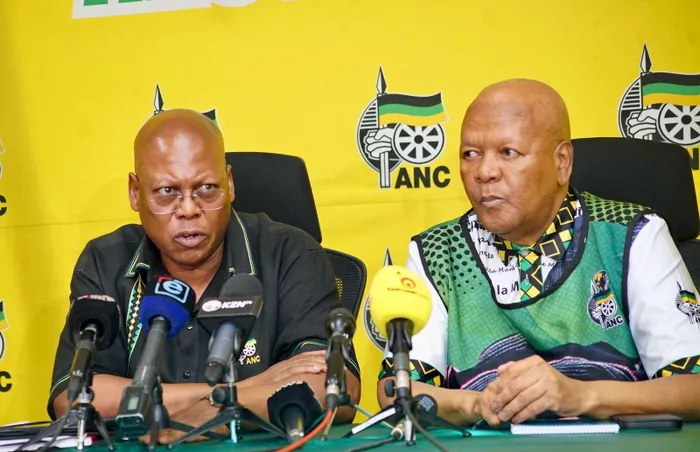
KwaZulu-Natal ANC Coordinator Mike Mabuyakhulu (left) and Convener Jeff Radebe. Concerns have been raised by some in the ANC leadership about the ability of the PTT to rebuild the ANC in KZN. Some of these concerns were unfair, demeaning, and unjustifiable, says the writer.
Image: Independent Media Archives
Prof. Bheki Mngomezulu
The decision by the national leadership of the ANC to instruct the KZN Provincial Task Team (PTT) to postpone its elective conference until after the 2026 Local Government Election (LGE) raises red flags and triggers critical questions. These questions relate to the ANC leadership at the national level as much as they do to the PTT.
The official reason for the postponement is that the province has not been able to have more than 800 of its branches ready for the conference. As such, the province is said to have failed to ensure that all its 11 regions elect their leaders by the set deadline of April 7, 2026.
Assuming these were the only reasons, why didn’t the ANC’s national leadership give KZN at least until the end of April to meet this threshold? Why was it necessary to instruct the province to delay its elections until after the 2026 LGE?
Importantly, what purpose do these elections serve in the upcoming LGE? If they play a role, how will this postponement affect KZN?
Perhaps to understand what is happening here, we must recall what happened before the 2019 general election with the IFP. The leadership of the IFP decided to postpone its national elective conference at the eleventh hour. The same reason for branches failing to meet the threshold was provided. On a closer analysis, some of us concluded that there was more to this postponement than met the eye.
Not surprisingly, a war of words ensued. I was one of those who were at the receiving end of the wrath of the party leadership. The matter was eventually settled when I explained myself and provided fact-based arguments and analyses on the matter.
Against this backdrop, the decision by the ANC national leadership is the same. The official reason is plausible. If branches fail to meet the threshold by a set deadline, the postponement is warranted. This is in line with the party’s constitution.
But what remains unclear is the reason for delaying the election until after the 2026 LGE. Are the challenges at the branch level of such a nature that they cannot be resolved in a month or two? When did the province start preparing for these elections compared to other provinces? If some challenges were anticipated, what did the ANC’s National Working Committee and the National Executive Committee do to remedy the situation? Importantly, where were the party’s top seven?
These questions implore us to look deeper into this postponement beyond just scratching the surface. Broader contexts will assist in shedding light on this incident.
On March 28, 2026, the ANC was scheduled to hold its KZN 114th provincial rally, as other provinces had done. However, this event too was postponed. The reason was to allow the party time and space to focus on preparing for the branch and regional elections. As already mentioned above, these elections too have been postponed.
This chain of events paints a pessimistic picture about the ANC’s prospects for success in KZN. Concerns have been raised by some in the ANC leadership about the ability of the PTT to rebuild the ANC in KZN. Some of these concerns were unfair, demeaning, and unjustifiable.
Speaking in his capacity as the Secretary-General (SG) of the ANC, Fikile Mbalula ridiculed his provincial interim leadership structure. He publicly stated that when they established the PTT, they thought that they had obtained a Ferrari, only to realise that they had a Tazz.
Whether he said this as a joke or out of excitement when he saw the media is immaterial. The reality is that such comments were disrespectful to the incumbents in the PTT. Importantly, such comments demonstrated his tacit admission that the ANC in KZN is not doing well. This is confirmed by regular visits to the province by the national leadership. Seemingly, even those visits have not yielded meaningful positive results that are discernible.
Now, the question becomes: would it be fair to apportion the blame for the ANC’s misfortunes in KZN to the PTT or does KZN’s challenges epitomise a national crisis that the ANC must face head-on? What can the party learn from its performance in the 2019 general election, 2021 LGE, and the recent 2024 general election, where it only obtained 40.18%?
Can the idea of KZN exceptionalism be sustained? What about recent developments in the Eastern Cape and Gauteng, where conferences were engulfed by litigation? Should the ANC’s national leadership not use the KZN situation(s) to do self-introspection and identify factors that have contributed to the party’s waning support?
There is no doubt that there was complacency in the ANC in dealing with the MKP. Some of us warned the ANC against unwittingly campaigning for the MKP. We were dismissed as “Zuma’s people.” Each time the results were announced, we were vindicated. Does the ANC have a plan on how to deal with the MKP threat, or will it wait and pray that the MKP makes its own mistakes, thereby weakening itself? Would that be a wise strategy?
Given what has been happening in the ANC since the “New Dawn” narrative, it remains unclear if the party (ANC) will regroup in KZN. Even in the other provinces where the ANC is still leading, its majority has been significantly reduced. What is the party doing about that? Instead of blaming external forces (including political analysts like me), has the party honestly enumerated the causal factors and put mechanisms in place to address them?
Across the African continent and elsewhere in the world, the trend is that liberation movements that become governing political parties lose grip on power over time. Some remain in office through dubious means. Has the ANC drawn lessons from those experiences?
KZN is an interesting province in many ways. It has always been the ANC’s biggest province, with eThekwini being its biggest region nationally. How did the ANC lose this support? Even more importantly, what is it doing about that?
* Prof. Bheki Mngomezulu is Director of the Centre for the Advancement of Non-Racialism and Democracy at Nelson Mandela University.
** The views expressed do not necessarily reflect the views of IOL or Independent Media.