

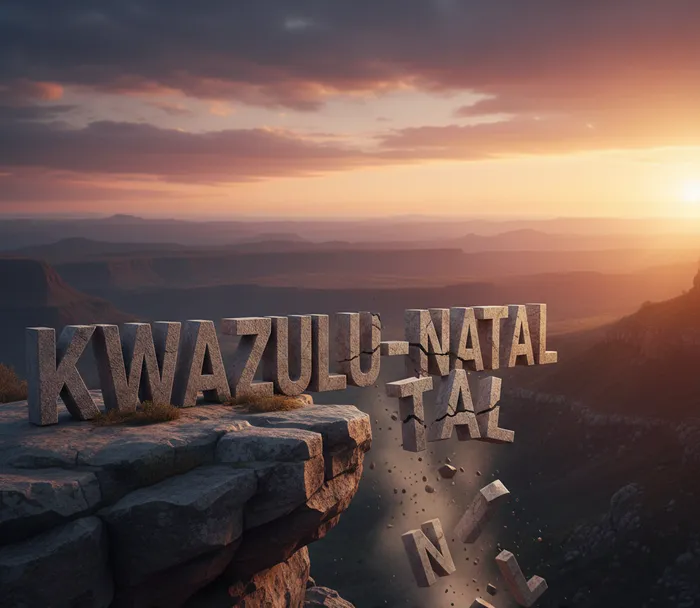
The debate around the renaming of KwaZulu-Natal fails to take into consideration the historical significance of the area's pre-colonial and apartheid boundaries. The writer argues for true cultural restoration and cautions the desire to frame the renaming around ethnicity but rather within the historical context that predates colonialism and apartheid.
Image: Gemini
The recent proposal by His Majesty, King Misuzulu kaZwelithini, to rename the province of KwaZulu-Natal to simply KwaZulu is a significant call for cultural and historical restoration.
Far from being a move rooted in contemporary partisan politics, this proposal addresses a fundamental question of identity, heritage, and the decolonial imperative.
It is an invitation to align the nomenclature of the land with the lived reality and ancestral history of the majority of its inhabitants.
A Legacy of Colonial Superimposition
The hyphenated name KwaZulu-Natal is a linguistic relic of a compromise era.
The Natal portion of the name dates back to 1497, when Vasco da Gama sighted the coastline on Christmas Day and named it Terra Natalis.
While this carries significance in maritime history, it remains a colonial label imposed from the outside.
In contrast, KwaZulu meaning Place of the People of Heaven is an indigenous designation that pre-dates colonial arrival.
By retaining Natal, we continue to give equal weight to a colonial landmark as we do to the centuries-old kingdom that defined the region’s social and political architecture.
The Precedent of Post-1994 Nomenclature
South Africa has a robust history of correcting geographic names to better reflect indigenous heritage and remove the vestiges of the colonial and apartheid eras.
The proposed shift for KwaZulu-Natal is consistent with a long line of successful administrative and cultural re-orderings since 1994:
These changes were not merely symbolic, they were acts of cultural reclamation. If the administrative centers and northern provinces can embrace their indigenous identities, there is no logical barrier to doing the same for the kingdom of the Zulu people.
Beyond Politics: A Matter of Social Cohesion
It is vital to view this proposal through a non-partisan lens. This is not about the expansion of political power, but about the recognition of Sovereignty and Heritage.
The Zulu Kingdom is one of the most recognized cultural entities globally. Calling the province KwaZulu acknowledges the constitutional recognition of traditional leadership and the unique cultural tapestry that defines this part of South Africa.
Renaming the province is a step toward psychological decolonization. It asserts that the identity of the land is rooted in its people, not in the calendar of a passing explorer.
The Path Forward: Public Consultation and Dialogue
The strength of our democracy lies in the principle of Ubuntu and the constitutional mandate for public participation.
The most constructive path forward for the government is to initiate a wide-reaching consultation process.
The introduction of political maneuvering into a matter of cultural and historical restoration is not only a distraction, it is a disservice to the dignity of the Zulu Crown and the heritage of the people of this province.
When His Majesty, King Misuzulu kaZwelithini, makes a call for the restoration of the name KwaZulu, he is speaking from a position of ancestral custody, not from a party-political manifesto.
To reduce this proposal to politics is to fundamentally misunderstand and intentionally undermine the role of the Monarchy in a democratic South Africa.
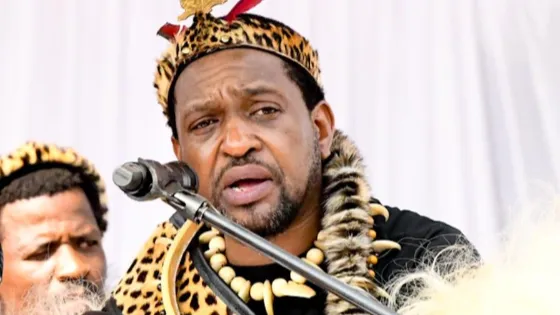
Communications specialist and entrepreneur Sandiel Ngema argues that there is a dangerous tendency for commentators to frame any assertion of Zulu identity as ethnic politics, like King Misizulu kaZwelithini's proposal for KwaZulu-Natal to be renamed. The writer argues that names like Gqeberha, KuGompo City or Mbombela were adopted, they were celebrated as victories for decolonisation, which exposes the double standards imposed on cultural restoration debates.
Image: SIPHAMANDLA MBHELE | KZN DSAC
The Fallacy of Political Opportunism
Critics who label this move as political often do so to stifle a necessary conversation about identity. However, there are several reasons why this call must be shielded from the political fray:
Avoiding the Ethnic Group vs State Trap
There is a dangerous tendency for commentators to frame any assertion of Zulu identity as ethnic politics. This is a double standard. When names like Gqeberha or Mbombela were adopted, they were celebrated as victories for decolonisation. To suggest that the same logic becomes political and divisive only when applied to KwaZulu is an act of intellectual dishonesty.
Restoring the name is not about excluding others, it is about accurately naming the home of the Zulu people. The name KwaZulu-Natal itself was a political compromise of the CODESA era, a temporary bridge between the old administration and the new.
It was never intended to be an eternal, unchangeable label.
A Call to Professionalism
The government, the President, and all stakeholders must approach this with the sobriety it deserves. If the conversation is allowed to be hijacked by politics the true essence of the King’s message, the restoration of dignity will be lost.
The best thing the government can do is to strip away the political noise and facilitate a genuine, respectful consultation. Let the people speak. If the citizens of this province wish to be identified by their ancestral name, no political party has the moral or historical right to stand in the way.
This is about the soul of a province and the legacy of its ancestors. Let politics stay at the door, let heritage lead the way.
Restoration is Not Exclusion
His Majesty’s proposal is an act of cultural affirmation, not social exclusion. To interpret the restoration of the name KwaZulu as a move toward tribalism or the marginalization of non-Zulu residents is a fundamental misreading of the King’s intent and the inclusive nature of the kingdom itself.
The name KwaZulu represents a historical and geographical identity that has always been large enough to encompass diversity. In the same way that living in France does not require one to be ethnically French, or living in Limpopo does not exclude those who do not speak Lobedu or Tsonga, the name KwaZulu defines a region’s heritage without demanding a singular identity from its inhabitants.
Moving Toward a Shared Identity
We must move away from the zero-sum mentality that suggests honoring one culture necessitates the diminishing of another. True social cohesion in South Africa is built on mutual respect. By acknowledging the primary indigenous identity of the land, we create a more honest framework for all other cultures to coexist.
The King’s call is a request for the state to recognize the land by its rightful name. It is an invitation for all who live within its borders, whether they are of Zulu, any South African, Indian, English, or Afrikaans descent, to be part of a restored, dignified, and clearly defined KwaZulu.
The Natal suffix was a compromise of the past, KwaZulu is the reality of the present and the vision for the future. It is a name that signifies a Place of the People of Heaven and there is room under that sky for everyone.
If the government is truly willing to listen to its people, it must take His Majesty’s proposal with the seriousness it deserves.
Restoring the name to KwaZulu is an act of honoring the past while simplifying the future.
It is a gesture of respect toward the throne and a significant milestone in the ongoing journey of South Africa’s self-definition.
As we have seen with Limpopo and Gqeberha, names carry weight. They tell us who we are and where we come from. It is time the Place of the People of Heaven stood on its own, unhyphenated and proud.
(Ngema is a communications specialist and entrepreneur with interests in mass media. His views do not necessarily reflect those of the Sunday Tribune or IOL)
For more thought-provoking opinions click on the link below:
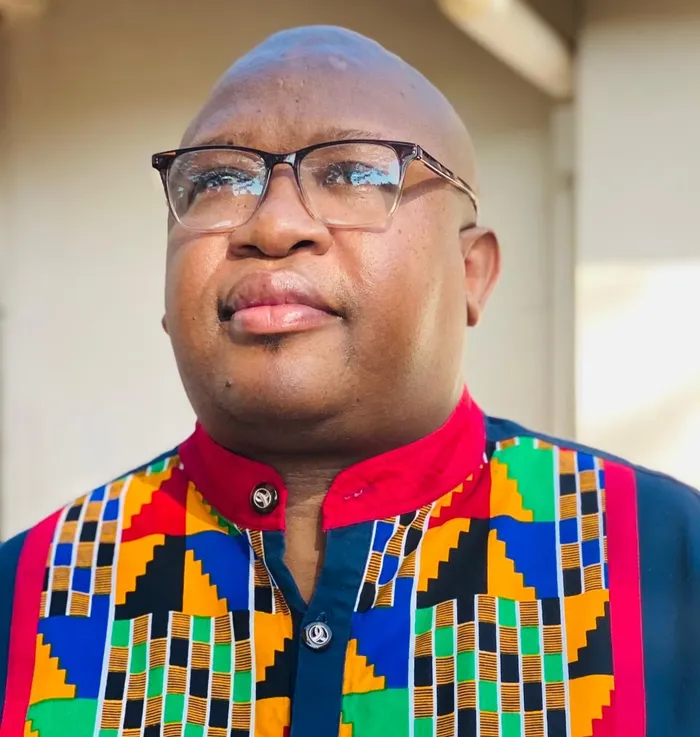
Sandile Ngema is a communications specialist and entrepreneur with interests in mass media.
Image: Supplied