

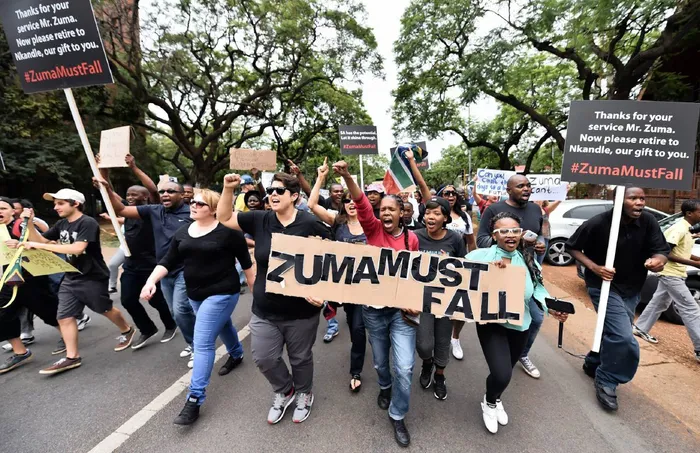
Thousands of South Africans marched from the Pretoria Art Museum to the Union Buildings nine years ago, on April 12, in the “Zuma Must Fall” protest, which coincided with then-president Jacob Zuma’s 75th birthday. The demonstration, held under the Save SA banner, drew support from across the political spectrum. Nearly a decade later, many of the grievances that fuelled the march persist, if not worsened, yet the public appetite for mass protest against the sitting state president has largely faded.
Image: OUPA MOKOENA Independent Newspapers
Nine years ago on April 12, South Africa witnessed one of the most striking political moments of the democratic era.
Major opposition parties marched to the Union Buildings in Pretoria demanding the resignation of then state president Jacob Zuma, a day that coincided with his 75th birthday.
The march followed a week of nationwide protests across major cities, as citizens from across the political spectrum voiced their anger over corruption, state capture and declining governance.
Jacob Zuma had become a rare unifying figure, not through admiration, but through opposition. Parties with sharply divergent ideologies found common ground in calling for his removal.
Under the banner of the newly formed civil movement Save South Africa, the scale of public dissent drew international attention and raised pressing questions about the state of South Africa’s democracy.
Founded by Sipho Pityana, Save SA became the focal point of the Zuma Must Fall campaign, bringing together civil society, opposition parties, trade unions, and faith-based organisations in protest against state capture.
When Cyril Ramaphosa finally rose to the presidency, expectations were high. In boardrooms and business forums, his ascent was hailed as a “new dawn”. Borrowing from the iconic song by the late Hugh Masekela, Thuma Mina (send me) became his rallying call.
In the private sector and broader society, he appeared almost messianic, a leader expected to restore integrity, revive institutions and pull the country back from the brink.
Yet hope has steadily given way to disillusionment. The anti-corruption promise that once endeared Ramaphosa to many has been overshadowed by inaction, persistent governance failures and an economy that continues to struggle.
What is most striking today is the contrast between then and now. By several measures, South Africa faces deeper challenges than it did nine years ago, from economic stagnation to institutional fatigue and persistent corruption. Yet the streets are largely quiet.
The question that demands reflection is simple but uncomfortable: why do South Africans appear less agitated now than they were during the Zuma years?
Save SA lost its voice after Zuma left public office on Valentine’s Day in 2018, yet numerous pressure points suggest that South Africa remains far from stable. State capture may not have been fully eradicated, but rather reconfigured with new actors.
The sweeping silence, from the fourth estate to opposition parties and civil society, signals a different kind of capture: not of institutions alone, but of dissent itself, and a waning appetite for reasoned accountability. There is no shortage of causes that could galvanise public protest, yet none appears capable of uniting citizens on a mass scale.
Pupils still wade through rivers to reach their classrooms. Young people idle on street corners as youth unemployment climbs to record levels. In an economy where even qualified doctors struggle to find work, graduates queue in their hundreds for a handful of entry-level jobs.
This is a ticking time bomb, and the prevailing silence should offer no comfort.
Was the outrage of 2017 driven purely by principle, or by personalities? And if the challenges facing the country today are as severe, if not more so, why has the spirit of mass protest faded?
Perhaps the true test of a democracy lies not in how loudly it rallies against a disliked leader, but in how consistently it holds power to account.
(This is an extended editorial comment published in the April 12, 2026 print edition of the Sunday Tribune, marking the ninth anniversary of the Zuma Must Fall protest march to the Union Buildings)
For more thought-provoking opinion pieces click on the link below.