

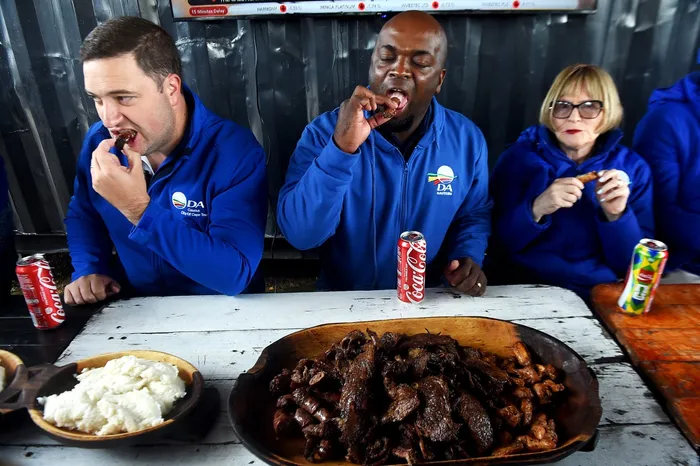
The newly elected leader of the Democratic Alliance (DA) Geordin Hill-Lewis, Federal Chairperson Solly Msimanga and Johannesburg Mayoral Candidate Helen Zille tuck into a meal while campaigning for the local government elections in Pimville, Soweto on April 13.
Image: Itumeleng English/Independent Media
Prof. Bheki Mngomezulu
The Democratic Alliance (DA) should be applauded for organising a successful two-day elective conference from April 11 to 12, 2026. The registration process went smoothly. The conference started on time, proceeded well, and concluded as per the initial schedule. This is what many political parties fail to do.
Another area where the DA deserves accolades is its decision to elect a young person, Gordon Hill-Lewis, to succeed John Steenhuisen as its new leader. This was a commendable move.
But now that the new leadership has been elected, several questions come to mind. The very first question becomes: will the new leadership be equal to the task of rebranding the DA? Put differently, can the leopard change its skin and its face?
These questions are not as easy as they seem at face value. One would have to apply one’s mind assiduously before answering them appropriately. Any response to each of these questions should be based on facts, not emotions or imagination.
The DA has consistently stated that it does not consider variables such as race, gender, or ethnicity. In a country like South Africa, it is naïve at best and dishonest at worst to ignore the race factor. South Africa’s beleaguered past is defined by race. It would be disingenuous to think that rebuilding this country can happen without addressing the race factor.
The DA’s neglect of race is well documented. It has been openly against policies such as affirmative action and Broad-Based Black Economic Empowerment (BBBE). This has been evidenced in its election of white leaders, ignoring black leaders.
Since 1994, of the five DA leaders, only one black person has led this party, Mmusi Maimane. The other four were Tony Leon, Helen Zille, John Steenhuisen, and now Gordon Hill-Lewis. Noticeably, of the ten newly elected DA leadership, blacks constitute about 30%. Are there not enough black people in the DA who qualify to lead?
Given this situation, will the DA be able to penetrate black-dominated areas such as townships and rural areas? If not, where does this leave the claim or promise by Hill-Lewis that under his leadership, the DA will expand its tentacles and reach areas it has never reached before?
Gender is another challenge the DA must contend with. Of the five leaders mentioned above, only one (Helen Zille) has been allowed to lead the party. Even with the new leadership, Siviwe Gwarube is the only female leader among nine males.
How will the DA respond to the criticism that it is a patriarchal party? Since it likes comparing itself to the ANC, will the latter not appear better than the DA in terms of ensuring gender parity? How does the party hope to endear itself with the electorate if it unwittingly refutes statistics showing that South Africa has more women than men?
It is commendable that the DA claims to focus on merits rather than gender or race. But the party’s failure to elect women to leadership positions is a serious indictment. The same thing happened in the DA’s previous congress, where Mbali Ntuli, who met all the criteria, was overlooked in favour of a male, John Steenhuisen. Ntuli was black, female, young, smart, educated, and loyal to the party. But being black and female worked against her.
Another question the DA will have to answer is, why does it have a bloated leadership structure? Its political rival, the ANC, moved from the top six to the top seven. By contrast, the DA has ten members in its leadership structure. Does this not give signals of what the party would do with the cabinet if it were to be the governing party? What would that say about the accusation levelled against the ANC of having a bloated cabinet?
As mentioned earlier, the DA should be commended for electing a generally young leadership. But this raises another question. To what extent will this young leadership be allowed to operate independently? Will it be able to resist old guard influence? Given that these old guards, such as Leon and Zille, are trusted by the funders, will the new “young” leadership afford to ignore what these old leaders put on the table?
Indeed, the party will argue that any engagement will be done in the spirit of comradeship and persuasion. However, the reality is that the scales shall be tilted in favour of the old members of the party who have more reputation than the new leadership.
The new DA leadership will take the party to the 2029 general election. How will it position itself against the ANC? Currently, the DA, which has been critical of the ANC, is now part of the multiparty coalition government led by the ANC.
Already, Hill-Lewis is on record saying that his party will not tolerate being viewed as an insignificant partner in the coalition government. When asked to comment on the DA’s decision to join the ANC-led coalition, Zille stated that they had to join the ANC to avoid what she called a “doomsday coalition” of the ANC, EFF, and MKP. A similar response was provided by Steenhuisen when he visited President Donald Trump in America with Cyril Ramaphosa.
How will Hill-Lewis redefine the DA’s role in the multiparty coalition? Will he be forced to remain in the coalition because his seniors feel that it is the better option, or will he take the DA back to its official opposition position? What impact would each decision have on the party’s political future?
This leads to another related question about the DA’s political identity. Has the party succeeded in ridding itself of the opposition tag, or does it oppose the same government it is part of? How will the new leadership negotiate these complexities? Importantly, does it have what it takes to redefine the DA?
Hill-Lewis is determined to reposition the DA. Conversely, Solly Msimanga suddenly sang Mmusi Maimane’s praises. Will the two leaders pull in the same direction? Only time will tell!
* Prof. Bheki Mngomezulu is Director of the Centre for the Advancement of Non-Racialism and Democracy at Nelson Mandela University.
** The views expressed do not necessarily reflect the views of IOL or Independent Media.