

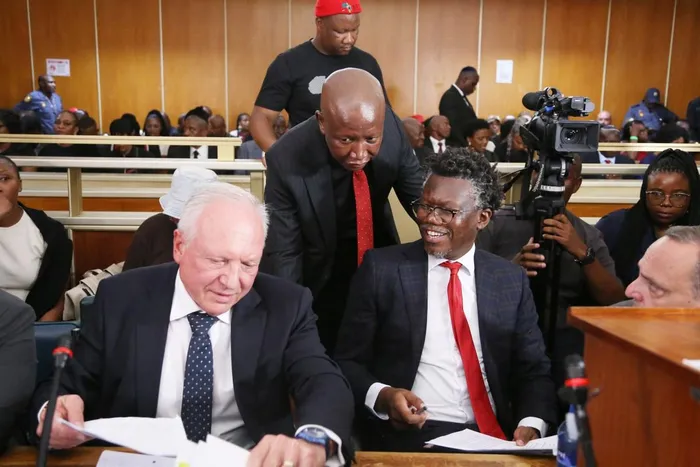
ECONOMIC Freedom Fighters (EFF) leader Julius Malema (centre) consults with his legal representatives Laurance Hodes SC (left) and Thembeka Ngcukaitobi SC at the KuGompo Regional Court on Thursday.
Image: AFP
Dr. Reneva Fourie
Julius Malema, the leader of the Economic Freedom Fighters, was sentenced to 5 years imprisonment on Thursday, 16 April. The sentencing follows his conviction last year for criminal charges laid by AfriForum after he discharged celebratory shots during the EFF’s anniversary rally in July 2018.
While he has appealed the sentence, the implications extend beyond the legal sphere. They reach into the contested terrain of political power, the future of left politics in South Africa and institutional independence.
Thirteen years after its formation, the EFF remains a significant actor in the political arena, despite organisational fractures and leadership challenges. The exits of prominent figures such as Floyd Shivambu, Dali Mpofu, Mzwanele Manyi, Busisiwe Mkhwebane and Mbuyiseni Ndlozi have indisputably weakened its internal coherence.
However, the party’s electoral performance points to a more nuanced reality than a narrative of collapse.
In the 2024 national election, the party experienced a decline of just over one percentage point compared with its 2019 result. However, the EFF performed significantly better in 2024 than it did in 2014, its inaugural electoral contest.
Provincially, the party improved its performance in five provinces, suffering only marginal losses in others, except in KwaZulu-Natal, where the emergence of the uMkhonto weSizwe (MK) Party proved a disruptive factor.
Nevertheless, the EFF remains overwhelmingly centred on Julius Malema. It derives its authority from his oratorical power and charisma. Malema is its primary strategist, its most recognisable voice and its core mobilising factor. His absence, particularly through incarceration, would test the party’s institutional depth in ways it has not previously confronted.
Malema’s sentencing and the outcome of his appeal also have implications for the broader left in South Africa. Despite its often populist and radical black nationalist rhetoric, the EFF, from a policy perspective, has positioned itself as a formidable parliamentary voice for economic justice and anti-imperialism.
The underlying social grievances that gave rise to the EFF, including mass unemployment and persistent racialised poverty, remain unresolved. The potential weakening of the EFF would therefore have implications that extend beyond party politics, particularly at a time when inequality remains stark and social tensions continue to simmer.
The South African Communist Party’s Conference of the Left, which will bring together various organisations and movements, reflects an awareness of the need for a collective strategy to achieve meaningful improvements in the quality of life of all citizens.
During a bilateral with the SACP in March, the EFF committed to joining the steering committee, which is organising the event. However, it is unclear whether the EFF can play a meaningful role in advancing the outcomes of such a gathering without its central figure. Being part of a collective might provide it with the institutional stability it needs.
Beyond these political considerations, the case also raises legal incongruencies about his sentencing. As a leader, discharging a firearm, even as a celebratory gesture, in a society where violence is pervasive and normalised, was highly irresponsible.
The guilty verdict was therefore justified. However, it is debatable whether the sentence imposed is proportionate to the act in question and whether it reflects institutional consistency.
AfriForum, Malema’s nemesis, has, itself, committed acts of treason. It has conducted a coordinated campaign to promote demonstrably false narratives of ‘white genocide’ and ‘land grabs’ to foreign governments, contributing to international perceptions that harm South Africa’s diplomatic standing and economic security.
Its leaders have also sought foreign intervention, including lobbying the US government to impose punitive sanctions on South Africa. Yet it has never been legally required to account for its acts of subversion and economic sabotage.
When one looks at the gravity of what Malema has done, a symbolic act of reckless bravado, and compares it with far worse crimes that plague South African society, the courts appear to send disturbingly different messages. Consider gender based violence, which claims the lives of thousands of women and children every year.
Perpetrators frequently receive lenient sentences. Prosecutions are often botched. Likewise, cases involving corruption or corporate misconduct often move slowly or fail to yield substantive accountability. The contradictions create unease about the uneven application of justice.
The NPA has to tread very carefully. They must be clear that they are sending a message that crime will not be tolerated, regardless of who the perpetrator is, but they must also be balanced. The prosecuting authority has been the subject of multiple inquiries, including the Nkabinde Commission, which exposed considerable political interference in its work.
This history places added pressure on the institution to demonstrate independence, consistency and adherence to the rule of law in all high-profile matters, particularly where public and political scrutiny is intense and sustained.
To exempt Malema from accountability on the grounds of his political significance would set a dangerous precedent. It would reinforce the very culture of impunity that has plagued South African governance for decades.
However, an unprecedentedly harsh sentence creates the perception that the Malema prosecution is politically motivated, further eroding public confidence in the justice system. Proportionality in sentencing and procedural fairness are therefore essential, as they help balance deterrence with legitimacy. Ultimately, the credibility of the justice system depends on being seen as both firm and impartial.
The sentencing of Julius Malema is not simply a legal event. It is a moment that crystallises many of the contradictions within South African society. It highlights the tension between accountability and political contestation, between institutional independence and historical mistrust, between individual leadership and collective organisation.
How these tensions are resolved will determine not only the future of the EFF, but also the broader trajectory of democratic politics in the country.
In this sense, the proceedings serve as a reminder that justice cannot be divorced from context. It must be grounded in principles, yet attentive to the realities in which those principles are applied.
The challenge for South Africa is to ensure that the pursuit of justice strengthens democracy rather than becoming another arena in which its fragilities are exposed. Only then can the rule of law command genuine respect and endure as a pillar of the nation.
* Dr Reneva Fourie is a policy analyst specialising in governance, development and security.
** The views expressed do not necessarily reflect the views of IOL or Independent Media.