

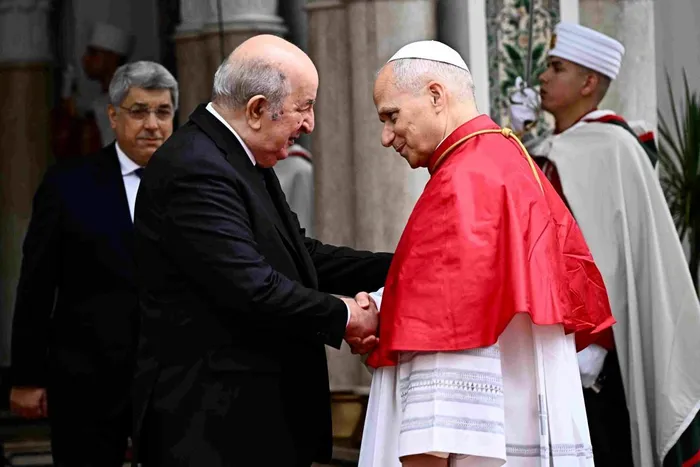
Pope Leo XIV meets with Algeria's President Abdelmadjid Tebboune at the Presidential Palace. The Pontiff's 11-day trip to Africa has also stressed coexistence, migration, and the Church’s attention to countries facing instability and inequality.
Image: AFP
POPE Leo XIV has embarked on an 11-day apostolic journey to four African nations: Algeria, Cameroon, Equatorial Guinea and Angola.
This visit, rich in symbolism and pastoral intent, carries profound significance for both the Catholic Church and the African continent. To fully appreciate its meaning, it is helpful to situate the journey within a biblical framework.
In the Gospel of Luke (22:31–32), Christ says to Saint Peter: "I have prayed for you … that your faith may not fail; and you, when once you have turned again, strengthen your brothers." This passage has long been understood as foundational to the Petrine ministry.
In this light, the pope's journey to Africa is fundamentally pastoral – a mission to strengthen the faith of his brothers and sisters in Christ. Yet this spiritual mandate also unfolds into broader social and global implications.
Africa today is emerging as a significant force within global Catholicism, marked by a vibrant and growing faithful. The pope’s visit serves both as a recognition of this reality and as encouragement to sustain it.
In recent years, the direction of evangelisation has increasingly shifted, with African missionaries being sent to the Global North to rekindle waning faith communities.
This reversal not only underscores Africa’s spiritual vitality but also highlights its evolving role in shaping the future of the church.
The visit also carries a message of peace. When Pope Leo XIV first appeared at the balcony of St Peter’s Basilica in May 2025, he greeted the crowd and the world with the words, "The peace of the Risen Lord be with you."
This greeting set the tone for his papacy. It is therefore no coincidence that Africa, home to regions grappling with conflict, including Sudan, Mozambique, the Sahel region and Nigeria, is a focal point of his early travels. Pope Leo visited the Anglophone sphere of Cameroon as an ambassador of peace but also to highlight to the global community the challenges that confound that place.
His presence is both a proclamation of peace and a tangible expression of the church’s concern for those enduring instability and hardship. The outbreak of armed conflict in several parts of the continent, particularly in Sudan and the Eastern Democratic Republic of Congo, has resulted in large-scale displacement and a deepening humanitarian crisis.
These developments have significantly strained national and regional capacities to manage migration and uphold refugee protection frameworks. In many instances, families have been forcibly separated, exposing systemic gaps in coordinated response mechanisms and cross-border protection policies.
As is often the case in such crises, the burden falls disproportionately on the poor and the most vulnerable. Women and children, in particular, face heightened risks, including gender-based violence and exploitation.
Persistent reports from conflict-affected areas point to the urgent need for strengthened safeguarding policies, improved humanitarian access, and more robust international co-operation to ensure accountability and the protection of fundamental human rights, built on the respect of human dignity.
Central to this concern is the principle of the Preferential Option for the Poor, a cornerstone of Catholic Social Teaching. Through this principle, the church aligns itself with the marginalised and vulnerable, sharing in their struggles and advocating for their dignity.
In Algeria, the pope visited a centre dedicated to caring for the poor and vulnerable, offering not only material support but also moral encouragement. Such encounters bring into sharp focus the lived realities of many Africans, whose daily lives are shaped by economic uncertainty and limited access to essential resources.
Elsewhere on the continent, the urgency of such solidarity is evident. In parts of the Democratic Republic of the Congo, particularly in the south, disruptions to humanitarian aid have left many without critical assistance.
By drawing attention to these conditions, the pope's visit amplifies the voices of those often unheard, urging both local and international communities to respond with compassion and action.
Ultimately, this apostolic journey aims to promote interfaith dialogue and collaboration. Africa’s rich tapestry of religious traditions presents both challenges and opportunities.
By promoting mutual understanding and co-operation among different faith communities, the pope underscores the importance of unity in addressing shared social concerns and building lasting peace.
Pope Leo XIV’s visit to Africa is not merely ceremonial. It is rather a deep human encounter, one that brings global attention to the continent’s faith, its struggles and its hopes.
Through gestures of solidarity, messages of peace and calls for justice, the apostolic journey affirms Africa’s central place in the life of the church and in the broader quest for a more compassionate world built on the virtue of ubuntu (humanity).
(Fr Nhlanhla T. Mchunu is Associate Secretary General of the Southern African Catholic Bishops’ Conference. His views do not necessarily reflect those of the Sunday Tribune or IOL)
For more thought-provoking views click on the link below:
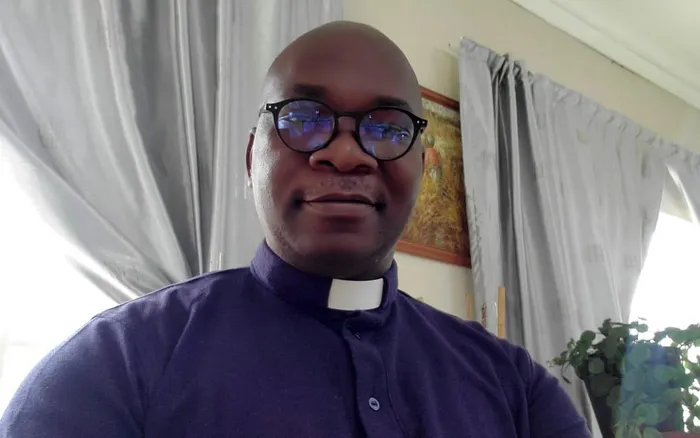
Fr Nhlanhla T. Mchunu is Associate Secretary General of the Southern African Catholic Bishops’ Conference.
Image: Supplied