

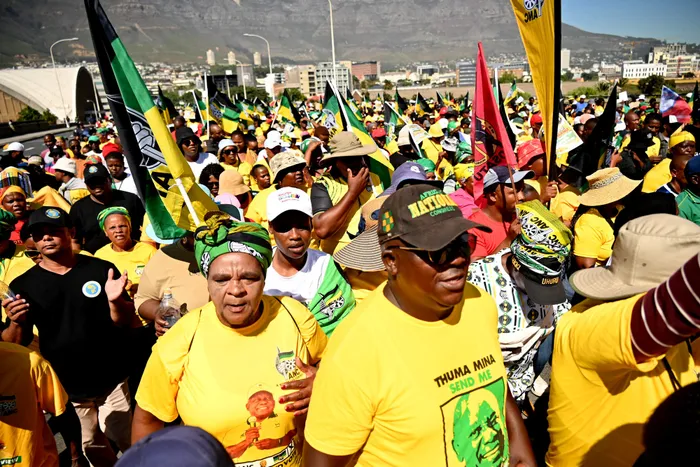
The long-standing alliance between the African National Congress (ANC) and the South African Communist Party (SACP) is facing a critical, potentially final split as the SACP prepares to contest the 2026 local government elections independently. The writer argues the fracture opens a door for uMkhonto weSizwe Party in KwaZulu-Natal.
Image: AYANDA NDAMANE Independent Newspapers
The signs are no longer indirect. The South African Communist Party (SACP) has drifted from the ideological ballast - as it has always claimed to be - into direct political ambiguity. In my opinion, the party can now only be described as a spent force within the Tripartite Alliance.
The SACP have always claimed to be the compass of the African National Congress (ANC). If anything, in KZN, it led them to an iceberg in 2024.
In 2017, Metsimaholo exposed a quiet restlessness. If we cast our minds back, we will remember that the SACP contested elections there the same year, winning three Proportional Representative (PR) council seats on their own steam.
Then, last year in Polokwane, they contested a by-election. There was no major breakthrough, but what remains relevant is that they once again contested independently.
Today, the SACP speaks of contesting the 2026 Local Government Elections (LGE), yet refuses to be clear on how. Where do they stand with the ANC then? That is the big question. Are they in? Are they out?
Or are they simply unwilling to confront their own diminishing relevance? Are they tired of being the ever-loyal junior partner after so long, particularly in a relationship where definitions seem blurred?
When a long-standing partner cannot speak plainly, it raises deeper concerns in any meaningful relationship. Movements are sustained by trust and clarity. What we are witnessing instead is a posture that risks being seen - quite evidently, through my eyes - as treacherous to the movement and alliance they helped build.
What are they publicly signalling, and what are they saying behind closed doors? What is clear, though, is that there is the political courage, the backbone, to walk away from the ANC - or is there?
Then there is the recent public spectacle around former SACP Leader, the late Chris Hani, with confirmation by the party’s national spokesperson that they are well on their way in terms of preparations for this year's LGE.
What we know is that where there is fragmentation, there is opportunity. And within the current political climate, that opportunity does not present itself neutrally. Instead, it tilts the balance of power in municipalities toward the uMkhonto Wesizwe Party (MKP) - not through strength of its own - but through the weakening of those who once governed with difficulty to start with.
The truth, uncomfortable as it may be, is that the Tripartite Alliance has become emaciated, reduced to bare bones in its current form. What once embodied unity of purpose -as they have always suggested -now reflects fragmentation, political fatigue and trite rhetoric.
For goodness’ sake, someone needs to take a stand!
And the ANC? It appears unable to publicly confront what is increasingly obvious. Even long-standing allies such as the South African Democratic Teachers Union (SADTU) have demonstrated, particularly in KZN, that allegiance is no longer automatic.
SADTU branded its vehicles “SADTU Says Vote ANC” and then - as it seems, through my frequent work on KZN’s Education portfolio committee - voted for the MKP. The question is - how deep does the capture of the latter go within Education and Health for example?
Having said all of this, from where many of us sit in the political trenches, the entire relationship seems unstable. It appears fragile, shows a lack of consistency, and is - by public pronouncements - visibly weakening. My question is: If the SACP is contesting elections independently, what does alliance mean in practice?
And if the alliance still stands, as they all claim, why the need to test independence at all? Leadership demands clarity. If this alliance is over, say so. If it can be rebuilt, then rebuild it with honesty. But ambiguity cannot substitute for direction. This may be too noble to say.
What is clear - to someone who observes from being in the thick of politics - is that the relationship is strained beyond redemption. The waning power of the ANC will only worsen internal arrangements at a national level.
The ANC in KZN, once considered its safe haven and largest area of support - where the SACP enjoyed being held in its arms - is now reduced to second fiddle. There not being enough space for the SACP anymore does not sit well, it seems. What was once quite evidently a relationship of convenience is now in evident ruin.
In the end, whether this now ill-fated relationship collapses or limps on, one thing becomes unambiguous: the Tripartite Alliance is no longer what it was, and may very well never be again. If the option of the reset button is available, then this is the time to press it. Fragmentation, while heading into the LGE, must be questioned - if not, it is sobering when one considers the alternative.
The reality, then, is that in provinces such as KZN, the future of stable governance will not be secured through historical alliances that no longer function with clarity or cohesion. It will depend on structured partnerships where responsibility is shared, accountability is enforced, and ambiguity has no place.
The DA, as a committed partner within KZN’s Government of Provincial Unity (GPU), has demonstrated that such stability is both possible and necessary. Our work in the provincial legislature reflects a consistent commitment to principle over politics, and to governance that places the interests of KZN’s people first.
The duty to raise the above-mentioned concerns does not come easily. It arises from a sober reading of the current political environment and a deep concern for the direction in which our municipalities may be heading. Because if the fragmentation of the Tripartite Alliance continues unchecked, the consequences will not be theoretical.
They will be felt directly in councils across KZN, where instability creates space for opportunism. And in that space, the MKP will not need to win decisively, it will simply need others to fragment. That is the risk before us. And it is one that cannot be ignored.
(Dr Imran Keeka, MPL is the Democratic Alliance Chief Whip in the KZN Legislature and a member of the province’s Health and Education portfolio committees. His views do not necessarily reflect those of the Sunday Tribune or IOL)
For more thought-provoking opinions click the link below:

Dr Imran Keeka is the Democratic Alliance Chief Whip in the KZN Legislature a member of the Health and Education Portfolio Committees.
Image: Independent Newspapers Archives