

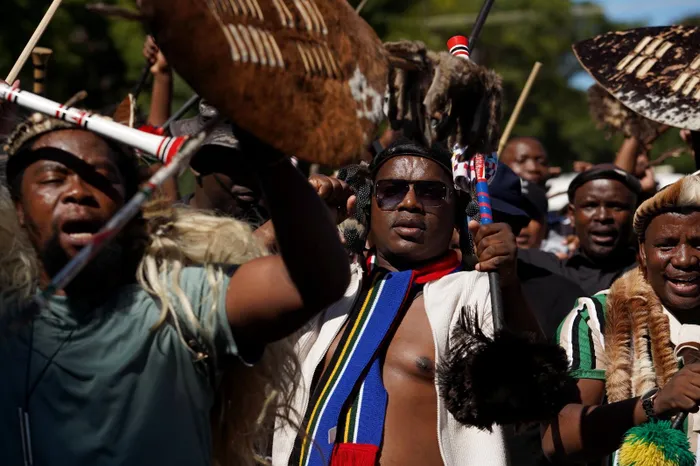
Supporters of the March and March anti-immigrants movement wielding traditional weapons during a protest at the Union Buildings in Pretoria on April 28.
Image: Oupa Mokoena/Independent Media
Prof. Bheki Mngomezulu
On March 28, 1994, Inkatha Freedom Party (IFP) organised a march to support the view that the party would not participate in the first democratic election of April 1994 unless the Zulu monarchy was accorded a special status and the Ingonyama Trust was recognised.
The route of the march was going to pass by Shell House in Johannesburg, which was the African National Congress (ANC) headquarters, now known as Luthuli House. ANC guards opened fire at the marchers who were brandishing traditional weapons, resulting in the deaths of 19 people, while several others sustained injuries.
When this matter was discussed during the Truth and Reconciliation Commission (TRC), the ANC’s 11 security guards were granted amnesty. The reason provided for such a decision was that the marchers were armed, and the political mood in the country at the time was volatile. As such, the victims did not get justice.
At the centre of this synopsis is the convergence of culture, law, and public safety. The main conundrum is found in Chapter 2, Section 31 of the 1996 Constitution, which focuses on cultural, religious and linguistic communities.
Specifically, Section 31(1)(a) states that “persons belonging to a cultural, religious or linguistic community may not be denied the right, with other members of that community, to enjoy their culture, practice their religion and use their language.”
However, Section 31(2) states that “the rights in subsection (1) may not be exercised in a manner inconsistent with any provision of the Bill of Rights.”
These two constitutional imperatives are sometimes used for self-gain or to advance self-interests. Those who support the carrying of traditional weapons in public invoke cultural rights enshrined in the constitution.
Conversely, those who are opposed to this practice lean more towards Section 31(2) and argue that brandishing weapons in public threatens other people and therefore infringes on their rights to safety.
Against this backdrop, recent incidents have brought this subject to the table. On Freedom Day, which was celebrated on April 27, 2026, as has been the case over the years, the main event that was addressed by President Cyril Ramaphosa was held in Mangaung, Free State. Those attending were advised not to carry weapons (traditional or otherwise) and not to wear party T-shirts. They heeded the call.
However, other events were held across the country where attendees wore party regalia since these were party celebrations, not a national event. The IFP’s main celebration was held at the Banquet Hall, Westonaria, in Gauteng province. Its focus was on the call to defend democracy and restore good governance. Noticeably, many of those who attended carried Zulu traditional weapons.
From their side, there was nothing wrong with this act since they were exercising their democratic right in line with the constitutional prescripts. However, others frowned upon this act, arguing that it threatened public safety. Those who carried these weapons advanced the view that they did not harm anyone but simply carried their weapons as a cultural practice.
Another example is what has been happening in various provinces – especially in KwaZulu-Natal and Gauteng. As civic organisations such as March and March, Operation Dudula and others called for the expulsion of illegal immigrants, traditional weapons were brandished in public. Leaders like Ngizwe Mchunu and Phakelumthakathi Ndabandaba brandished their traditional weapons in public in accordance with their Zulu culture.
A few questions arise.
Firstly, are these protest marches cultural or political events? If they are cultural events, then the carrying of weapons may be justifiable and would not be in contravention of the Constitution. However, if they are political events or something else, it remains unclear if the carrying of traditional weapons has any basis.
Secondly, since these marches are legal and organisers first seek permission and have the routes of the marches approved, are there any terms that accompany the approvals regarding the public display of traditional weapons? What guides government authorities when granting permission to the marchers? Do they refer to the sections of the Constitution cited above?
Thirdly, given that whites in general, and Afrikaners in particular, are known to traditionally have guns, which they were trained for, what would happen if Afriforum were to apply for a march against something and brandish guns of different sorts? Would that be interpreted as a “cultural practice” or a threat to public safety?
Fourthly, it is an undeniable fact that traditional weapons are displayed in public with no intention to harm anyone. But what mechanisms are put in place to prevent some maniacs from doing something bizarre that would trigger public violence and threaten public safety?
Fifthly, should the carrying and public display of traditional weapons be confined to cultural events, but be restricted or even prohibited during political events that have no cultural overtones? How would such a decision align with or be in contravention of the Constitution?
The brief history provided, and the questions posed above, necessitate self-reflection on what we have been doing as a country thus far. We have a responsibility to groom the youth properly. As such, we must teach the youth the right things. This includes making them distinguish between cultural and political events and thus being able to act accordingly.
From a human rights point of view, it is true that all rights should be respected. At the same time, no right should infringe on other people’s rights. This balancing act means that all government officials, the political leadership, and the leadership of all Chapter 9 institutions should apply their minds assiduously.
This is critical because South Africa comes from a painful past. Some of those who were the victims of political violence in the past still have scars. Any careless brandishing of traditional weapons, whether they are guns, assegais or other types, could open old wounds and leave communities traumatised.
Therefore, while it is correct and justifiable to enjoy all the freedoms enshrined in our current constitution, rationality should always prevail to ensure public safety while respecting human rights.
* Prof. Bheki Mngomezulu is Director of the Centre for the Advancement of Non-Racialism and Democracy at Nelson Mandela University.
** The views expressed do not necessarily reflect the views of IOL or Independent Media.