

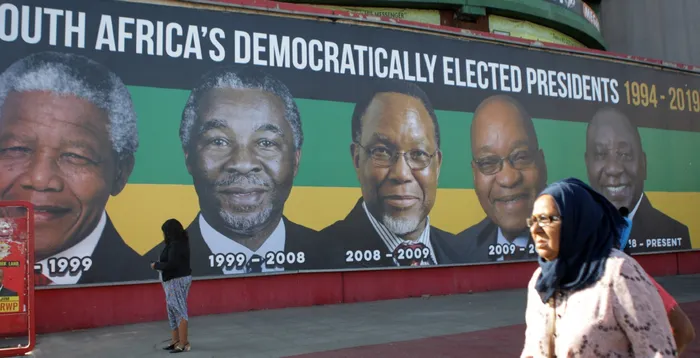
Smiling faces of South Africa’s democratically elected presidents since 1994 from Nelson Mandela, Thabo Mbeki, Kgalema Motlanthe, Jacob Zuma to the incumbent Cyril Ramaphosa, adorn a wall at the corner of Yusuf Dadoo and Dr AB Xuma streets in Durban. Of those who entered a second term, two were unable to complete it, a political curse that now appears to hover over the incumbent.
Image: Independent Newspapers Archives
In her 1946 novel All Men Are Mortal, the French existentialist philosopher and author Simone de Beauvoir depicts immortality not as a gift, but as a curse. Eternal life, she argues, leads to the erosion of meaning, love and virtue because actions no longer carry stakes or consequences.
Her protagonist, Raimon Fosca, a 13th-century Italian nobleman, drinks an elixir of immortality believing endless time will allow him to achieve greatness for his city. Instead of empowerment, he becomes trapped in an endless cycle of repetition.
Because Fosca has infinite time, no single moment or choice carries weight. He cannot fail because he can always try again, and that makes every victory hollow. He watches everyone he loves die, until he eventually stops caring about human relationships altogether. He describes his existence as a “nightmare” in which the world is dead and white, with only him and an immortal mouse left.
Without an end, there is no urgency to act, no reason to cherish the present, and ultimately, no authentic way to be human.
Politics, too, relies on the stakes of an ending.
When Nelson Mandela was elected as South Africa’s first legitimate president in 1994, he made it clear that he would not seek a second term. In doing so, he preserved the dignity of finality. His presidency had purpose, urgency and a clear horizon.
His successors, however, have increasingly found themselves caught in what might be called the Fosca trap, the belief that political power can be insulated from consequence.
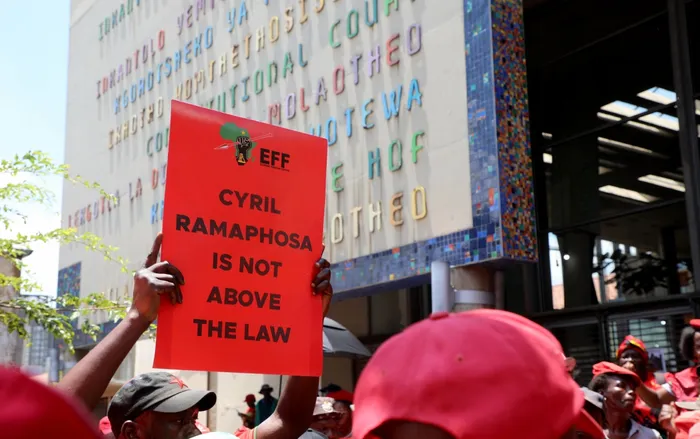
Scores of Economic Freedom Fighters (EFF) supporters gathered outside the Constitutional Court on Friday for the 30th anniversary of the adoption of the South African Constitution. They arrived to hear the apex court deliver the highly anticipated Phala Phala judgment, which ruled that the National Assembly’s December 2022 decision to block an impeachment vote was unconstitutional and invalid. The judgment may signal the beginning of the second-term political challenges that haunted both of President Cyril Ramaphosa's predecessors.
Image: TIMOTHY BERNARD / Independent Newspapers
Thabo Mbeki served nearly two terms before being forced to resign in 2008, in the ninth year of his presidency. His downfall began in earnest nine months earlier, when he suffered a bruising defeat at the ANC’s December elective conference in Mankweng, Polokwane, where Jacob Zuma was elected ANC president.
From that moment, South Africa witnessed the destabilising competition between power centred at ANC headquarters in Luthuli House and authority housed at Mahlamba Ndlopfu, the president’s official residence. Mbeki’s presidency became increasingly difficult to sustain, and in September 2008, Kgalema Motlanthe was required to step in as interim president for seven months until the May 2009 elections.
When the ANC won those elections, it paved the way for Zuma’s presidency. He, too, appeared politically immortal, surviving repeated motions of no confidence, court cases and impeachment efforts. Yet his second term ended the same way Mbeki’s did: unfinished. On Valentine’s Day in 2018, Zuma was forced out, making way for Cyril Ramaphosa.
Those exits cemented a political truth within the ANC; an incumbent president becomes fundamentally weakened at the tail end of a second term.
Even Mandela, during his single term, faced attempts to puncture the aura of invincibility surrounding the presidency. He was hauled before court in a civil matter by Louis Luyt, then head of South African Rugby Football Union, over a commission investigating allegations of racism in rugby administration. While the Constitutional Court later ruled that compelling a sitting president to testify in that manner was improper, the political spectacle to humiliate him had already served its purpose. It was, in effect, Luyt’s attempt to symbolically impeach a man widely seen as likeable and untouchable.
Twenty-six years later after Luyt's move, on the 30th anniversary of the adoption of South Africa’s Constitution, the Constitutional Court of South Africa has once again been asked to define the limits of presidential protection, this time in relation to Ramaphosa and the National Assembly’s December 2022 decision to shield him from impeachment scrutiny over his handling of the Phala Phala farm robbery.
It is not yet the end of the road for Ramaphosa. With the ANC holding 40% of parliamentary seats and the Government of National Unity (GNU) partners lacking consensus on how to proceed, impeachment is far from certain. Many parties have found the comforts of Cabinet too enticing to risk political instability. Others who once campaigned loudly against fiduciary neglect now find themselves explaining their own wasteful expenditure.
But the comparison to Beauvoir’s Fosca is becoming unavoidable.
The ANC and its GNU partners appear to be concocting their own elixir of immortality, using parliamentary mathematics and coalition convenience to ensure that no single failure carries a terminal consequence. By shielding a president from full accountability, they attempt to remove the stakes from power itself.
That is where danger lies.
In Beauvoir’s novel, Fosca’s immortality produces a dead and pale world because nothing he does truly matters. Likewise, when a political system uses its collective weight to evade accountability, it risks making the Constitution itself feel hollow. If failure bears no consequence, then political victory becomes as empty and lifeless as Fosca’s endless existence.
Ramaphosa is no longer the seemingly invincible figure who appeared capable of weathering every legal and political storm, from the South African Revenue Service probe that found both him and his business, Ntaba Nyoni Estate and Feedlot, to be tax-compliant; to the South African Reserve Bank finding that he had not contravened foreign exchange regulations; and to the Public Protector South Africa clearing him of breaching the Executive Members’ Ethics Act.
This is the beginning of his second-term reckoning, the same slow-burning curse that razed Mbeki and Zuma, both of whom ultimately found themselves before live television cameras, announcing resignations they never intended to make.
With local government elections less than six months away, some parties in the GNU may decide it is time to wipe the gravy from their chins, stop chewing the fat, sharpen their political instincts and stand on the side of accountability.
If, instead, like Fosca clutching his elixir, they continue drinking from the cup of collective protection, they may secure their survival, but lose their purpose.
Mdadane is editor of the Sunday Tribune
For more thought-provoking perspectives click on the link below: