

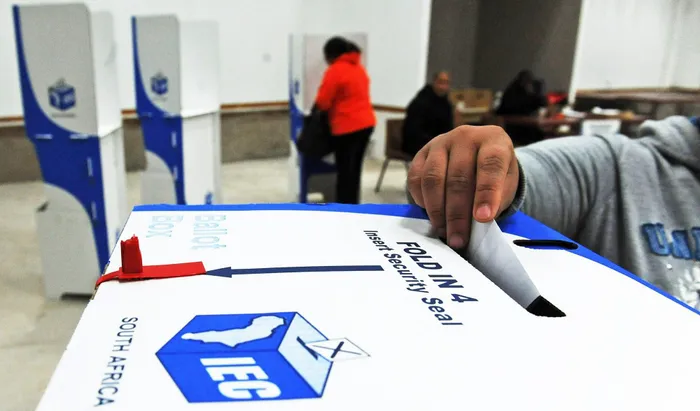
The Electoral Commission of South Africa's unprecedented two-week deployment to KwaZulu-Natal was not routine preparation. It was an emergency intervention in a province where democracy is fracturing, trust has collapsed, and the 2026 local government elections promise to be the most fiercely contested in a generation, writes former editor of the Sunday Tribune, Jovial Rantao.
Image: Independent Newspapers Archives
When the Electoral Commission of South Africa (IEC) dispatched its full complement of commissioners to KwaZulu-Natal for an intensive week of stakeholder consultations ending on 24 April, the gesture carried a weight far beyond administrative diligence. It was an admission - carefully worded but unmistakable - that South Africa's most politically combustible province stands at a crossroads that could define the character of the 2026 local government elections and, with it, the integrity of the country's democratic project.
KZN has never been an ordinary province. It is the birthplace of many ANC leaders, the historical heartland of the IFP, and — since the seismic political rupture of 2024 — the primary fortress of uMkhonto weSizwe Party (MKP), the party that carries Jacob Zuma's name and his defiant legacy. The elections due later this year will pit these forces against one another in a contest as much about identity and betrayal as about ward-level service delivery.
The IEC's intervention, framed in the measured language of institutional outreach, was in fact a calculated high-stakes mission. That mission can only be understood by reading the full and sobering weight of the data it was responding to.
A Province Where Democracy is Losing Argument
The 2026 Human Sciences Research Council Voter Participation Survey handed the IEC a document that should alarm every South African committed to constitutional governance. In KwaZulu-Natal, satisfaction with democracy has collapsed from 54% in 2004 to a devastating 6% in 2025. The national figure, itself troubling at 36%, looks robust by comparison.
This is not a statistical footnote. It represents the evaporation of democratic legitimacy across an entire province of more than 12 million people. When fewer than one in fifteen residents say democracy is working for them, the institutions of that democracy face an existential test. The IEC is one of those institutions, and it knows it.
Trust in the IEC itself stands at a precarious 20% in KZN — the lowest in the country and a full twelve percentage points below the already concerning national average of 32%. The IEC, whose founding mandate is to guarantee free and fair elections, cannot fulfill that mandate in a province where four in five residents have no confidence in it.
Economic despair runs parallel to political disillusionment. Eighty-eight percent of residents in KZN are dissatisfied with current economic conditions; the same proportion expect conditions to worsen over the next five years. Sixty percent say their communities have deteriorated over the past five years. In this landscape, voting can seem to many citizens not like a civic act of hope, but a ritual of futility.
Zuma's War and the ANC's Rearguard
Against this backdrop of democratic erosion, the 2026 local government elections in KZN carry political stakes that are national in their implications but visceral in their local expression.
The MKP, which decimated the ANC's provincial dominance in the 2024 general elections, has signalled its intent to press that advantage to its logical conclusion: the complete displacement of the ANC from a province it has governed since the advent of democracy. Zuma, whose political survival instincts remain sharp despite — or because of — his legal travails, understands that KZN is the engine of MKP's national relevance. A decisive local government victory here would consolidate MKP's position not merely as a protest vehicle but as a governing party with territorial roots.
For the ANC, the calculus is equally existential. KZN has historically been among the party's most productive vote provinces. To lose it at local government level — wards, councils, municipalities — would be to lose the organisational infrastructure that underpins provincial elections in 2029. The party will mount what insiders describe as a powerful rearguard action: drawing on national resources, deploying senior leadership, and counting on the memory of what the ANC has built in the province over three decades.
The IFP, now governing nationally in coalition with the ANC, occupies its own complex position in this triangle - a party with deep provincial roots navigating national alliance obligations while defending its own constituency against the MKP surge. The NFP, the EFF and smaller formations add further volatility to a provincial political map already rendered unpredictable by the events of 2024.
The meetings with the DA and MKP — the two parties whose consultations with the IEC remain to be concluded — are themselves instructive. Their rescheduling, noted carefully in the commission's statement, is a minor operational detail that carries no small political symbolism. The IEC's insistence on completing those engagements underscores its commitment to non-partisanship at a moment when being perceived as impartial is, in KZN, a remarkably difficult thing to achieve.
The Violence Imperative
No analysis of KZN's electoral environment is complete without confronting its history of political violence. The province has experienced some of the bloodiest episodes of political killing in post-apartheid South Africa, most devastatingly during the IFP-ANC conflicts of the 1980s and early 1990s that left thousands dead. The July 2021 unrest, which followed Zuma's imprisonment and reduced parts of the province to scenes of economic and social devastation, offered a grim reminder that the capacity for organised violence has not been extinguished.
In this context, the IEC's engagements with the security cluster — SAPS, prosecutorial authorities, and intelligence structures — take on particular urgency. The commission's statement notes assurances received about "security readiness" and, critically, "preparedness for investigation capacity to deal with election cases." These are not procedural courtesies. In KZN, elections and violence have historically been related phenomena, not separate ones.
The engagement with King Misuzulu kaZwelithini, whose court emerged from the IEC meeting with a strong royal pledge to encourage voter registration and "peaceful, respectful and responsible" participation, is perhaps the most strategically significant single outcome of the week's work. The Zulu monarch's voice carries moral authority across rural communities and traditional structures that no political party alone can reach. His endorsement of peaceful participation is not ceremonial; it is substantive.
Rebuilding Trust from a Low Base
The IEC's honest acknowledgment of institutional shortcomings from the 2024 elections, long queues, app failures, voter management device concerns, speaks to a maturity that is both necessary and, in the KZN context, strategically vital. In a province where the IEC's trust rating stands at 20%, the perception of accountability matters as much as its practice.
The operational picture from the commission's own readiness assessment is encouraging in its detail. Of the 9 948 electoral staff vacancies in KwaZulu-Natal, 9 268 —93%— have been filled. Training is underway. Voting district boundary realignment, triggered by ward change from the Municipal Demarcation Board (MDB), has been completed in 40 of 44 municipalities. The four outstanding municipalities — eThekwini, Inkosi Langalibalele, Alfred Duma and uMkhambathini — await final wards from the MDB before that work can conclude.
The targeted communication and registration rollout from Saturday to Monday is the first practical test of whether the commission's rebuilt credibility can translate into voter reconnection. KwaZulu-Natal's 76% stated voting intention - above the national average and one of the few genuinely positive data points in an otherwise sobering dataset - suggests the appetite for participation exists, even if the trust in institutions to enable it fairly does not yet match that appetite.
Why the Two Weeks Mattered
Electoral commissions in consolidated democracies conduct stakeholder engagement as a matter of routine. In KZN in April 2026, the IEC's week-long deployment was something qualitatively different: a deliberate, high-visibility act of institutional re-presence in a province where democratic institutions have been haemorrhaging legitimacy for two decades.
The consultation with the KwaZulu-Natal Church Leaders Group and the Christian Council acknowledges what political science sometimes forgets that — moral authority in communities under stress is exercised not only through the ballot but through the pulpit, the community hall, and the traditional kraal. Faith leaders who preach peaceful participation amplify the IEC's reach into constituencies where party political messengers are mistrusted.
The civil society engagements address the ecosystem surrounding elections: the monitors, the educators, the legal observers, and the community organisations that form the connective tissue between formal electoral institutions and lived democratic experience. Their constructive participation — noted positively in the commission's own assessment — matters especially in a province where that connective tissue has in places been severed.
The Broader Democratic Lesson
KwaZulu-Natal's electoral crisis — for it is a crisis, however diplomatically the IEC has chosen to describe it — carries lessons that extend beyond the province's borders. When satisfaction with democracy falls to 6%, when institutional trust collapses to one in five, when economic despair reaches 88%, the question is not merely whether citizens will vote. The question is whether elections retain the capacity to deliver accountability, representation and peaceful change.
South Africa's constitutional democracy was designed to answer that question in the affirmative. The Electoral Commission exists to uphold that answer. The two weeks it spent in KwaZulu-Natal were, in this sense, not a regional stakeholder exercise. They were an act of democratic preservation - imperfect, incomplete, but necessary.
Whether the investment pays dividends will be visible when the votes are counted. The commission has done what institutional credibility demands in a moment of institutional doubt. KwaZulu-Natal will now do what democracies always ultimately require: make its choice.
(Rantao is an editor, political analyst and media trainer. His views do not necessarily represent those of the Sunday Tribune or IOL)
For more from the Sunday Tribune, follow us on Facebook, Instagram and X

Jovial Rantao is an editor, political analyst and media trainer.
Image: File