

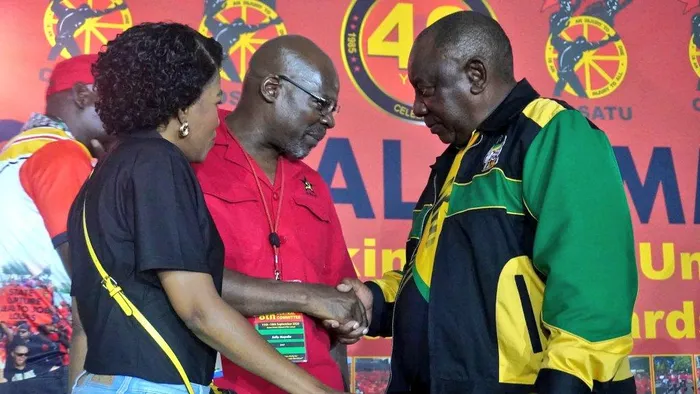
Secretary General of the SACP Solly Mapaila greets ANC President Cyril Ramaphosa during Cosatu’s 40th anniversary celebrations. The SACP’s decision to contest the upcoming local government elections independently for the first time in decades signals a major shift within the Tripartite Alliance, reflecting growing tensions over ideology, identity and political direction, argues the writer.
Image: Cosatu / X
Something significant is happening in South African politics — and we should not mistake it for a crisis. What we are witnessing, as we approach the local government elections in November, is the maturing of our democracy. For the first time since 1994, South Africans are being asked to choose not just between parties, but between genuine ideological positions.
For three decades, our politics was organised around a single historical fault line: those who fought apartheid and those who defended it. The ANC’s moral authority rested on its liberation credentials. The DA’s opposition was framed around governance and the market. The SACP remained tucked inside the alliance, its socialism expressed through influence rather than the ballot. South Africans never truly had to choose between left and right — because the choices were never clearly presented as such.
That era is ending.
The GNU as an Ideological Catalyst
The Government of National Unity (GNU), born from the ANC’s 2024 electoral losses, has done something unintended but profoundly democratic — it has forced every party to declare itself. The ANC, by governing alongside the DA, has revealed the limits of its own ideological flexibility. The DA, by entering government, has shown that its market-oriented worldview is no longer simply opposition politics — it is now policy. And the SACP, by choosing to contest elections independently, has planted a flag on the left that has not been visible on a South African ballot in the post-apartheid era.
This is not a collapse. This is clarification.
The KwaZulu-Natal Dimension: A Move of Calculated Ambiguity
Nowhere is this ideological repositioning more fascinating to watch than here in KwaZulu-Natal. The ANC’s decision to invite James Nxumalo — one of the longest-serving SACP members in the province and former Mayor of eThekwini — to lead the party’s charge towards the local government elections is a move that deserves careful reading.
On the surface, it is a shrewd organisational decision. Nxumalo is experienced, respected, and carries institutional memory of eThekwini’s governance that few can match. But the ideological subtext is harder to ignore.
Is the ANC using Nxumalo’s SACP pedigree to tactically neutralise the SACP’s independent electoral threat in KZN — essentially telling left-leaning voters that they need not go elsewhere, because the left is already leading the ANC’s campaign? Or is something more substantive at play — a signal that the ANC in KZN is consciously tilting towards a more leftist economic agenda, differentiating itself from the GNU’s ideological contradictions at a national level?
Both readings are plausible. And that ambiguity is itself politically revealing.
If it is tactical, it is a calculated attempt to strangle the SACP’s independent momentum before it takes root at ward level — where a split progressive vote could hand councils to opposition parties. If it is ideological, it suggests that the ANC in KZN recognises that its constituency is fundamentally a working-class, left-leaning one — and that governing alongside the DA nationally cannot be allowed to define the party’s identity locally.
Either way, Nxumalo’s deployment tells us that the ANC understands the ideological stakes of November better than its national messaging sometimes suggests.
What November Will Test
The approaching local government elections will be the first real test of whether South African voters are ready to vote on ideology rather than identity or loyalty. Can the SACP attract working-class voters in urban wards on a platform of economic transformation? Can the ANC hold the centre — and the left — while managing contradictory coalition pressures nationally? Can the DA consolidate governance gains without being seen as the architect of a rightward shift?
These are the questions mature democracies ask. Brazil asked them. India asks them every cycle. Even the United Kingdom, after decades of consensus politics, is in the middle of a similar ideological sorting. South Africa is not falling apart — we are catching up with the natural evolution of democratic politics.
The Freedom Charter Revisited
The SACP’s proposed Left Conference arrives at precisely the right moment. Revisiting the Freedom Charter — not as a relic but as a living programme — and honestly examining what the CODESA compromises delivered and what they deferred, is exactly the kind of political work a maturing democracy must do. The ANC’s admission that it never fully controlled the National Treasury is not merely an embarrassing confession. It is an invitation for South Africans to ask harder questions about who has been shaping our economic direction — and who should be.
The land question, unemployment, and the concentration of economic power remain unresolved. A democracy that cannot debate these things openly, across genuine ideological lines, is not yet fully democratic.
No More Borrowed Ideologies
South Africa now has an opportunity to develop a political identity that is authentically its own — drawing on the Freedom Charter, on African communalism, on the economic lessons of developmental states in the East, and on the lived experience of its working majority. The Left Conference, if it opens itself beyond party structures — inviting Amakhosi, civil society, and youth formations — could begin to build something genuinely new.
The rooi-gevaar is dead. The liberation framework is exhausted. What is emerging in its place is something healthier — a democracy where your vote reflects what you believe, not merely where you come from.
James Nxumalo’s return to the front lines in KZN, whatever its motivation, is a reminder that ideology has not disappeared from South African politics. It has simply been waiting for the right moment to resurface.
November may be that moment.
(Gumede has worked in the communications space at various levels. His views do not necessarily reflect those of the Sunday Tribune or IOL)
For more thought-provoking perspective visit our site at the Sunday Tribune and follow us on Facebook, Instagram and X