

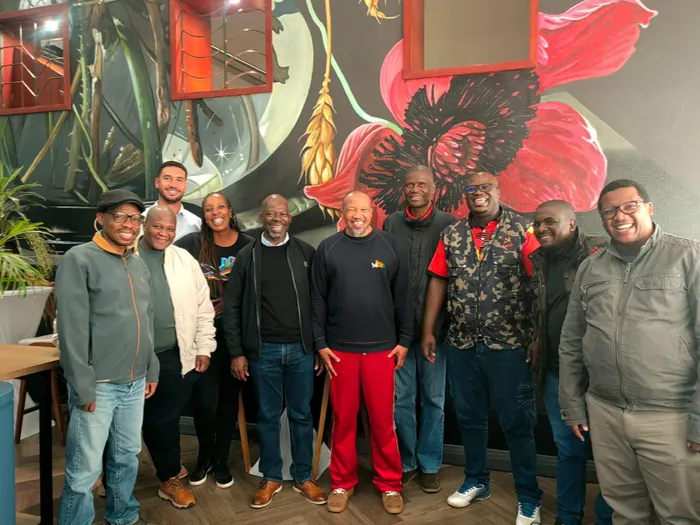
SACP and NUMSA leadership at a preparatory meeting for the Conference of the Left held in Johannesburg on April 21. A strengthened Left coordination will help articulate alternatives rooted in community needs rather than tender-driven politics, says the writer.
Image: AFP
Aviwe Rapelang Mohapi
South Africa continues to confront profound structural challenges: stubborn unemployment hovering near crisis levels, widening inequality, and an economy still largely shaped by the interests of monopoly capital.
In this context, the Conference of the Left, set for 29 to 31 May 2026 at the Birchwood Hotel in Boksburg, offers a space for left-leaning organisations, unions, community groups, and progressive formations to explore greater coordination.
Under the theme “Building a Left Movement for Working Class and Popular Power,” the gathering is not about enforcing rigid ideological agreement, but about fostering practical unity in action against shared systemic problems.
The 1994 democratic breakthrough ended formal apartheid and brought important gains in political rights and social services for millions. Yet it left the commanding heights of the economy largely untouched. Patterns of ownership, investment priorities dominated by finance capital, and an outward-oriented growth model have persisted, reproducing racialised poverty and exclusion.
Any serious Left initiative today must grapple with this unfinished business: how to build popular power capable of driving deeper economic transformation in the interests of workers, the unemployed, and rural communities.
Sceptics have questioned the value of such broad platforms, pointing to real tensions within the South African Left. Concerns about ideological consistency, the track record of alliance politics, and the risks of including forces with differing histories or emphases are understandable. Building effective unity is never straightforward in a society scarred by decades of division.
However, the alternative - fragmented struggles that fail to challenge concentrated economic power - has repeatedly proven insufficient. The question is not whether differences exist, but whether there is enough common ground on core issues like resisting austerity, defending public services, and confronting wage suppression to justify coordinated effort.
In this process, the South African Communist Party (SACP) plays a vital leading role as the vanguard of the working class. Grounded in Marxist theory and with a long history of organisation in workplaces, communities and the liberation movement, the SACP brings strategic depth, theoretical clarity and organisational discipline to this initiative.
Working together with other left-leaning organisations, unions and popular structures, the Party helps convene the Conference of the Left. This collective leadership is essential: it anchors the process in rigorous class analysis while broadening participation, providing the continuity and grounding needed to build a genuine Left Popular Front that advances working-class interests rather than narrow electoral or elite agendas.
Critics sometimes allege that the SACP is complicit in the country’s current difficulties because some of its members serve in government. This view misunderstands the nature of the alliance and the Party’s Marxist approach to tactical engagement. SACP members who occupy positions in government do so as members of the ANC, implementing ANC policy and direction - not an independent SACP mandate.
Communists have always approached such participation tactically, as a means of defending democratic gains and advancing popular interests within the constraints of the current balance of forces, while maintaining the Party’s independent analysis and long-term commitment to socialism.
Disagreement with neoliberal elements or austerity measures within government policy does not vanish; it is expressed through internal contestation, public critique and, above all, the strengthening of independent working-class organisations outside the state.
Far from shielding capitalism, this approach seeks to use every available terrain to shift the balance toward the working class, while recognising that ultimate transformation requires mass extra-parliamentary struggle led by organised workers themselves.
The crisis South Africa faces is not cyclical but rooted in the logic of capitalism under local conditions. Decades of market-oriented policies have failed to deliver inclusive growth. Load-shedding scars, infrastructure backlogs, youth joblessness, and the casualisation of labour reflect deeper failures of a system that prioritises profitability over human needs.
In such circumstances, Left forces have a responsibility to move beyond isolated campaigns toward sustained, organised pressure that can shift the balance of class forces. This does not require erasing political distinctions overnight. It demands an honest assessment of the national situation and practical steps forward.
A Left Popular Front approach, if developed carefully, can help bridge different sectors of the working class and progressive movements. Trade unions facing workplace exploitation, community organisations battling service delivery collapse, youth structures confronting hopeless futures, and political formations committed to anti-capitalist perspectives all encounter the same entrenched interests.
Coordination allows for shared political education, joint campaigns, and amplification of demands that individual groups cannot advance effectively alone. This includes pushing for land reform that empowers small farmers and rural workers, strategic public control over key sectors, expanded social wages, and industrial policy oriented toward employment rather than extraction.
Critics rightly stress the importance of independent working-class organisations. History demonstrates the dangers of subordinating popular movements to narrow electoral calculations or elite accommodations. Genuine socialist politics must maintain critical distance from capital and avoid becoming mere managers of a failing system.
At the same time, tactical engagement in governance structures has sometimes yielded defensive gains for ordinary people. The challenge lies in ensuring that such participation advances rather than dilutes the long-term struggle for systemic transformation. A conference of this nature provides space to reflect on these tensions openly, learning from both successes and setbacks since 1994.
The breadth of participation envisaged - spanning unions, civic structures, student bodies, and various political currents - mirrors the complex reality of South Africa’s progressive terrain. Not every participant will share identical long-term programmes, nor should they be expected to. What matters is convergence around opposition to policies that entrench monopoly power, erode living standards, and weaken democratic accountability.
This pragmatic unity in action has precedents in global left traditions, where diverse forces have collaborated on immediate battles while debating strategic differences. The risk of dilution exists, but so does the greater danger of sectarian isolation that leaves workers facing austerity alone.
From a Marxist perspective, I believe ideological clarity remains essential. Discussions at the conference should foreground class analysis: the centrality of the working class as the agent of transformative change, the need to combat both economic exploitation and divisive ethnic or xenophobic mobilisations, and the importance of internationalist solidarity.
Political education must counter neoliberal narratives that present market “realism” as the only option. Concrete outcomes could include commitments to defend initiatives like the National Health Insurance, support militant yet democratic trade unionism, and campaign against budget cuts that harm the poor.
Timing ahead of local government elections adds relevance. Municipalities have become symbols of both potential people-centred development and, too often, failure through corruption or incompetence. A strengthened left coordination will help articulate alternatives rooted in community needs rather than tender-driven politics.
Yet the conference’s value extends beyond electoral cycles. Sustainable change requires rebuilding grassroots organisations and extra-parliamentary pressure that holds all centres of power accountable.
No single gathering can magically resolve the left’s challenges. Sustaining momentum will demand follow-up mechanisms, disciplined implementation of agreed actions, and continual vigilance against co-option or opportunism.
The process must prioritise the voices and interests of ordinary workers over personality-driven projects. Success will be measured not by media headlines but by tangible advances in popular mobilisation and policy influence.
South Africa’s Left stands at an important juncture. The limits of the post-1994 settlement are evident in the daily hardships faced by the majority. While scepticism toward broad initiatives is healthy, outright dismissal overlooks the objective need for greater working-class coherence.
The Conference of the Left represents one serious attempt to address that need - imperfect, contested, but necessary. Progressives committed to dismantling the foundations of inequality should engage constructively, contributing ideas and energy to ensure it strengthens rather than weakens the struggle for a more just order.
In the end, the working class requires not rhetorical unity but organised power capable of confronting capital’s dominance. Platforms that foster coordination, education, and joint struggle, while preserving space for principled debate, are part of how that power can be rebuilt. The Conference of the Left may prove to be a modest but meaningful step in that direction.
* Aviwe Rapelang Mohapi is the National Education Officer at NEHAWU. He is also a political activist and writes in his personal capacity.
** The views expressed do not necessarily reflect the views of IOL or Independent Media.