

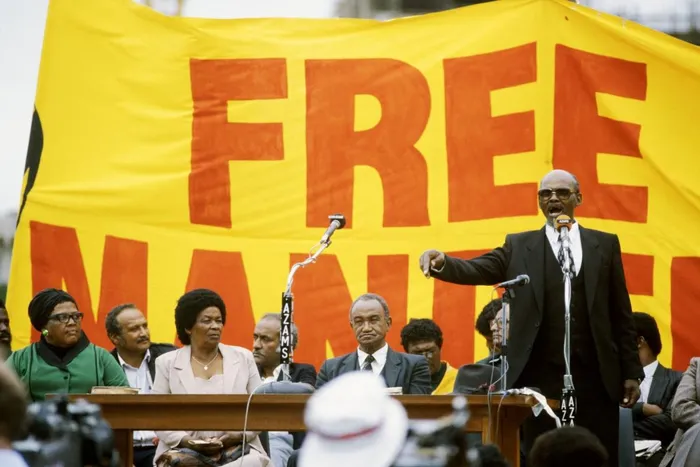
Leaders of the United Democratic Front (UDF) (from left) Florence Mkhize, Albertina Sisulu, Archie Gumede and Henry Fazzie at a Free All Political Prisoners rally held in Durban on December 15, 1985. Many of the people who built the ANC during decades of repression earned reputations for honesty, humility and commitment to ordinary citizens. Many of those people now occupy the margins of the organisation, says the writer.
Image: AFP
Dr. Reneva Fourie
The African National Congress recently closed the public nomination process for mayoral candidates across municipalities. The initiative broadened the pool beyond existing membership and enabled recruitment of candidates from broader society.
The process was intended to strengthen participation, improve governance and attract professional expertise into local government. The decision, however, revealed a deeper organisational crisis within the ANC.
The opening of public nominations for senior leadership positions suggested that the party leadership no longer believes its own structures could produce sufficient numbers of suitable candidates.
The ANC entered democratic government in 1994 with immense moral authority. It carried the hopes of millions who had endured apartheid and who believed that public office would be guided by sacrifice, discipline and service.
Many of the people who built the organisation during decades of repression earned reputations for honesty, humility and commitment to ordinary citizens. Large numbers worked quietly within the structures of the liberation movement without seeking personal recognition. Those individuals helped create the ethical foundation that gave the ANC legitimacy across South Africa and beyond.
Many of those people now occupy the margins of the organisation. Some withdrew after becoming disillusioned with factional conflict and patronage politics. Others remained inside the movement but lost influence because they lacked the networks and resources that shape internal competition.
The rise of expensive leadership campaigns, slate politics and personality-driven mobilisation created conditions that favour visibility above integrity. In this environment, principled figures struggle against individuals skilled in political marketing and self-promotion.
The ANC attempted to reassure members by emphasising the need for a proven track record and an understanding of the document, ‘Through the Eye of a Needle’, which outlines qualities associated with ethical leadership and disciplined conduct. The public advertising of leadership positions, however, carries serious political consequences for a movement shaped through political struggle and shared values.
The ANC emerged from a tradition grounded in collective service and social transformation. During the liberation era, political development involved long periods of education, community engagement and organisational discipline.
Leaders emerged through years of service under difficult conditions and demonstrated commitment above personal gain. That culture established standards of accountability and loyalty to public ideals.
The decision to recruit candidates through public nomination processes reflects the broader decline of internal political confidence within the ANC. The party lost its national majority for the first time in the 2024 general election.
Public frustration over corruption, unemployment, failing infrastructure and weak service delivery damaged its standing in many communities. Instead of responding to this decline by drawing on its reservoir of experienced and ethical members, the organisation looked outside its ranks for renewal. The process sent a message that years of service inside branches and community structures no longer guarantee organisational trust or recognition.
When candidate selection is opened to individuals with limited or no roots within the movement, it exacerbates the movement's vulnerability. Some entrants may understand the movement’s language and symbols but lack a deeper connection to its traditions and political culture.
Others may possess professional credentials without any grounding in the social struggles that sustained the ANC during difficult periods. The weakening of the organisation’s ideological quality suits those who wish to loosen the historical relationship between the ANC, the South African Communist Party, and the Congress of South African Trade Unions.
The ANC has also moved steadily towards political and economic positions once associated more closely with the Democratic Alliance and other centrist formations aligned with business interests. Its economic direction increasingly emphasises fiscal restraint, market confidence and investor priorities.
These positions receive greater prominence than redistributive transformation and state-led development. The Government of National Unity deepened perceptions that the ANC leadership has become more comfortable with coalitions involving parties to its right than with rebuilding a strong working-class orientation rooted in labour and community struggles.
Regardless of its public utterances to the contrary, the organisation reinforced this perception by refusing to participate in the Conference of the Left, a gathering intended to encourage dialogue among progressive organisations, labour activists and left-leaning political forces.
The ANC's absence from such a platform strengthens concerns that the leadership sees greater strategic value in stabilising relations with business-oriented interests than in rebuilding ties with grassroots formations rooted in working-class politics.
The movement’s closer alignment with elite economic interests changes the type of people attracted to it. A liberation organisation ingratiated into the political and commercial establishment becomes attractive to ambitious professionals, tender networks and business figures seeking influence, gradually replacing a service ethic with a culture centred on career advancement and material accumulation.
This pattern appears in many liberation movements across Africa. Parties that once depended upon sacrifice and ideological commitment became vulnerable to careerism after entering government. State power and economic opportunity became closely connected to political office. Organisational advancement increasingly depended upon factional alignment and resource mobilisation. The ANC now confronts this historical challenge inside South Africa.
Many individuals within the organisation still represent a different tradition. These members built reputations through consistency, discipline and service over many decades. They remained active during periods marked by corruption scandals and declining public trust.
Their credibility developed through direct engagement with communities and through practical involvement in local struggles involving housing, schools, transport and public safety. The tragedy for the ANC is that these quieter figures may offer precisely the credibility needed to restore public confidence.
South Africans have repeatedly expressed frustration with corruption and political arrogance. Many voters seek evidence of honesty, competence and humility rather than theatrical displays of loyalty to liberation history.
Rebuilding trust requires leaders whose records demonstrate ethical conduct and commitment to substantial transformation over many years. Such credibility cannot easily be manufactured through advertising campaigns or recruitment exercises.
A political movement that neglects its most principled members risks losing the moral continuity that once sustained it. Historical identity alone cannot protect an organisation from decline. Values survive through people who embody them in practice.
When those individuals are ignored, marginalised or pushed aside by opportunists, the movement gradually becomes hollow. The language of liberation may remain visible, though its substance weakens.
* Dr Reneva Fourie is a policy analyst specialising in governance, development and security.
** The views expressed do not necessarily reflect the views of IOL or Independent Media.