

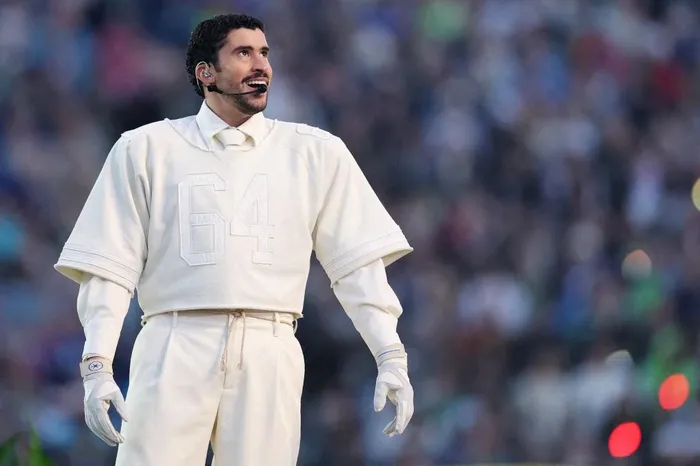
Bad Bunny broke records during his performance at the Super Bowl LX Halftime Show.
Image: AFP
During my time covering the Africa Cup of Nations in 2008 and 2015, the draw always seemed to send Bafana Bafana to the most rural of towns and cities.
In those days, reaching your destination felt like an odyssey. A standard 200km bus trip could take up to seven hours, with Basic Instinct 1 and 2 apparently the only movies available on the flickering screen at the front. You generally had to make do with terrible accommodation that cost an arm and a leg, stoically enduring cold showers for two weeks straight before Bafana were inevitably knocked out and we could finally head home.
AFCON is a much more refined tournament these days. Travel is easier, accommodation is comfortable, and you no longer need to hitch a ride on the back of a scooter to find an internet cafe to file your match report. Yet, those rugged days remain some of my fondest memories of touring our great continent.
It is the people who make a sporting event a "vibe" and provide the memories that last a lifetime. A language barrier exists in almost every country you visit, but the language of sport is universally understood.
Watching Bad Bunny’s Super Bowl half-time show on repeat this past week reminded me of this — and specifically of a little Cuban joint a group of South African journalists discovered in Mongomo, Equatorial Guinea, during the 2015 AFCON.
We were staying at a hotel with a bakery next door that made the best bread rolls, but man cannot live on rolls and eggs alone.
We were eager to explore and experience the Mongomo nightlife. Equatorial Guinea is the only Spanish-speaking country in Africa, and my Spanish was largely limited to the ability to order up to four beers, thanks to Pitbull’s “I Know You Want Me (Calle Ocho)”. If you know, you know ...
That is exactly what we ordered before the owner of Restaurante El Balcon asked if we would like traditional mojitos and cigars. “Si, si,” we replied, excitement etched across our faces.
The mojitos were fantastic, but they packed a serious punch. After the third round, I noticed a graveyard across the street and thought that after a few more, I might as well book a spot there.
As the night progressed, the mojitos kept coming and the music started. We ended up dancing with the locals to Marc Anthony’s “Vivir Mi Vida”, which played about five times in a row at the request of the tipsy South African scribes.
I didn’t have a clue what was being sung; I just knew it was the best night of the tour. For a moment, we forgot about our dismal hotel, the limited menu, and an even worse Bafana.
When I returned to South Africa, I downloaded the song and looked up the lyrics. It was little wonder we had such a good time; it literally translates to: “I'm gonna laugh, I'm gonna dance. I'm gonna live my life…”
Fast forward to the Super Bowl, and Bad Bunny’s performance sent that same joy through my heart.
Sport and music are the only two truly global currencies. They are the only spaces where a person from a quiet street in Equatorial Guinea and a fan in a VIP box in the United States can feel the exact same emotion at the exact same time.
My experience in that Cuban restaurant taught me that having a "fun time" isn't about the words you speak; it’s about the frequency you are tuned into.
Bad Bunny didn't need to speak English to own the Super Bowl spotlight, just as we didn't need to speak Spanish to enjoy ourselves in Mongomo.
In a world that often feels divided by what we say, it’s worth remembering the things that make us sing and cheer in unison. Sometimes, the best way to understand each other is to stop talking and start listening to the beat.
* John Goliath is Independent Media regional sports editor and a contributor on The Last Word on Rugby on our YouTube channel The Clutch