

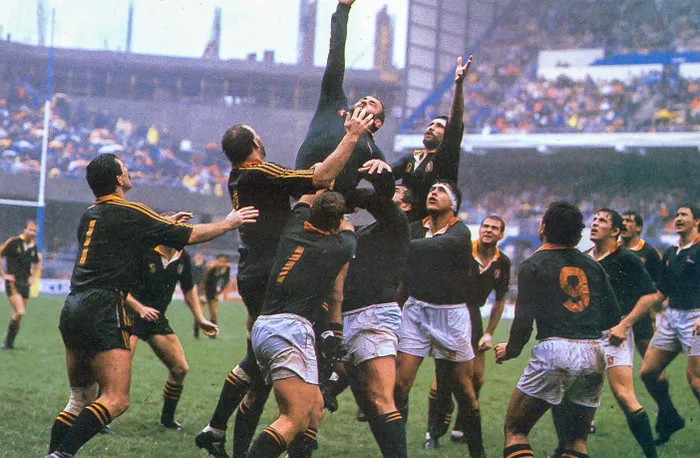
Cavaliers v SA Newlands Moolman": Springbok lock Louis Moolman leaps for the ball in a lineout during the first Test against the Cavaliers at Newlands.
Image: FILE
In April 1986, just six months after PW Botha had wagged his finger at the world and committed South Africa to another era on the wrong side of the Rubicon, 30 rugby players slipped clandestinely out of New Zealand and popped up in Johannesburg — to the great surprise and delight of Springbok fans.
South African rugby had just joined its cricket counterparts in staging a rebel tour.
The eagerly awaited sequel to the tumultuous 1981 tour of New Zealand had been scheduled by the International Rugby Board for 1985, but the New Zealand government canned the tour.
Annoyed Bok fans were still brooding over the lost chance to get even with the All Blacks when Louis Luyt, the Transvaal Rugby Union, and Yellow Pages (the business telephone directory company) collaborated to recruit the '85 All Black tour squad minus just two players in scrumhalf David Kirk and wing John Kirwan.
Accurately billed as the Battle of the Giants, it would be a four-Test, 12-match tour under the stewardship of two All Black legends in Colin Meads and Ian Kirkpatrick. The presence of those hard-nosed veterans of expeditions to South Africa gave the tour a some legitimacy.
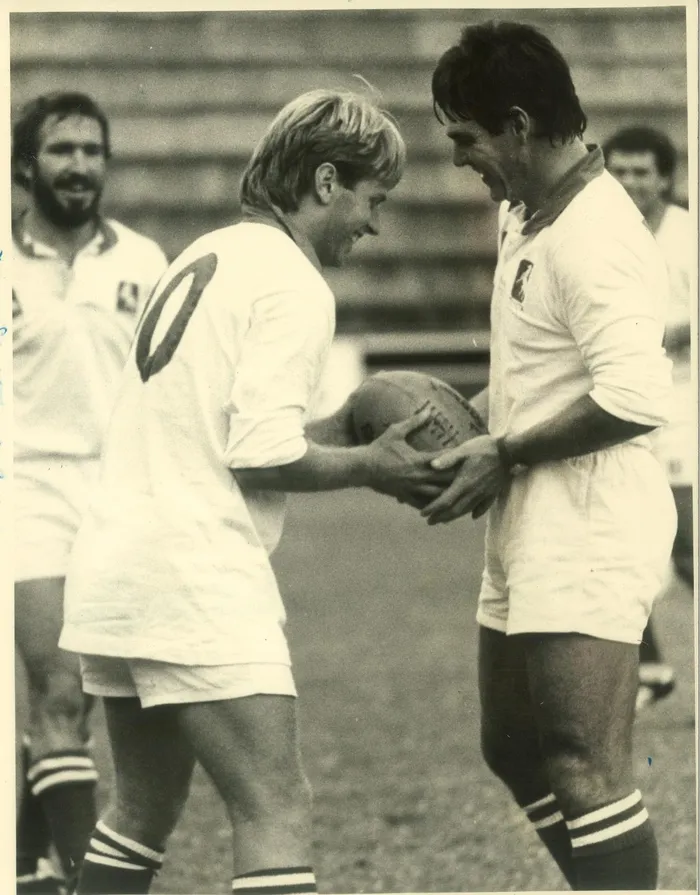
Naas and Danie: Naas Botha and Danie Gerber were star players in the Springboks' series win over the rebel Cavaliers.
Image: FILE
The secret recruitment of the All Blacks was breathtaking in its daring and masterful in its execution. Only the blockbusting Luyt, the JR Ewing of rugby, could have done it.
On the flight over, the Kiwis decided that they would be called the Cavaliers. Back in New Zealand, they became known as the rebel All Blacks. None of the matches were televised in New Zealand, and for commentary, they needed to tune in to South African radio.
Cocooned in their luxury hotels, the Cavaliers were oblivious to the state of emergency in South Africa. With coach Meads cracking the whip, the focus was on beating the Boks. They also happened to be extremely well paid. Each player was paid US$50,000, a fortune in 1986, especially for a rugby player, because this was still the amateur era.
By contrast, the Springboks were unpaid.
The Cavaliers were highly motivated to become the first New Zealand team to win a series in South Africa. Every player had Test experience, and for the first Test, at Newlands, their starting line-up boasted 219 caps while the Boks could muster just 75.
This was not surprising. Since the '81 tour, the Boks had played just six Tests in five years as isolation squeezed — in 1982 they played South America twice, and in 1984 they played two Tests against England and another two against South America.
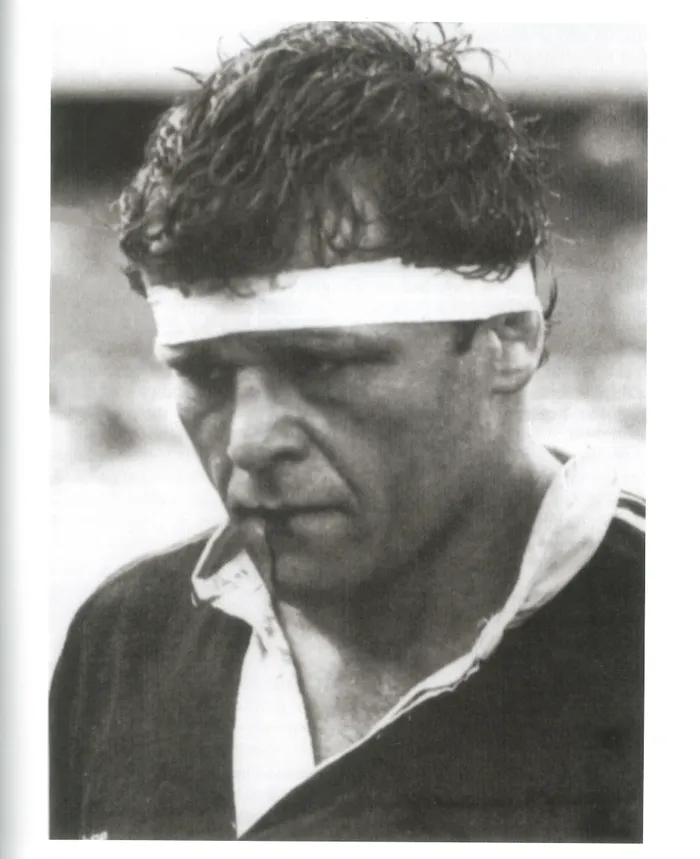
Andy Dalton broken jaw: Andy Dalton captained the Cavaliers but was sidelined after Northern Transvaal flank Burger Geldenhuys broke his jaw with a punch.
Image: FILE
Two heroes of '81, Ray Mordt and Rob Louw, had joined rugby league giants Wigan in 1985, and others had retired.
Still, there were only six new caps in the Bok team for the first Test. Mordt was replaced by Jaco Reinach, the holder of the national record for the 400m. Christo Ferreira stepped in for the retired Divan Serfontein. There were new caps for a precocious hooker called Uli Schmidt, a rangy No 8 in Jannie Breedt, a war horse flank in Wahl Bartmann, and completing a fine loose trio was a mighty 22-year-old named Gert Smal.
Bartmann got his chance because the form flank, Burger Geldenhuys, had infamously ruled himself out of contention because of his punch from behind that broke the jaw of tour captain Andy Dalton in the match against Northern Transvaal.
SA rugby boss Danie Craven was outraged and insisted that Geldenhuys would never again play for the Springboks. He never did. Craven said: “There is no room in my vocabulary for an incident like that — no room — and no mercy.”
Coach Cecil Moss, a member of the Springbok team that trounced the All Blacks 4-0 in 1949, used just 24 players during the series. There was no need for changes because the Boks played excellent rugby.
The first Test belonged to Naas Botha, the Bok captain. Rainy Newlands was a mud bath, and Botha kicked 17 immaculate points.
But the Midas touch deserted him in Durban in the second Test when he fluffed six penalties and four drop-goal attempts to allow the Cavaliers in for a deserved 19-18 victory.
On the Highveld, the Cavaliers were well beaten 33-18 at Loftus Versfeld and 24-10 at Ellis Park.
There were unforgettable moments from the Boks in those Tests: great tries by Danie Gerber, Schmidt, and Reinach (the father of Springbok Cobus). Those watching on TV will never forget the moment when Reinach got the ball in space: “Hier is spoed,” said the commentator Gerhard Viviers before gaining excited momentum: "Hier is spoed!! Hier is spoed!!!!” The sprinter flew across 50m to score a sensational try.
And nobody who saw it will forget Cavaliers prop Gary Knight's descent into oblivion thanks to Smal's right hook after provocation. A flour bomb did it to Knight at Eden Park in 1981, a Smal haymaker repeated the dose five years later.
The intent to win from the Cavaliers was evident in how they took the fight to the South African teams. Their match against Natal was especially violent. The great Springbok Keith Oxlee said he had never seen more fighting. The videotape of the game showed 64 punches.
There was controversy when the Cavaliers hooker Hika Reid made the feelings of his team clear to referee Ken Rowlands at the final whistle of the fourth and final Test when he gave the little Welshman a shoulder nudge as they left the field.
At the post-match function, a disgruntled Dalton accused Rowlands of bias in his handling of the four Tests.
Botha was cutting when it was his turn to address the audience, “Now you know how we felt in 1981,” he said to Dalton, alluding to how another Welshman, Clive Norling, had engineered victory for the All Blacks in the deciding Test at Eden Park.
The Cavaliers went home to a slap on the wrist — an effective two-Test suspension. Most were in the All Blacks team that won the inaugural World Cup a year later.