

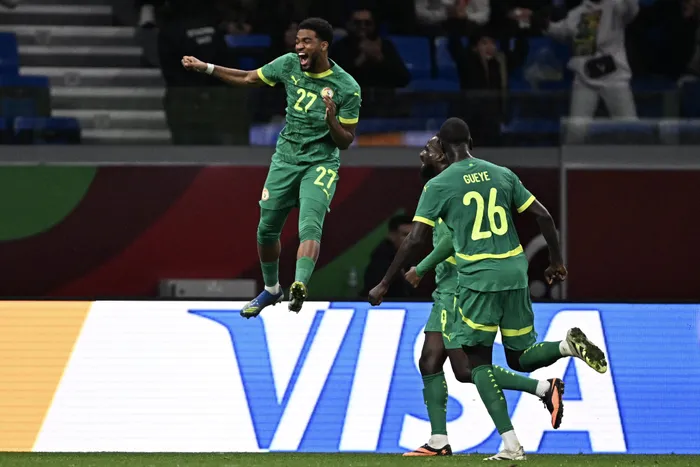
Senegal forward Ibrahim Mbaye celebrates scoring his team's third goal during the Africa Cup of Nations Round of 16 match against Sudan at Grand Stadium in Tangiers on Saturday.
Image: AFP
In the aftermath of their shock victory against Tunisia in Morocco on Saturday night, Mali reportedly splashed out 3 million francs on their ‘magic man’ to ensure that fortune swings in their favour in the ongoing 2025 Africa Cup of Nations (AFCON).
Mali seemed doomed when Woyo Coulibaly was shown a red card in the 26th minute, leaving Mali to play with 10 men for most of the match against the higher-ranked Tunisia.
After Tunisia took the lead in the 88th minute, Mali’s mystical effort came to the fore seven minutes into stoppage time with a sensational penalty to force the match into extra time.
Mali’s conquest was one of the intriguing talking points at AFCON.
In an extraordinary achievement, Mali has reached the quarter-finals of AFCON 2025 without a single win after four matches in Morocco.
Mali finished their three-group stage matches with as many stalemates, including one against Morocco, the world’s No. 11-ranked team.
In Saturday’s last 16 match against Tunisia, the 10-man Mali held out for yet another draw (1-1).
In the penalty shoot-out, Mali goalkeeper Djigui Diarra was the hero of the day with two saves in the penalty shoot-out, ensuring a 3-2 win for his country.
In a groundbreaking first for AFCON, the Round of 16 matches will be played across eight different stadiums, an unprecedented move in the rich history of the competition.
The excitement surrounding AFCON is palpable, as Morocco prepares to host this prestigious tournament. This significant decision reflects the organising committee’s commitment to enhancing the tournament experience and broadening its geographical reach within the country.
The transformational shift to utilising eight stadiums demonstrates Morocco’s ambition to elevate the tournament and provide an unforgettable experience for fans and players alike.
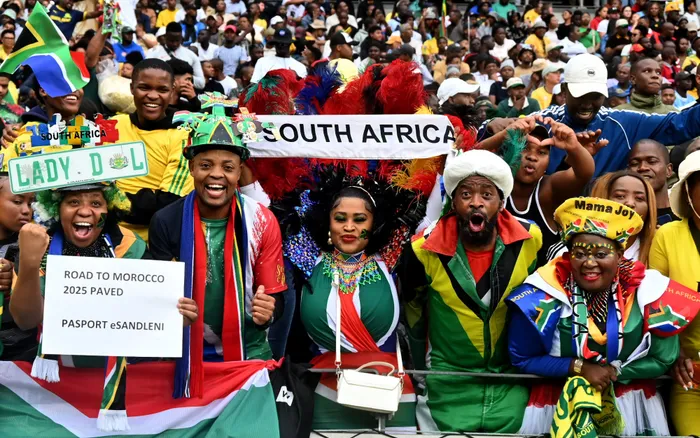
Bafana recently achieved the rarest of feats by their standards; finishing the Afcon qualifiers on top of their group and unbeaten.
Image: Ayanda Ndamane/Independent Newspapers
Moroccans’ display of passion and dedication underlines their status as a true football nation.
Each of Morocco’s group matches drew astonishing crowds, with more than 60,000 supporters, showcasing a love for the game.
Morocco’s exceptional organisational prowess and world-class stadium facilities resonated deeply with its citizens. Fans poured into the stands, creating a tapestry of colour and sound that echoes far beyond the stadium’s confines.
In stark contrast, only two other matches during the tournament attracted crowds hovering just above 40,000 [Senegal vs DR Congo – 41,672 and Egypt vs South Africa – 40,219].
This staggering difference underscores Morocco’s unique position in African football and its ability to galvanise public support.
Sudan has etched its name in AFCON history by becoming the first team to qualify for the AFCON knockout stage without scoring a single goal.
They progressed to the Round of 16 as one of the four best third-placed teams, finishing with three points.
The points came from an unexpected 1-0 victory over Equatorial Guinea, after a controversial own goal.
This victory marked only Sudan’s second-ever AFCON win.
Ibrahima Mbaye became AFCON’s youngest goalscorer ever on Saturday evening.
The 17-year-old French-born Senegalese prodigy scored in his team’s decisive 3-1 victory over Sudan after coming on as a substitute.
He surpassed a record that had stood unchallenged for two decades. Nigerian football icon's John Obi Mikel and Victor Obinna Nsofor previously held the record at ages 18 years, 9 months & 5 days and 18 years, 10 months & 10 days, respectively.