

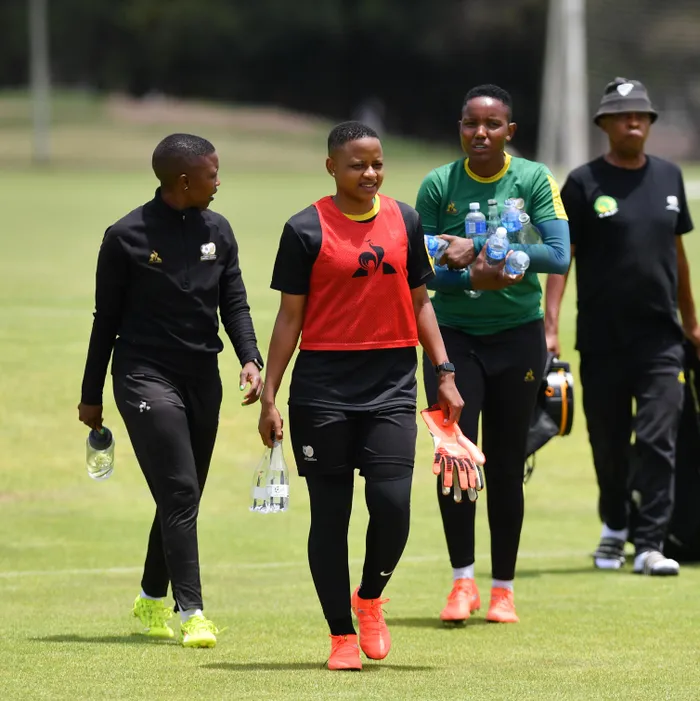
Bambanani Mbane, Refilwe Jane and Andile Dlamini during the COSAFA Womens Championship 2025 Banyana Banyana training at The Ranch Resort, in Polokwane.
Image: BackpagePix
The postponement of the Women’s Africa Cup of Nations was initially met with frustration across the continent but for South Africa women’s national football team, it could quietly prove to be a blessing in disguise.
When CAF confirmed that the tournament in Morocco would be moved from its original schedule to later in the year, it disrupted carefully laid plans for several national teams.
South Africa were among those already preparing in earnest, with coach Desiree Ellis and her technical team mapping out the road toward another shot at continental glory.
Unlike four years ago, Banyana will not head into the tournament as defending champions.
That crown now belongs to the Nigeria women’s national football team, who staged a dramatic comeback to beat the Morocco women’s national football team in the most recent final to secure a record-extending tenth continental title.
For South Africa, that reality adds another layer of motivation.
Yet the delay may also offer something that is often scarce in international football — time.
For Ellis, the additional months could be invaluable in refining a squad that is currently undergoing a period of transition.
Several players who formed the backbone of the team that lifted the 2022 Women’s Africa Cup of Nations are still around, but the national setup has gradually begun integrating younger players as part of a long-term squad redevelopment process.
That balancing act between experience and youth inevitably requires patience.
The recent participation in the COSAFA Women’s Championship also reflected that approach.
Ellis used the regional tournament to expose several emerging players to international football, giving them valuable minutes in a competitive environment while continuing to assess depth across the squad.
For a team rebuilding while still expected to compete for trophies, those opportunities are vital.
The extended preparation window now allows the coaching staff to further evaluate those emerging players and determine who can make the step up to the continental stage.
International tournaments are rarely won by a starting XI alone — squad depth often proves decisive.
It also gives Banyana an opportunity to address some of the inconsistencies that crept into their performances during the last continental cycle.
Tournament football is often decided by the smallest margins, and those extra weeks of preparation can make a crucial difference.
Equally important is the physical condition of the squad. Several of South Africa’s key players ply their trade overseas and endure demanding club schedules across Europe and the United States.
The revised calendar allows the technical team to better manage workloads and ensure players arrive at the tournament fresh rather than fatigued.
From a tactical perspective, the delay could also help Ellis fine-tune the team’s approach.
African women’s football has grown increasingly competitive, with nations like Nigeria and Morocco raising the standard in recent years.
For Banyana, reclaiming the continental crown will not be straightforward.
But if used wisely, the postponement could provide South Africa with a rare advantage — time to regroup, blood new talent and return to the continental stage stronger.