

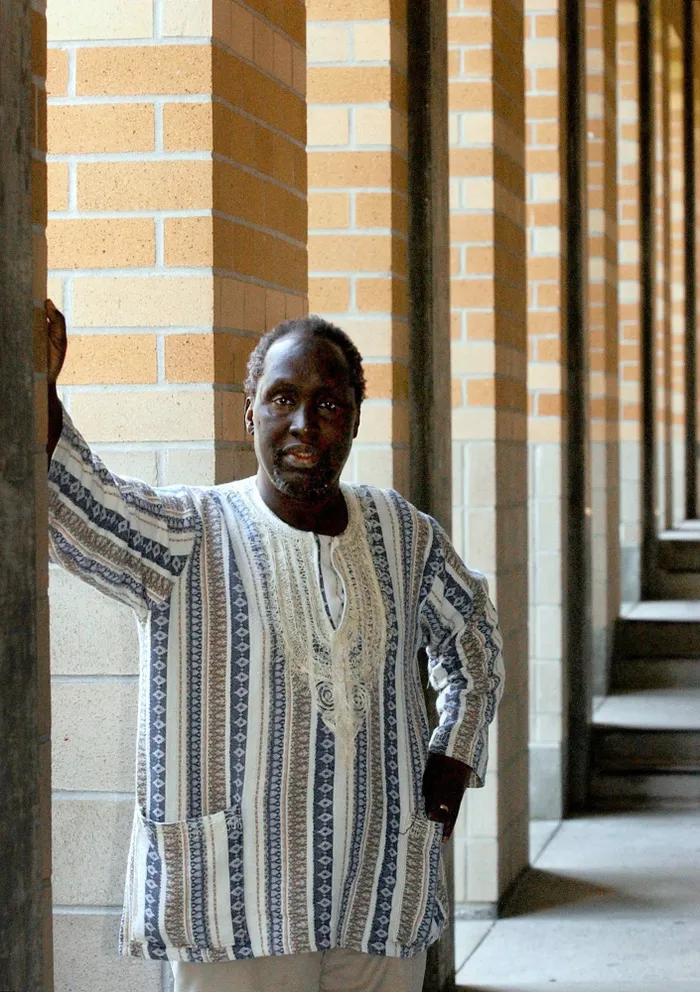
Ngugi wa Thiong’o is considered one of the giants of African literature.
Image: Supplied
WITH the passing of Ngugi wa Thiong’o, the literary world has lost not merely a great writer, but one of its most profound moral and intellectual beacons.
A towering figure in African letters, he combined erudition with humanity, sharp wit with unwavering conviction, and artistic brilliance with radical compassion.
Ngugi was more than an author — he was a scholar, a teacher, a public intellectual, and a tireless advocate for linguistic and cultural sovereignty. His novels, plays, and essays did not merely reflect African society; they interrogated it, challenged its injustices, and refused to look away from oppression.
For speaking truth through fiction, he was imprisoned — not for who he was, but for what he wrote. And yet, his voice only grew louder.
Globally revered, Ngugi redefined African literature by centring indigenous languages as vessels of dignity and resistance. His pioneering commitment to writing in Gikuyu was not a retreat from the global stage, but a bold reclamation of it. He proved that to write in one’s mother tongue is not parochial — it is revolutionary. His legacy is not confined to books; it lives in the countless writers, students, and activists he inspired to reclaim their voices, their histories, and their words.
He was a man of quiet charisma — intimidating in his intellect, yet profoundly humble. Those who knew him speak of his generosity: the time he gave freely, the ideas he shared without ownership, the mentorship extended to thousands across continents.
He listened as much as he spoke, and when he did speak, his words carried the weight of lived experience and the sparkle of unforced wisdom. His readings were performances — poetry alive with rhythm, humour, and ancestral resonance. He made oratory feel sacred, and scholarship feel human.
His work deconstructed colonial narratives not through polemic alone, but through the beauty of storytelling — the kind that lingers in the marrow. He showed us that literature is not decoration; it is memory, medicine, and mobilisation. In his hands, the novel became a site of liberation, the poem a call to conscience.
Even in death, Ngugi remains present — in the classrooms where his texts are studied, in the conferences where his spirit still presides, in the silence before a reader turns the first page of Decolonising the Mind. He taught us that true intellectual courage lies not in conformity, but in fidelity—to language, to truth, to the people.
He never wore just one hat. Biographer, historian, playwright, critic, activist — he moved between genres as effortlessly as breath. His curiosity was insatiable; his generosity, boundless. He gave his knowledge like water to the thirsty, never hoarding, never claiming ownership. He was, in every sense, a library walking among us — and with his passing, we have lost not just a mind, but an entire archive of wisdom.
Some say he was the flame. But I believe he was the flame — not merely lit by it, but embodying it: burning brightly, warming others, refusing to be extinguished.
In the wake of his death, the world grieves — not only for what he produced, but for the person he was: principled, gentle, fearless, and unfailingly kind. He was a model of integrity in an age hungry for authenticity. His life reminds us that greatness need not be loud; it can be steady, rooted, and deeply humane.
We will miss his voice. But we will never lose his message.
As John Donne wrote: “Death, be not proud… One short sleep past, we wake eternally / And death shall be no more.”
Ngugi wa Thiong’o lives in every child learning to read in her mother tongue, in every scholar daring to write beyond the empire’s grammar, in every soul awakened by his words.
* Dr Vusi Shongwe works in the Department of Sport, Arts, and Culture in KwaZulu-Natal and writes in his personal capacity.
** The views expressed here do not reflect those of the Sunday Independent, IOL, or Independent Media.