State calls for Maistry conviction
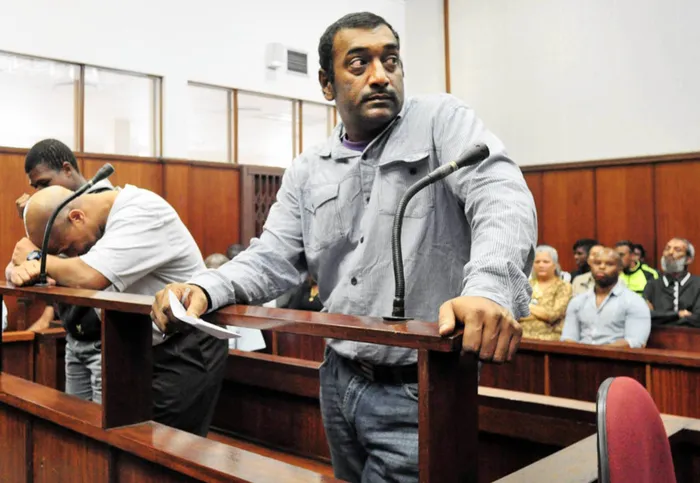
Inderesan 'Alvin' Maistry. Inderesan 'Alvin' Maistry.
The State has argued in the Durban High Court that it proved its case against Department of Labour inspector Inderesan ‘Alvin’ Maistry who, along with two others, is accused of killing his wife.
The fate of Maistry, 45, Bongani Lucky John Manyathi, 28, and Mandelenkosi Zamokhawakeh Jobe, 41, will be decided by Acting Judge Burt Laing next month.
The State alleged that Maistry masterminded the murder of his wife, Charmaine Naidoo, 32, and conspired with Jobe and Manyathi in the crime.
The trio pleaded not guilty.
Naidoo, who ran a general dealer shop in Merebank, was stabbed multiple times in her neck.
Her body was found on February 18 last year in Umbumbulu on the KwaZulu-Natal South Coast, some nine hours after she was abducted at gunpoint from her Merebank home.
Naidoo was forced into her vehicle and was murdered soon afterwards.
Her handbag and its contents were left intact in her vehicle.
State advocate Nadira Moosa claimed that Maistry had orchestrated the killing and that Jobe and Manyathi were also involved in the conspiracy.
She submitted that the evidence of the State witness, Feroza Banoo Ebrahim, a sex worker, should not be overlooked.
Moosa said Ebrahim had introduced Jobe to Maistry.
The introduction allegedly came about after Maistry, who was known to her as Naseer when he frequented the escort agency she worked at, had asked her to find someone to get rid of his in-laws.
“This was a premeditated murder by the three accused. It will be a grave injustice if Ebrahim’s evidence is not taken into account. Maistry had informed her of his plot to kill his in-laws, but the actual victim was his wife,” she said.
“The cellphone records showed that Maistry and Jobe were in contact with each other on the days preceding the murder, on the night after the deceased was abducted and murdered and on the days thereafter.”
Moosa rejected the contention by advocate Shane Matthews (instructed by attorney Shireen Subrathi), acting for Maistry, that the deceased’s brother, Shane Narsiah, would have heard all of Maistry’s cellphone conversations when they travelled together before and after Naidoo was murdered.
“Maistry dropped off Narsiah at his home around 9.40pm on February 17 last year,” said Moosa.
“Therefore it is highly improbable that Narsiah would have had knowledge of the cellphone calls which Maistry and Jobe had exchanged after 9.40pm.”
Matthews argued that the testimony by investigating officer, Warrant Officer Budgie Nagasur at Maistry’s bail application in the Durban Magistrate’s Court, that Naidoo was shot, was incorrect.
“The deceased was never shot. No firearm was used in the murder. The deceased was not shot,” said Matthews.
Moosa subsequently set the record straight by saying it was an unintended mistake and that it was not done to deny bail being granted to Maistry.
Matthews argued that while Maistry was a suspect before he was arrested, the court should not ignore the theory that Naidoo might have been killed by robbers and left on the side of the road.
“We live in South Africa. That is a possibility. Such crimes happen here. The TV which the court heard was stolen from the deceased’s home was sold to a pawnbroker. There were claims that the TV was shipped to the Congo. If that really happened, then it must have been the fastest way to get a TV out of South Africa because it took less than a day,” he said.
Jobe and Manyathi’s counsel argued that they were not involved in the murder conspiracy.