

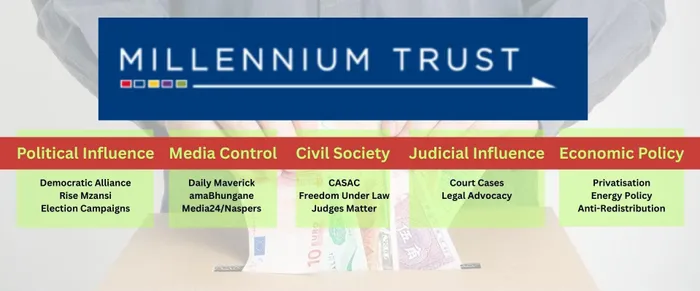
The Millennium Trust funds initiatives in media, law, civil society, and politics across South Africa, supporting organisations such as Daily Maverick, amaBhungane, CASAC, Freedom Under Law, and Judges Matter. | These grantees are said to operate with full editorial and organisational independence, but the Trust’s influence is said to be exercised indirectly through advocacy, investigative work, and legal reform efforts, rather than through direct control. | The Trust provides financial support to the Democratic Alliance
Image: Sizwe Dlamini
ECONOMIST Dr Séan Mfundza Muller has issued a stark warning about the growing power of South Africa’s ultra-wealthy, spotlighting Michiel le Roux, co-founder of Capitec Bank, and his alleged behind-the-scenes influence on media, politics, and civil society through strategic funding, raising questions about accountability, transparency, and the integrity of democratic institutions.
Speaking on Ntsiki Mazwai’s Moya podcast, Muller said: “Another South African billionaire, who I think is very interesting, is Michiel le Roux, who is one of the people behind Capitec. Now, as far as I know — and I heard this both from a private source and then I also came across a public source of this information — Le Roux is behind a trust called the Millennium Trust.”
Muller explained that, according to his research and private discussions, the Millennium Trust, which was founded around 2010, supports a “constellation of powerful voices in civil society”, noting: “The Millennium Trust funds the Daily Maverick, amaBungane, the Council for the Advancement of the South African Constitution (Casac), Freedom Under Law, as far as I know … and I’m going from memory here.”
He further said that the trust operated with a certain degree of opacity: “But so you’ve got all these civil society organisations, all these media outlets being funded by this … trust. I mean, I’ve gone to look at the directors. You would never guess from the directors of this trust. You would not be able to find out who’s behind it.”
Muller described how he discovered the connection: “I only found out because I stumbled across something online and because somebody who had direct knowledge … told me privately that Le Roux is behind this.”
When reached for comments, the Millennium Trust said they would get the appropriate person to respond to questions from the Sunday Independent, but had not got back to us by the time of compiling this report. Attempts to get comments from Le Roux drew a blank.
Regarding potential implications, Muller raised concerns about editorial independence and transparency, saying: “While these funds support critical journalistic and civic activities, concerns persist about their impact on editorial independence. Newsrooms such as the Daily Maverick and amaBhungane maintain that funding does not dictate editorial control, yet the exact terms and amounts often lack full public disclosure, raising questions about transparency in media financing.”
He also spoke about Le Roux’s financial support to South Africa’s main opposition party, the DA: “Michiel le Roux funds the DA … so he also funds their court cases. He funds the civil society organisations that apply to the court to be friends of the court in court cases. And he funds the media houses that report on all of that.”
Muller posed a rhetorical question on the ramifications for public understanding: “Okay, now, how do you think as an ordinary person, you’re going to be able to get accurate information on, for example, who’s corrupt and who’s not, who’s good and who’s bad?”
He noted that Le Roux’s donations reportedly exceeded R50 million between 2021 and 2023 through private companies such as Fynbos Ekwiteit and Fynbos Kapitaal, making him among the largest disclosed donors to the DA within that timeframe.
Muller also commented on broader patterns of philanthropic influence: “This is just one billionaire. When they control three, right, and those are just the ones we know about, right, that’s not even like particularly covert. As soon as you know who’s funding the trust, you can figure that out loud, right? There’s a whole lot of other stuff that we know less about, what we have to find out about through private sources … like who’s funding Rivonia Circle … which is another thing which I’ve raised over the last couple of years.”
Reflecting on new civic movements and political projects, Muller observed: “Rivonia Circle was really the platform that Songezo Zibi used to start Rise Mzansi, which eventually we discovered was funded by the Oppenheimers.”
Rise Mzansi's spokesperson Mabine Seabi said Zibi was the chairperson of Rivonia Circle, and resigned prior to the establishment of the party.
“This is not a secret nor is it something sinister. Second, the Oppenheimers were neither involved in nor were they any of the founding donors,’’ he said.
Muller added a cautionary perspective on concentrated power and its effects on democratic processes: “Basically, these power structures matter a lot. And right now, under this current coalition government, in my view, they are driving everything that’s happening. The political level is actually a bit of a distraction.”
Political analyst Professor Sipho Seepe said electoral campaigns play a critical role in providing voters with choices and funding provides the necessary means.
"This is where private funding comes in. To limit the influence of private funders, parliament has promulgated laws that require parties to declare the source and the amount of funding received. This insistence on transparency is one way of ensuring that the voice and interests of the voters are not subordinated to private interests,’’ he said.
Economist Duma Gqubule said this is an attempt to influence economic direction.
“I think there is an attempt to buy political support, influence and economic directions. They want to have more control of economic directions. And this is wrong, we need to do away with the system of private companies funding political parties. It leads to corruption and capture of the state,’’ he said.
Meanwhile, Muller added that from the analysis he had done and worked on, private funding appears to have a large, highly distortionary effect on all domains.
“It's questionable whether the high profile 'civil society' organisations who tend to be reported on in the media and involved in various crucial public initiatives like the National Dialogue, even deserve to be considered as such. The fact that the same funders are funding organisations across all three domains is especially worrying.’’
South Africa’s existing disclosure frameworks require political parties to declare donations above certain thresholds, yet gaps remain in full transparency, particularly with regard to indirect funding and philanthropic support to media and civil society organisations.
Calls are increasing for stronger transparency norms, improved funding disclosures, and clearer safeguards to uphold editorial independence and democratic accountability.
*This story has been updated to include a response from Songezo Zibi, as well as further comment from Seepe, Gqubule and Muller.