

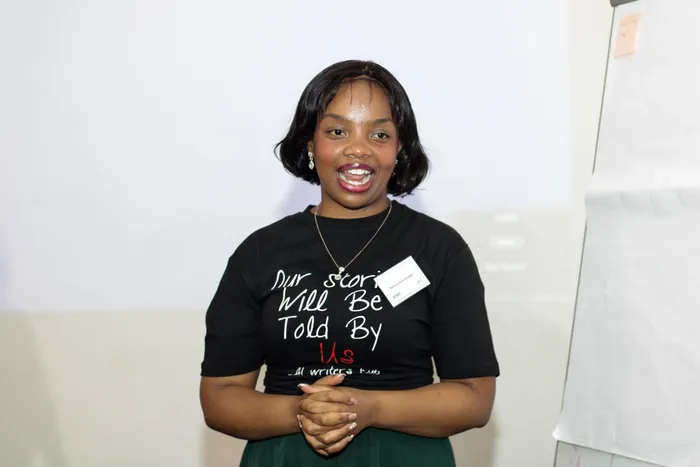
Ntsiki Khunju is a passionate writer, child protection advocate, and women’s rights activist.
Image: Supplied
On 15 August 2025, Pretoria became the stage for the National Youth Dialogue, a gathering of young leaders from across South Africa, convened for a pivotal conversation with President Cyril Ramaphosa.
The dialogue sought to confront the country’s pressing realities, youth unemployment, gender-based violence, sexual and reproductive health rights (SRHR), and inequality.
Among those in attendance was Nkeletseng Tsetsane, a Young Urban Women (YUW) Mamelodi Community Facilitator, accompanied by adolescent girls and young women (AGYW) from her programme.
For her, the invitation was more than symbolic. It was, in her words, “a level of trust in how I can relay the concerns of those who sent me. I will not sit with the information but return and report back.”
This moment marked both historic recognition and a strategic opportunity, a chance to amplify young feminist voices within national decision-making.
A Journey from the Streets to the National Stage Nkeletseng’s journey into grassroots feminist advocacy began long before her facilitation role.
Her activism was ignited during the 2018 #TheTotalShutdown Intersectional Womxn’s March, when women across the country united against gender-based violence and femicide.
In March 2025, she officially became a YUW Mamelodi facilitator, guiding a group of 30 young women through excursions, workshops, and dialogues. What she witnessed was a transformation.
“Some of the most timid young women came out of their shells. They became critical of abnormal conditions that had become normalised in their communities. And most importantly, I have witnessed a sisterhood that always leaves me in awe.”
Asked what she would tell the president if given a single minute, her answer was sharp: “The nation has lost trust in the current leadership.
''If there is hope as small as a mustard seed to restore this through genuine people-centred leadership, can he please find it?”
While the invitation carried weight, not all participants walked away inspired.
Phemelo Moshoeshoe, a Young Urban Women participant and SRHR advocate who attended alongside Nkeletseng, voiced sharp disappointment at the event.
“The dialogue barely addressed the lived realities of young people on the ground, especially around SRHR,” she said.
“The space was filled with elders who are not youth, speaking about youth matters on our behalf, and although we appreciate their level of insight, we prefer to have young people address young people-related issues.
”For her, the biggest frustration was the lack of accountability in how budgets meant to address youth socio-economic challenges fail to translate into urgent action.
“The engagement touched very little on what implementation of developmental and empowerment programs looks like. That’s where the crisis lies.”
The issues that matter most to the AGYW participants Nkeletseng works with can be summed up in one word: ACCESS, to economic opportunities, quality healthcare, and education.
“Policy knowledge is essential,” she insists. “You cannot fight for rights you do not know exist. Our role as facilitators is to make sure youth participation is not tokenistic but meaningful.”She also highlights corruption as the most devastating injustice faced by communities: “It robs people of dignified lives. In the absence of order, disorder reigns and terrorises our communities.”
Despite this, she remains committed to feminist leadership. “Taking up space as a young Black woman means showing up ready, knowing the issues, reading, researching, and being prepared to do the work.”
When asked what she hopes this dialogue will mean years from now, Nkeletseng doesn’t mince words: “Tangible change to people’s daily lives. I wish we could get to a point where leaders lead because they are genuine leaders, not people waiting for their chance to loot.
”The National Youth Dialogue may have been a milestone. Still, for women like Nkeletseng and Phemelo, its true test lies in whether it sparks real change, in communities, policies, and the lives of South Africa’s youth. Until then, they remain resolute: the struggle continues, and their voices will not be silenced.''
Ntsiki Khunju is a passionate writer, child protection advocate, and women’s rights activist.