

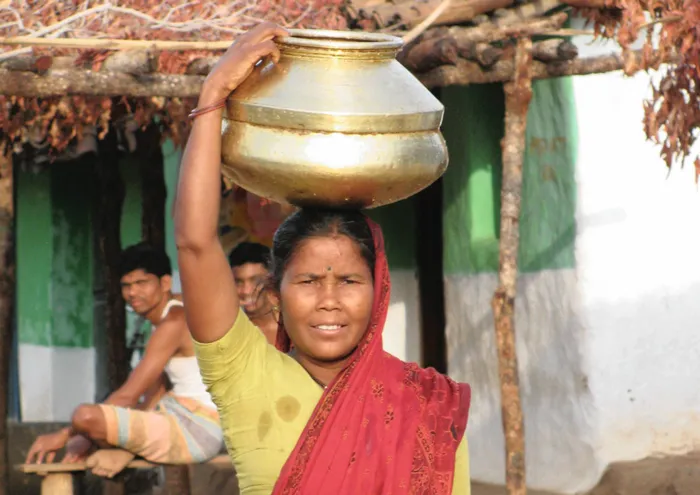
A granny reflects the tranquillity of village life. Picture: Kate Turkington A granny reflects the tranquillity of village life. Picture: Kate Turkington
The first night I share my bed with a hundred fireflies. I am lit up like a Christmas tree as they dance around me, flickering and twinkling, tiny pin-pricks of luminescence like so many Tinkerbells, before gently settling on my bare arms and legs, glowing brightly.
Where am I? Banjaar Tola Tented Camp in the middle of one of India’s largest national parks during the monsoon.
Earlier, as my guide DK and I hunt for a tiger and her two cubs on the fringes of the forest, we see the chital, a beautiful spotted deer that is favoured prey for tigers.
A small herd of more endangered Barasingha, rescued from near extinction, splosh by as we pass ghost trees – named after their pale green-grey trunks – and sacred strangler figs. Strange bird calls pierce the clammy air.
The forest is not the thick, impenetrable jungle of Nepal or Vietnam. Rather it’s a tall forest of elegant Sal, teak and Mahua trees made a delicate fresh green by early rain, along with meadows, nullahs (dry stream beds), rivers and wetlands.
India peafowl (peacocks) stalk the edges of streams and emit their strange, discordant cries. A small troop of the Common langur – acrobats of the jungle, much like our vervet monkeys – clamber high up the branches and gaze down at us dispassionately.
Hindus identify them with Hanuman, the Monkey God of myth and legend, and they’re now protected throughout the region.
Around a bend, we find a herd of Gaur. Sometimes called Indian Bison, they are taller and heavier than African buffalo but more docile.
Of the 60 tigers that roam the park, we see not a whisker.
Then the monsoon – a week earlier than usual – arrives with dramatic rolls of thunder. Sheets of rain pour down, stinging heavy drops scald our faces, and our flimsy ponchos are no match for the torrent.
A wild pig slips and slides in the mud in front of us before skittering off into the forest.
It took me 12 hours to get to Khanya National Park, 1 945km2 of pristine wilderness deep in India’s interior. I had to take a plane from Delhi to Nagpur, then travel by road deep into the heart of the state of Madhya Pradesh.
And the journey is a microcosm of India. I stroked a 500 year-old Banyan tree (like the one Buddha sat under), ate sweet, small bananas and drank something milky.
Leaving Nagpur, an industrial hub also known for its oranges, we left contemporary Indian life with its huge billboards of impossibly beautiful, airbrushed, bejewelled women and handsome men advertising everything from diamonds and saris to aftershave.
Below them, thousands of motorcycles, scooters and bicycles jostle in heavy traffic, their riders appearing exhausted, wives or girlfriends perched behind like bright butterflies. Even in the midst of dirt and squalor, the women glow in brightly coloured saris, sequins glinting from every fold.
Signs for educational establishments are also plentiful.
Further away from the city, there are bullock carts, wandering dogs and frisky goats, a truck with the bonnet up and the driver sleeping on the engine, a Sikh temple, roadside shrines.
Skeletons of old trucks line the road like the fossils of dinosaurs and there are piles of litter all over.
Finally, we get to the rolling, flat countryside. There’s an enormous contrast between the chaos of the towns and the tranquillity of village life. We pass small, neat villages with red-tiled mud houses as women draw water from the communal well, and men plough the fields with oxen. Girls sit grooming each other as children draw patterns in the dirt.
At Banjaar Tola, the five-star luxury tented camp set up across the river from the Khanya National Park, the nine suites are designed to blend into their surroundings and have a minimal impact on the sensitive riverine environment.
With the bamboo floors, canvas roofs and walls, and floor-to-window glass doors, I feel part of nature, not cocooned from it.
A special feature is a “floating” veranda that overlooks the river where I nearly floated off with the fireflies.
But now it’s time to brave the monsoon, shoot a tiger (with my camera, of course) and move on to Pench National Park.
Luckily, the monsoon has not yet reached Pench, four hours’ drive east of Kanha. Although it’s called a typical central Indian teak jungle, this word also seems inappropriate for the landscape of tall, slender trees, wide open spaces and vast expanses of water – even though this is where Rudyard Kipling found his inspiration for Mowgli and The Jungle Book.
Baghvan lodge is more traditional colonial style than Banjaar Tola. My room has a carved wooden bed with a huge picture of an Indian princess overhead, a separate bathroom and dressing room with an open rooftop machan, where, if I choose to do battle with millions of flying insects, I can sleep out under a mosquito net.
I’m positioned on the edge of a nullah, which is alive with birdsong at dawn.
My bird list already includes a Black-rumped Flameback (a woodpecker that rivals Bollywood for colour and panache); the Indian Grey hornbill, a shikra and lots of other small raptors, a pair of Collared Scops owls, a Rufous treepie, a Black ibis, coucals and cuckoos.
The piercing cry of the Common Hawk-cuckoo is unceasing from dawn to dusk.
The first evening I visit a local village. I see brightly painted mud houses with red-tiled roofs, thin oxen (because it’s the end of the dry season), women carrying water, children playing, a small neat school and house, walls decorated with the slogan: “Let’s Go to School.”
The villagers are welcoming and friendly because the lodge has provided much work for them and contributed to their educational and social upliftment. This village even has a TV satellite dish. Which is not the case in many rural villages where, a social worker tells me, newborn girl babies are still drowned in buckets and wives are set alight if their dowries are deemed inadequate.
The next morning I have a rare sighting of the Indian wild dog, and then… there she is. One of my life’s defining moments.
A huge tigress with two seven-month-old cubs the size of fully grown leopards gambolling around her as she dozes on a rocky bank, occasionally rolling on her back, all four paws in the air, and then mooching off to another nap spot.
I don’t know if the late 18th-century English poet Blake had ever seen one of these magnificent animals when he wrote the iconic poem Tiger, tiger, burning bright… but he certainly got it right. She blazed in orange, brown, gold and white among the greenery.
But how can she hunt when she is so fiercely bright, I ask Sri, my guide?
He gently reminds me that animals only see in black and white. Take the colour out of your pictures when you get home, he says, and you won’t see that tiger against the jungle background.
If you want to find tigers in India, expect a long, tough journey that’s not for sissies. But when you get to your destination, the accommodation is fabulous, the people wonderful and the tigers are genuinely heart-stopping.
When I saw my tiger, tears came to my eyes. And I’m definitely not a sissy. - Sunday Tribune
Kate Turkington was hosted at the stylish boutique Park Hotel in New Delhi. www.theparkhotels.com
Banjaar Tola and Baghvan are five-star luxury lodges owned and operated by AndBeyond & Taj www.andBeyond.com