

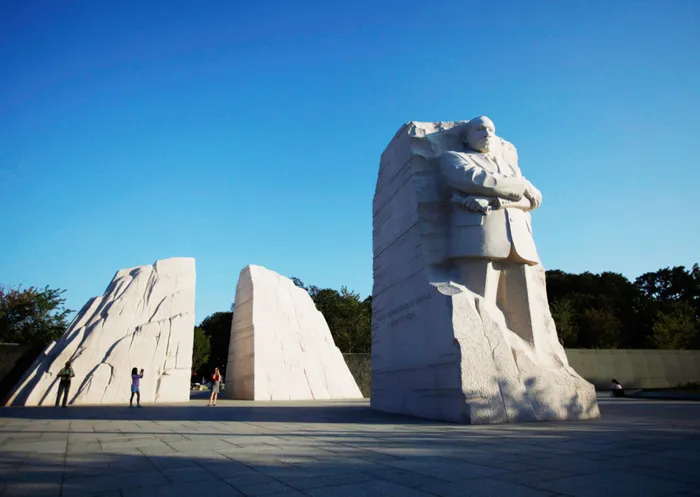
The new monument of Martin Luther King Jr, with its symbolic 'carved mountain', was opened last week by President Barack Obama. The new monument of Martin Luther King Jr, with its symbolic 'carved mountain', was opened last week by President Barack Obama.
It is a walk of barely 200m, an easy stroll even in the heat – down the steps of the Lincoln Memorial and past the ghostly soldiers of the Korean War Veterans’ Memorial to 1964 Independence Avenue.
Physically, the journey takes me five minutes, maybe six. In other ways – politically, spiritually, sociologically – it has taken many people far longer.
For it is here that Washington DC’s newest landmark, the Martin Luther King Jr National Memorial, was opened last week by President Barack Obama, on the 48th anniversary of the civil rights leader’s seismic “I Have A Dream” speech – virtually within audible range of the spot where he delivered it, under Abraham Lincoln’s statuesque gaze.
Not before time, either. It is no outlandish claim to say the arrival of an official site dedicated to the civil rights struggle in the US capital is long overdue.
The National Mall already pays tribute to several of the causes the country has battled for. When Obama pulled back the curtain, there was a sense of an oversight being corrected.
The ceremony was a momentous event: the first memorial on the mall built to honour someone other than a former president. As many as 400 000 spectators marked the occasion – the largest gathering there since the current commander-in-chief’s 2009 inauguration.
Yet all this faded as I approached the new memorial.
A palpable peace hung over the site – even as construction workers made adjustments to the adjacent information centre.
Created by the Chinese sculptor Lei Yixin, the monu-ment offers a take on a single quote from King’s famous speech: “With this faith we will be able to hew out of the mountain of despair a stone of hope.”
Visitors enter through a passage between two giant chunks of pink granite (the mountain of despair) to find the man himself emerging in relief, 8.5m tall, from a third block (the stone of hope) – and staring south across the Tidal Basin, to where the presidential memorials to Thomas Jefferson and Franklin Delano Roosevelt lie.
The alignment is deliberate. Said an architect: “It sits in a direct line between Lincoln, the man who kept the US united, and Jefferson, who drafted the Declaration of Independence.”
The significance of the proximity to Jefferson becomes obvious later in the day when I amble around the Tidal Basin and find the third US president’s most iconic words etched into the wall of the neo-classical temple that celebrates his life: “We hold these truths to be self-evident, that all men are created equal, that they are endowed by their Creator with certain inalienable rights, that among these are life, liberty and the pursuit of happiness.”
With the King memorial visible in the background, they ring with new clarity. But first there are the quotes on the King memorial itself, 14 of them, taken from books and speeches, cut into a 135m wall behind the main sculpture.
Some are defiant: “We shall overcome, because the arc of the moral universe is long. But it bends towards justice.”
Some are hopeful: “We must come to see that the end we seek is a society at peace with itself, a society that can live with its conscience.”
Some are poetic: “Darkness cannot drive out darkness; only light can do that. Hate cannot drive out hate; only love can do that.”
One is missing. Glancing to her left, perhaps towards the White House, architect Mieko Preston said: “There is no need to quote ‘I have a dream’ because that dream has been realised.” - Daily Mail