

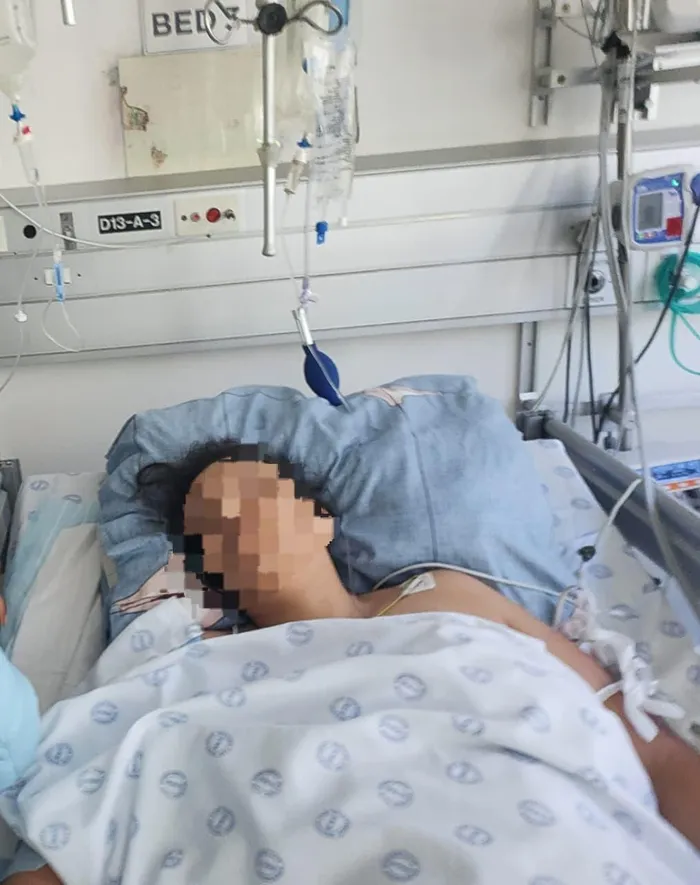
Noerisah Sonday in hospital
Image: Supplied
“I thought I was going to lose my sister because of that hospital...”
These were the words of 39-year-old Noerisah Sonday's, younger sister, describing the terrifying moments after Sonday suddenly collapsed and was rushed to Mitchells Plain District Hospital.
Sonday’s family said the incident happened within seconds: she collapsed, lost control of her bodily functions, and was later informed one of the main arteries on the left side of her brain had burst…but the news of the burst artery only came nine hours, this after hospital staff allegedly brushed it off as being a “head pain- which is less serious than patients with chest pains” .
Sonday’s sister, who requested to remain anonymous, explained when they rushed her sister she had been experiencing all the symptoms and from the onset she knew something was off.
“This wasn't a normal headache. My grandmother and uncle passed away from the same symptoms, so I knew and tried to inform the staff about our family history. I also have some medical experience, but I honestly believe that people’s titles go above what the public experiences or also knows.”
The family said they were shocked when nurses reportedly triaged her as Code Green, indicating a non-urgent case.
“That is why I am very baffled that the nurses said she was green, because she came in with those symptoms. Nine hours later the doctor confirmed the same thing that she had bleeding on the brain,” the sister said.
The sister said she repeatedly tried to escalate the situation. “I said, ‘I want to talk to the doctor in charge.’ I needed to understand why she wasn’t being prioritised. I think it’s a little bit of a title thing. You are the public, we are doctors. When I looked at her, I thought, "I could have lost her.”
She added that the family was told that Mitchells Plain Hospital is one of the busiest in the province and that patients with chest pain are considered more urgent than patients with head pain.
After being triaged, the patient remained waiting for hours and was later transferred to Groote Schuur Hospital, where doctors performed a DSA coil procedure to treat the aneurysm. She is now in high care, stable but continuing to show stroke-like symptoms and experiencing head pain, while further tests are being conducted due to concerns about possible meningitis.
The family has lodged a formal complaint with the hospital, which requested the patient’s name in order to conduct an investigation. They were told to allow 25 working days for the process to be completed and feedback to be provided.
“What hurts the most is that while they see these people as just patients, they are our family, and sometimes we know our family better.
“All I can do is thank God she is still with us because I don't know what I would do without her. She is literally the only relative I have, my sister, my dad, my nieces and nephew, and brother-in-law is all I have, what would we have done without her?”
The Western Cape Department of Health and Wellness confirmed that a formal written complaint has been received and that their team is investigating. Department spokesperson Samantha Lee-Jacobs said staff at Mitchells Plain Hospital operate under immense pressure due to high numbers of emergency and life-threatening cases.
“The dignity and respect of our patients are not taken lightly. Our team takes the care of all patients presenting to the facility in high priority, and they are working under immense pressure,” Lee-Jacobs said.
She explained that triage is essential to prioritise patients based on the severity of their condition and that sometimes a patient’s condition can change while waiting for care.
However the family is refuting this, explaining that the patient came in with the exact same symptoms she had left with when she was transferred to Grooteschuur.
“The symptoms became worse, but it was already very bad when we got there. My sister even told me when I visited her that she would have died...those words ring in my ears and I cannot help but cry because she is basically of the only family I have left, her my father, my nieces and nephew and my brother in law.”
Meanwhile, the Health and Other Service Personnel Trade Union of South Africa (Hospersa) said it is aware of the concerns raised following the case.
While the union said it cannot comment on the clinical details of an individual patient, it expressed concern for the family and wished the patient a full recovery.
Hospersa noted that long waiting periods in emergency departments are unfortunately common in many public hospitals due to high patient numbers, limited staff and resource constraints.
Emergency units often receive far more patients than they were designed to handle, particularly at district hospitals. Because triage systems prioritise the most critical cases first, patients assessed as less urgent may wait several hours before being seen.
The union added that staffing shortages, limited resources and delays in accessing beds, diagnostic tests or specialist care can all contribute to long waiting times.
Hospersa also noted that triaging neurological symptoms can be particularly challenging.
Symptoms such as headaches, dizziness or weakness can be linked to a wide range of conditions from mild illnesses to life-threatening emergencies making it difficult for healthcare workers to immediately determine the severity of a case in a busy emergency unit.
The union said conditions can also change rapidly, which is why ongoing reassessment and access to diagnostic testing are essential to ensure that patients whose symptoms worsen are identified quickly.
Hospersa believes stronger investment in staffing, improved infrastructure and greater support for emergency care services are necessary to strengthen patient safety in public hospitals.
Tracy-lynn.ruiters@inl.co.za