Inter-Congolese Dialogue the Key to Lasting Peace in the DRC
YEAR IN REVIEW
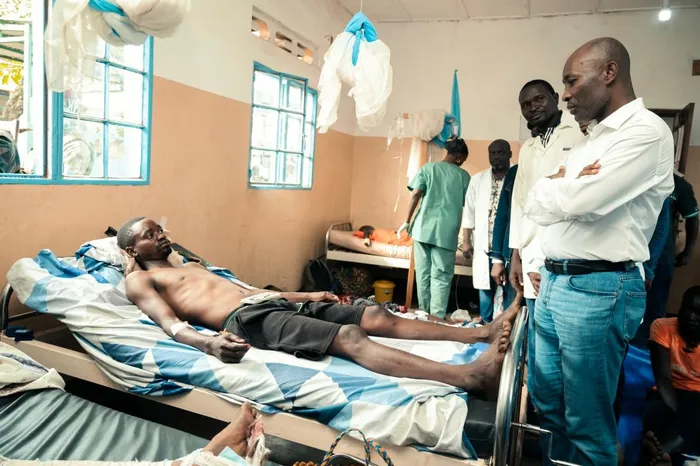
South Kivu Governor Jean-Jaques Purusi Sadiki (right) visits wounded brought to the Uvira General Hospital from the area of intense fighting between the M23 and Democratic Republic of Congo (DRC) forces in Uvira on December 7, 2025. DRC President Felix Tshisekedi and his Rwandan counterpart Paul Kagame ratified an agreement in Washington that was intended to restore peace in eastern Congo, but which so far has had little effect on the ground.
Image: AFP
Dr. Claude Kabemba
Before the ink could dry on the peace accord brokered by President Donald Trump—now being referred to as the Washington Peace Accord—violence had once again erupted in the eastern Democratic Republic of Congo (DRC). The March 23 Movement (M23), backed by Rwanda, has launched a new offensive around the strategic town of Uvira in South Kivu.
This renewed violence reminds us that “Peace agreements are not peace—they are promises. And promises only matter when leaders fear disappointing their citizens more than they fear each other.”
At the signing ceremony on Thursday, 27 November 2025, in Washington, D.C., Presidents Paul Kagame and Félix Tshisekedi could barely look each other in the eye, nor could they exchange a comfortable handshake. Their strained body language alone signalled that genuine peace remains a distant prospect.
A Necessary Step, But Not Yet a Guarantee
The peace accord signed in Washington is undeniably a welcome development. Any step toward ending this decades-long conflict is worth embracing. Too many lives have been lost; even as leaders exchanged formalities abroad, people continue to die at home.
Millions remain displaced, living in precarious conditions within and beyond the DRC’s borders. Families have been destroyed, communities uprooted, and the number of orphans is rising. Any initiative that offers even a faint glimmer of hope deserves recognition.
Yet the critical question remains: will this peace hold?
Unresolved Security Questions
The agreement leaves several fundamental issues unresolved:
- The FDLR Question: Rwanda has consistently justified its presence in eastern DRC by pointing to the threat posed by the FDLR. Yet the accord provides no clear timeline or mechanism for disarming or neutralising the group. Without clarity here, mistrust will persist.
- The Withdrawal of Rwandan Troops: Kigali’s commitment to withdraw its forces is tied directly to the fate of the FDLR. As long as that uncertainty remains, full withdrawal is unlikely to materialise.
- The M23 and Internal Congolese Dynamics: The accord acknowledges, for the first time, that the M23 rebellion is fundamentally rooted in internal Congolese political grievances. Dialogue in Doha continues, but outcomes are uncertain. President Tshisekedi maintains that resolving tensions with Rwanda will weaken the M23, which he views as Rwandan proxies. Whether this assumption holds will shape what comes next. Under pressure, Tshisekedi engages the M23 cautiously and timidly.
Governance: The Heart of the Problem
The M23 conflict is not merely a regional security issue. It exposes deeper governance failures inside the DRC. Sustainable peace requires a genuine inter-Congolese dialogue—one that confronts political fragmentation, state weakness, and local grievances. Accountability must be part of this process. Those who committed atrocities, on all sides, must be brought to justice. Without justice, any peace will be fragile.
A Deal Without Enforcement
The most glaring weakness of the agreement lies in its lack of enforceability. In the Great Lakes region, commitments without guarantees have failed time and again. Without credible mechanisms for monitoring, verification, and consequences for non-compliance, this accord risks becoming yet another addition to the long catalogue of broken promises.
Equally troubling is the exclusion of the M23. A peace agreement that leaves out one of the principal armed actors is, in effect, an agreement built on a fault line. If the war is to stop, all those engaged in the conflict must be part of the process. Leaving the M23 outside the framework was therefore a predictable recipe for failure.
The current escalation of violence—illustrated by the M23’s push to seize the strategic town of Uvira—is not accidental. It is a calculated move to strengthen the group’s bargaining position in the ongoing negotiations in Doha with the Kinshasa government. Following the Washington accord, there is an expectation that dialogue between the government and the M23 will accelerate, potentially paving the way for the long-delayed inter-Congolese dialogue.
Should the M23 take Uvira, the consequences would be severe. Control of Uvira would open a corridor enabling advances into several provinces, including the mineral-rich province of Katanga. This would dramatically alter both the military and political landscape, further jeopardising the fragile prospects for peace.
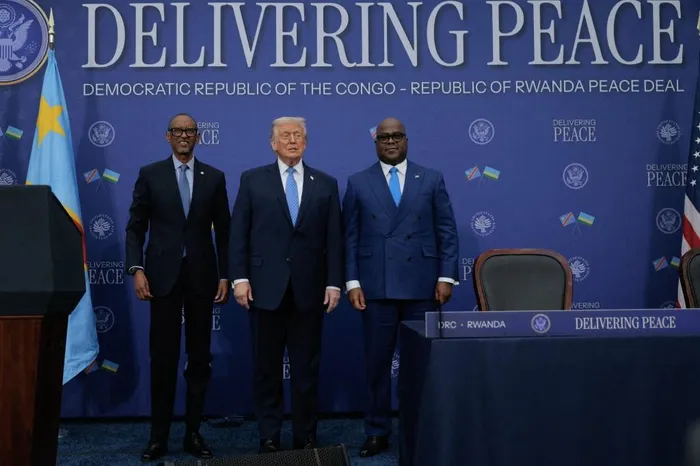
U.S. President Donald Trump (centre) poses for photographs with Rwandan President Paul Kagame (left) and Democratic Republic of Congo President Felix Tshisekedi after signing a peace accord at the Donald J. Trump Institute of Peace on December 04, 2025 in Washington, DC. Peace in the Great Lakes region has never been secured by signatures alone. It has always depended on sincerity, accountability, and genuine political will, says the writer.
Image: AFP
An Emerging Economic Angle
The peace accord represents a calculated move by the United States to secure access to and influence over the DRC’s rare earth and critical minerals, aiming to counter China’s dominance in the region.
One notable development is the establishment of a clear economic cooperation and regional integration pathway. Under the accord, the DRC and Rwanda have committed to launching a Regional Economic Integration Framework (REIF).
The framework seeks to formalise mineral supply chains, attract Western investment in mining, energy, infrastructure, and tourism, and promote cross-border trade and connectivity—including collaboration on hydropower, resource processing, and other infrastructure projects.
Specifically, the agreement envisions joint work on processing minerals domestically rather than exporting raw materials, developing shared infrastructure such as railways, energy networks, and transport corridors, and cooperating in sectors like tourism, environment, and public health.
The accord also signals renewed U.S. engagement in the region. Through the U.S. International Development Finance Corporation (DFC), Washington has pledged support for private-sector investments in critical-mineral mining and processing, infrastructure, and regional connectivity, with the stated goal of transforming the region’s resources into sustainable economic development rather than fueling conflict-driven exploitation.
Economic interdependence can strengthen political stability—but only if it is grounded in fairness, transparency, respect for sovereignty, and local benefit. Without these safeguards, economic cooperation risks deepening grievances and entrenching inequality rather than addressing the root causes of conflict.
In this sense, the accord’s economic dimension offers a real—but fragile—opportunity. It could provide a foundation for lasting regional integration and shared prosperity, provided that its implementation is genuine, inclusive, and accountable.
The question is how China would position itself in this aggressive USA resource diplomacy?
Peace Requires More Than Signatures
Peace in the Great Lakes region has never been secured by signatures alone. It has always depended on sincerity, accountability, and genuine political will. A peace accord only matters when the leaders who sign it are prepared to honour it—not just in words, but in action.
For this agreement to endure, for it to become more than yet another hopeful document, it must be signed with conviction, not merely with ceremony.
Yet the atmosphere at the signing told another story. The visible stiffness and unease between Presidents Félix Tshisekedi and Paul Kagame stood in stark contrast to the confidence projected by President Donald Trump as he presided over the event. Their strained body language suggested that trust—an essential ingredient for peace—remains dangerously thin.
Whether this accord becomes a turning point or fades into the long list of unfulfilled promises will not be determined in Washington. It will depend on the courage and commitment of the leaders who signed it, and on their willingness to confront the underlying drivers of the conflict.
Most critically, the negotiations between the Kinshasa government and the M23 must accelerate. Without a rapid and meaningful dialogue that brings the rebels into the political process, the current offensive could push the conflict toward an even more dangerous phase.
An M23 advance into Katanga—the cobalt- and copper-rich economic heart of the DRC—would be catastrophic. Losing control of this region would sever Kinshasa’s access to vital revenue streams and could threaten the very stability of the state.
Peace will not come from paper. It will come from choices—urgent, difficult, and courageous choices—made by those who claim to seek it.
* Claude Kabemba (PhD) is the Executive Director of Southern Africa Resource Watch.
** The views expressed do not necessarily reflect the views of IOL, Independent Media or The African.