

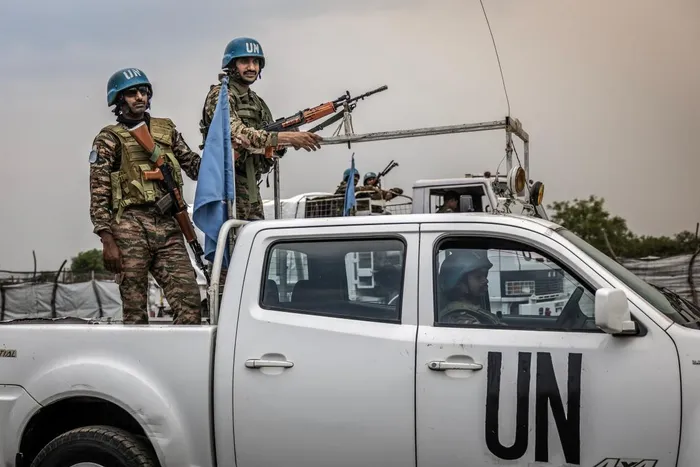
Indian peacekeepers serving with the United Nations Mission in South Sudan (UNMISS) patrol near an airstrip in the strategic opposition-controlled town of Akobo, Jonglei State on February 12, 2026.
Image: AFP
Tamara Ryzhenkova
As of 2025, South Sudan is the youngest and, according to certain data, the poorest country in the world. South Sudan gained independence from Sudan in 2011, following a referendum held in 2005. It was initially expected that the move toward independence would bring the country prosperity.
However, internal divisions quickly escalated into an armed confrontation. In December 2013, President Salva Kiir accused First Vice President Riek Machar of attempting a coup. This resulted in a civil war.
The conflict flared up in the capital, Juba, and rapidly spread to other regions. Soon, it evolved into an ethnic conflict: the Dinka people, loyal to Kiir, clashed with the Nuer people, who supported Machar.
Both groups belong to the Nilotic ethnic group and make up the largest segments of South Sudan’s population (the Dinka comprise about 35% and the Nuer around 15% of the country’s population).
The conflict was marked by widespread atrocities, including mass killings, ethnic cleansing, and sexual violence, and became one of the most devastating crises in the region’s history. According to UN estimates, by 2018, the war had claimed around 400,000 lives, displaced four million people, and triggered a large-scale humanitarian disaster. The nation’s fledgling economy was left paralysed, and its infrastructure lay in ruins due to the fighting.
In September 2018, the R-ARCSS agreement was signed in Khartoum, Sudan. It aimed to establish a coalition government, a power-sharing model, and a 36-month transitional period leading up to elections. The agreement also included mechanisms for disarmament, demilitarisation, and integrating opposition forces into the national army.
However, the implementation of the agreement stalled: as of 2026, the key conditions of the agreement, such as establishing a permanent constitution and conducting a national census, remain unfulfilled.
The events of the past year have intensified the crisis. In March, Machar was detained and placed under house arrest, and on January 19, 2026, Kiir dismissed Machar’s wife, Angelina Teny, from her position as Minister of Interior.
Her dismissal dealt a significant blow to the 2018 peace agreement, given that her ministerial position was established as part of the power-sharing arrangement between the government and the opposition.
The opposition views these actions as a deliberate violation of the R-ARCSS provisions regarding power-sharing, leading SPLM/A-IO factions to launch offensives across various regions of the country. Forces led by General Simon Gatwech Dual, commander of the Kitgwang faction of SPLM/A-IO, have seized the town of Pajut and army positions in Akobo county.
On February 2, 2026, Gatwech officially declared his withdrawal from the Port Sudan Peace Agreement, which he had signed with the South Sudanese government a year earlier (in February 2025). He accused President Salva Kiir of sabotaging peace efforts and announced a return to open hostilities.
Machar’s supporters in the opposition also insist on meeting the preconditions for elections, which include releasing political prisoners, reforming the electoral commission, and ensuring security guarantees. Opposition leaders argue that the ongoing process is rigged in favour of the government.
Commanders within the SPLM/A-IO have threatened to advance on the capital, Juba, which is currently protected by the SSPDF and a contingent of Ugandan troops sent to aid government forces.
In turn, the authorities have accused the rebels of using cattle theft raids as a means to destabilise the situation. The fragmentation of the conflict is exacerbated by the emergence of new armed groups, such as the South Sudan Rescue Operation and the Red Belt Group, although the opposition movement has historically relied on the White Army for military support.
What is the White Army?
The term “White Army” refers to community-based youth militias organised along sectional and clan lines. The name derives from the white ash that Nuer herders traditionally apply to their skin and faces in cattle camps to protect against insects.
The main occupation of the Nuer people living in the greater Upper Nile region is cattle herding, and the primary role of the White Army is self-defence: safeguarding herds and territories from raids and looting, especially when central authority is perceived more as a threat than a guarantee of protection.
In these formations, authority flows from communities rather than from political leaders. These decentralised armed groups are organised along clan lines, following the longstanding self-defence traditions of the Nuer people. The White Army has participated in conflicts alongside the opposition since the 1990s, including in the civil war of 2013-2018 and the skirmishes of 2025-2026, but it operates autonomously.
In a lawsuit filed against Machar, the South Sudanese government has reiterated its familiar claim that the White Army is an armed wing of the SPLM/A-IO acting under Machar’s orders. This assertion aims to depict the mobilisation of the Nuer clans as a conspiracy organised by the opposition.
Humanitarian catastrophe
The resurgence of hostilities has had devastating humanitarian consequences: hundreds of people have died, and hundreds of thousands have been displaced. Many have sought refuge in swampy areas without access to food or medical care.
Displacement has been exacerbated by the South Sudanese army ordering the evacuation of all civilians and UN personnel, as well as the staff of other charitable organisations, from three counties in Jonglei State ahead of military operations against opposition forces.
Humanitarian missions have also been affected; on the night of February 1-2, several staff members from Doctors Without Borders (MSF) went missing following an airstrike on a hospital in Jonglei State.
Cattle raiding, traditionally used for settling scores, paralyses the local economy. Natural disasters such as floods and droughts, outbreaks of cholera, and the aftermath of the war in neighbouring Sudan have further worsened the situation. According to the UN, in mid-2025, over 1.9 million people were internally displaced, while 2.3 million refugees sought safety in neighbouring countries.
Approximately 9.3 million people (out of a total population of around 11 to 13 million) need humanitarian aid, with 7.7 million facing food shortages during dry months and 2.3 million children at risk of acute malnutrition. Women and children suffer the most due to rising incidents of sexual violence, child labour, and education disruptions.
What’s next?
The crisis in South Sudan has implications for all of East Africa. Uganda, Ethiopia, and Sudan are grappling with an influx of refugees and widespread border crossings. Uganda’s support for Kiir strains relations with the opposition, which is linked to Sudan.
The Intergovernmental Authority on Development (IGAD) and the African Union are calling for dialogue, but meaningful progress remains elusive. Western partners, including the US and EU, have criticised delays in reforms and insist on adherence to the R-ARCSS.
Today, the 2018 peace agreement has effectively lost its practical relevance. The December elections, if they indeed take place, may only exacerbate existing tensions and provoke a return to a full-scale war.
Without internal dialogue involving all parties to the conflict, coupled with effective diplomatic efforts and mediation, South Sudan faces an even greater humanitarian and political disaster, and risks becoming a perpetual source of instability in Africa.
* Tamara Ryzhenkova is a senior lecturer at the Faculty of Asian and African Studies at St. Petersburg State University. This is an edited version of the article published at https://www.rt.com/
** The views expressed do not necessarily reflect the views of IOL, Independent Media or The African.