

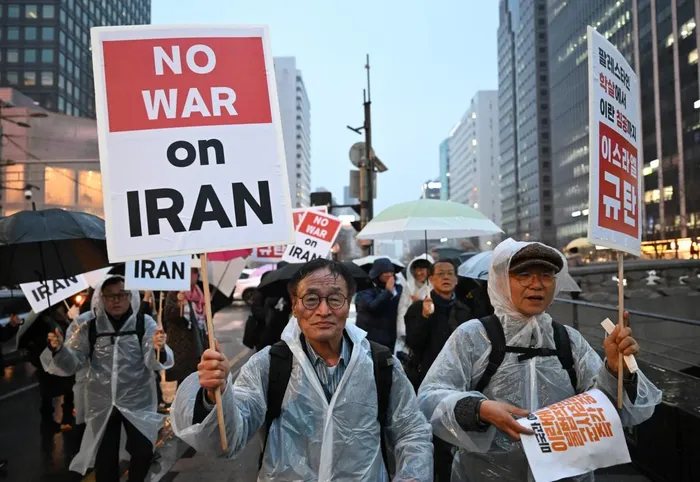
Protesters carry placards reading "No war on Iran!" as they march toward the US embassy during a rally condemning the US and Israeli attacks on Iran in Seoul on March 5, 2026
Image: AFP
Prof. David Monyae and Prof. Victor Qin
The events of 28 February 2026 marked a watershed in Middle East geopolitics.
Under the pretext of prolonged indirect negotiations, the United States and Israel executed a precision decapitation strike that killed Iranian Supreme Leader Ayatollah Ali Khamenei, along with his daughter, son-in-law, grandchild, and several aides.
The operation, “negotiation smoke screen for decapitation,” dismantled the core of Iran’s theocratic leadership with surgical accuracy, leveraging total information dominance over Iranian communications and movement patterns. This was not framed as mere retaliation but as a deliberate regime-change attempt aimed at dismantling the Shia resistance axis, breaking the nuclear deadlock, and eliminating Iran’s long-range missile program.
The strike has triggered a power vacuum in Iran, regional chain reactions across the Gulf, and a profound challenge to the post-Cold War global order. For BRICS nations and the broader Global South, the implications are dual-edged. It is immediate strategic and economic vulnerabilities, and a historic opening to accelerate multipolarity and reshape global governance.
Politically, the strike represents the most blatant post-Cold War assertion of hegemonic “rule by exception.” The operation violated core principles of the UN Charter—prohibiting the use of force without self-defence justification or Security Council authorisation—by assassinating a sitting head of state under false diplomatic cover. This sets a dangerous precedent for the Global South.
If the world’s remaining superpower and its closest ally can execute a “negotiate-and-strike” decapitation of a sovereign leader with impunity, no developing country’s leadership is safe. International law’s authority collapses when great powers openly practice what it calls “national terrorism,” having already assassinated over 100 Iranian officials and scientists since the Soleimani precedent. For BRICS and Global South states, this erodes the normative shield that weaker nations have relied upon since 1945.
Within BRICS, the political fallout is asymmetric but unifying.
China and Russia emerge as the natural counterweights. China is expected to move beyond “diplomatic neutrality” and “trade-only” engagement, providing “substantive protection” to reshape a just order—including humanitarian aid to Iran and support for its asymmetric warfare capabilities rather than high-end systems vulnerable to Western interference.
Russia, already Iran’s strategic partner, is positioned to supply military and economic backing while acting as a mediator to prevent uncontrolled escalation. India faces a more complex bind; its growing energy imports from the Gulf, strategic partnership with the US and Israel, and simultaneous membership in BRICS and the Quad create internal tension.
Brazil and South Africa, though geographically distant, see the strike as confirmation of the jungle law returning, reinforcing their long-standing advocacy for UN reform and permanent African and Latin American seats on the Security Council.
The power vacuum in Iran further amplifies these dynamics. Three evolutionary scenarios loom large: a smooth transition under a new Supreme Leader, military government takeover by the Revolutionary Guards, or regime collapse leading to civil war. Each carries distinct implications for BRICS. A stable but hardline successor would prolong the “long war of attrition” against the US-Israel axis, forcing China and Russia to sustain economic lifelines to Iran to prevent total isolation.
A military regime might paradoxically offer pragmatic openings—less ideologically rigid on economics—yet still fiercely anti-US, aligning with BRICS preferences for sovereign autonomy. Regime collapse, Washington desires most, would unleash Kurdish insurgencies, refugee waves, and missile proliferation risks that spill into Iraq, Turkey, and the Gulf, directly threatening Chinese Belt and Road Initiative (BRI) corridors and Russian influence in the Caspian and Caucasus.
For the Global South writ large, Iranian collapse would validate the narrative that Western “regime change” experiments produce chaos rather than democracy, further delegitimising liberal interventionism.
Economically, the strike’s ripple effects are immediate and severe, centred on energy markets and supply-chain fragility. Iran ranks as the world’s fourth-largest oil producer. Any sustained disruption or Hormuz Strait closure—achievable by Iran simply sinking one vessel—could push global oil prices above $200 per barrel.
For BRICS importers, the consequences are stark. China, the world’s largest crude buyer, would face sharply higher energy costs, inflationary pressure on its manufacturing sector, and potential delays in BRI energy projects across Central Asia and Pakistan.
India, already importing significant volumes via alternative routes to bypass sanctions, would see its fuel subsidy burden explode, threatening fiscal stability and the affordability of essential goods for its 1.4 billion citizens. South Africa and Brazil, net energy importers, would confront similar cost-push inflation at a time when both are still recovering from post-pandemic debt pressures.
Even BRICS energy exporters are not insulated. Russia, while potentially benefiting from higher prices in the short term, risks oversupply gluts if Gulf producers (Saudi Arabia, UAE) ramp up output to compensate, or if Western sanctions on Iranian oil force a full market reconfiguration.
Saudi Arabia and the UAE—recent BRICS partners—are caught in a dilemma: they quietly welcome Iran’s weakening but dread the economic fallout. Their “Middle East Silicon Valley” ambitions could evaporate if Hormuz instability triggers insurance premiums a hundred or thousand times higher and refugee or missile threats materialise.
Global South oil importers from Indonesia to Egypt to Nigeria would suffer most acutely, with fuel and food price spikes risking social unrest reminiscent of the 2008 and 2011 waves.
Beyond oil, the strike accelerates supply-chain diversification and de-risking trends already underway within BRICS. The operation also serves as a cautionary tale for Global South states. Without information sovereignty, conventional deterrence collapses.
BRICS responses are likely to intensify existing initiatives—China’s push for indigenous chip, satellite, and cyber capabilities; Russia’s parallel military-tech ecosystem; India’s “Atmanirbhar Bharat” self-reliance drive; and collective BRICS efforts in alternative payment systems to shield trade from Western financial weapons.
The anticipated surge in global inflation and trade costs will further incentivise intra-BRICS trade in local currencies, commodity-backed settlement mechanisms, and parallel logistics corridors bypassing chokepoints like Hormuz or the Malacca Strait.The moral and narrative dimension compounds these effects.
US “kill-and-bomb-only” conduct contrasts with Russia’s humanitarian efforts in Ukraine. This narrative gap deepens the Global South's alienation from Western-led institutions. Developing nations increasingly view the US as a destabilising force that offers no constructive post-conflict vision—only destruction.
The result accelerated Global South awakening, greater support for Chinese and Russian proposals for reformed global governance, expanded BRICS+ mechanisms and demands for a multipolar order where sovereignty and development rights trump hegemonic exceptionalism.
Civilizational dialogue to bridge Judeo-Christian and Islamic divides, respect for plural development paths, and rejection of imposed value systems resonate strongly with African, Latin American, and Asian states wary of Western democracy promotion.
Great-power responsibility assigns China and Russia constructive mediation roles—China providing aid and asymmetric support, Russia balancing escalation. “Asymmetric defence” becomes the security doctrine of choice. cheap, resilient tools (missiles, drones, cyber) rather than expensive platforms easily neutralised by Western information dominance.
Without information autonomy, there is no right to wage war, and this will likely become a guiding principle for BRICS defence cooperation forums.
In conclusion, the 2026 US-Israel decapitation of Iran’s leadership is not merely a Middle East event; it is a stress test for the entire post-1945 order. For BRICS and the Global South, it delivers short-term economic pain through energy shocks and heightened insecurity, but long-term political opportunity.
Whether the crisis evolves toward Iranian military pragmatism, prolonged attrition, or chaotic collapse, one outcome is already clear: the strike has made multipolarity not an aspiration but an urgent necessity. In an era when multipolarization becomes an irreversible historical trend, hegemonic behaviour grows increasingly unpopular.
The coming years will test whether BRICS and the Global South can translate this moment into concrete institutional reforms—expanded BRICS mechanisms, new security architectures, and genuinely autonomous technological ecosystems—before another “surgical” precedent renders sovereignty a privilege reserved for the strong.
* Prof. David Monyae is the Director of Research on Chinese Modernisation Think Tank and Victor Qin Professor of Political Science , SunYat-sen University.
** The views expressed do not necessarily reflect the views of IOL, Independent Media or The African.