

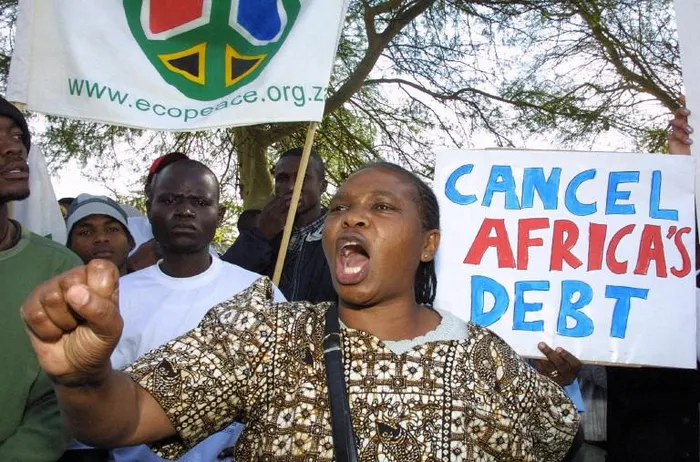
Kenyan activist Wahu Kaara (center) from the Kenyan Debt Relief Network and other anti-globalisation protesters demostrate at the African Union launch held in the International Convention Centre, Durban, South Africa on July 8, 2002.
Image: Rajesh JANTILAL / AFP
Dr. Reneva Fourie
On May 25, Africa Day returns as a reminder of the historic struggle against colonial domination and economic subordination.
Sixty-three years have passed since the Organisation of African Unity (OAU) was founded in Addis Ababa. The founding generation of African liberation movements understood that political independence would carry meaning only if it produced economic sovereignty, social dignity and continental unity.
At the preceding All-African People's Conference in 1958, Kwame Nkrumah warned that “… unity must be the keynote of our actions.” He added, “Our enemies are many, and they stand ready to pounce upon and exploit our every weakness. They play up our vanities and flatter us in every kind of way.” Those words continue to speak directly to the condition of the continent in 2026.
Africa possesses immense mineral wealth, a young population, agricultural capacity and strategic importance in global trade. As the world becomes increasingly multipolar, the continent has an opportunity to assert itself with greater confidence. Yet unassertive leadership, political fragmentation, conflict and economic docility still shape decision-making.
South Africa’s chairing of the Southern African Development Community exposes some of these contradictions. Pretoria wields economic and political influence, yet struggles to provide consistent leadership amid governance failures, economic instability and security concerns in the region.
Eswatini, for example, still faces a dictatorial monarchy, the repression of dissent and growing frustration among ordinary citizens. A SADC chair genuinely committed to the founding principles of African independence and dignity would activate the bloc’s mutual defence and governance protocols, confront the absolute monarchy directly and place the rights of the Swazi people above diplomatic convenience.
Regional weaknesses reflect a larger continental problem. The African Union has made some progress through institutional reforms and Agenda 2063. Yet it still struggles to move beyond declarations and summit diplomacy.
The organisation lacks the capacity to enforce its own charters, discipline governments that violate democratic norms, coordinate meaningful responses to continental crises and advance common positions internationally. Funding constraints also hinder the organisation, with many member states failing to pay their annual contributions on time, leaving the AU vulnerable to foreign donors.
The Union has likewise failed to adequately embed itself among the continent’s citizens. The result is a continental body that talks endlessly but acts rarely – a monument to forgone opportunities.
Political cohesion across the continent is also weakening. There have been important gains, including favourable agreements at the Johannesburg G20 Summit, the adoption of a unified Common African Position on Debt and the advancement of plans for a Pan-African Credit Rating Agency.
However, voting patterns at the United Nations increasingly reflect fragmented national interests rather than collective continental positions. Many African states have deepened bilateral relations with major external powers and Israel. This, while the genocide against Palestinians is persisting alongside intensified conflict in Lebanon and military aggression against Iran.
The Chairperson of the AU Commission, Mahmoud Ali Youssouf, was recently photographed showing excessive deference to French President Emmanuel Macron. Similarly, Kenya has consolidated itself as a Western-aligned stronghold on the continent.
It hosts security training missions and enters military agreements with the United States and its allies. This competition for favour from powerful external states undermines any claim to a coherent African foreign policy agenda.
Economic cohesion has likewise suffered. Despite significant progress in moving the African Continental Free Trade Area from framework to operational phase, and the announcement by the AfCFTA that intra-African trade reached $220.3 billion in 2024, major structural challenges remain. African economies still export raw materials while importing finished goods at high cost. Foreign corporations dominate key sectors, including mining, telecommunications, finance and energy.
Collective negotiation at institutions such as the World Trade Organisation remains limited. African states frequently compete against one another for foreign investment while offering concessions that weaken labour standards, taxation and national control over resources. Without a genuine commitment to coordinated economic planning and industrial policy, Africa will continue to struggle for development despite its human and natural wealth.
The AU has attempted to strengthen its security architecture, yet conflict remains another obstacle to unity and progress. Many of these conflicts are fuelled, prolonged or manipulated by actors from outside the continent seeking access to minerals, strategic influence or military advantage. While internal contradictions certainly exist, external powers have consistently exploited them for their own benefit.
Sudan’s devastating civil war has displaced millions and killed hundreds of thousands, with external powers backing rival factions. The Democratic Republic of the Congo remains trapped in violence as foreign interests compete for its mineral wealth.
Mozambique, the Central African Republic, Mali and South Sudan are similarly caught in recurring cycles of instability. Yet, the AU still exercises limited influence within the United Nations Security Council. African lives remain expendable to those who profit from instability.
Internal divisions among Africa’s people also weaken continental solidarity. Afrophobic tendencies have become increasingly visible in South Africa, where migrants from other African countries are often blamed for unemployment, crime and pressure on public services.
Frantz Fanon warned of this danger when he wrote, “The colonised man will first manifest this aggressiveness which has been deposited in his bones against his own people.” Economic hardship and social frustration are redirected towards fellow Africans instead of the structures that sustain inequality and underdevelopment.
Many of these failures lie in the neo-colonial structures that still govern Africa’s position in the global political economy. The continent exercises limited influence in the International Monetary Fund and the World Bank, institutions that continue to shape economic policy across much of the developing world.
African countries are instructed on what to privatise, which subsidies to cut and how to manage fiscal budgets. Too often, ruling elites have become complicit in this arrangement while ordinary citizens remain trapped in poverty.
Africa Day should therefore become more than a celebration of historical achievement. African leaders must recover the courage to defend continental interests, strengthen continental institutions and reduce dependence on foreign powers.
African economies must industrialise through cooperation, public investment and expanded intra-African trade. Citizens must reject neo-colonialism and rediscover a pan-African consciousness grounded in shared struggle and shared destiny. The task of this generation is to reassert dignity, strengthen unity and build loyalty to the broader African project among leaders and citizens alike.
* Dr Reneva Fourie is a policy analyst specialising in governance, development and security.
** The views expressed do not necessarily reflect the views of IOL or Independent Media.