

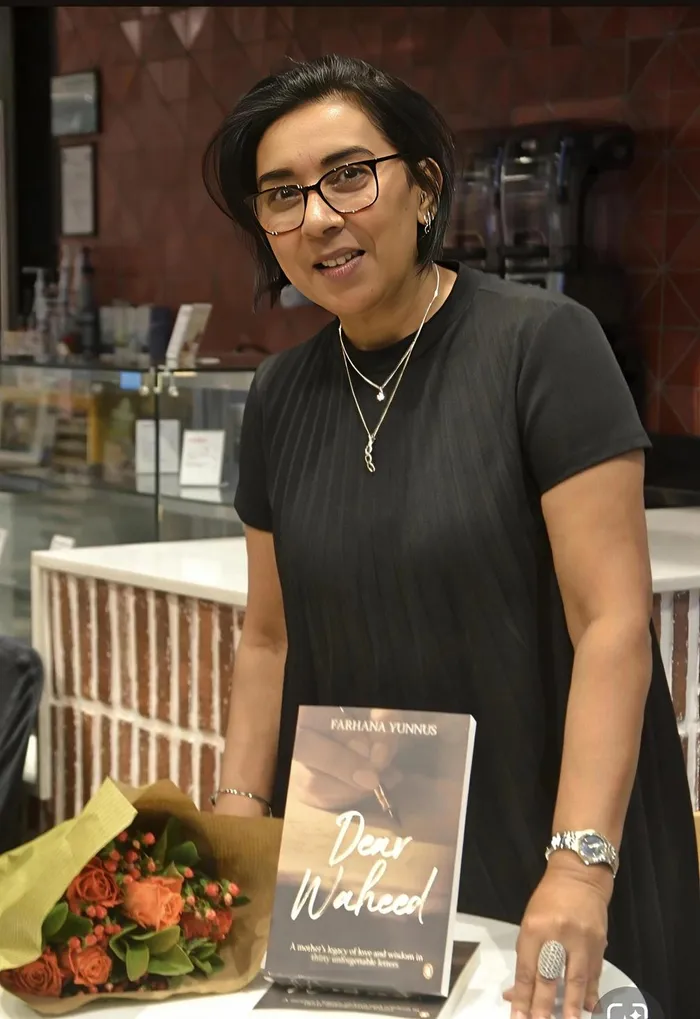
Author Farhana Yunnus says the journey of writing "Dear Waheed" has transformed her.
Image: Supplied.
For South African writer, artist, educator and mother Farhana Yunnus, the Covid-19 lockdown didn't just bring the world to a standstill; it created a vast, painful silence between two cities.
While she remained in Cape Town, her son, Waheed Yunnus, was in Durban.
In that isolation, faced with the fragility of life and the physical distance from her child, Farhana picked up her pen.
What began as a way to reach across the map became "Dear Waheed", a collection of 30 letters written over the course of Ramadaan.
It is a book born of a mother’s need to preserve her love, but it has evolved into a universal manual for healing.
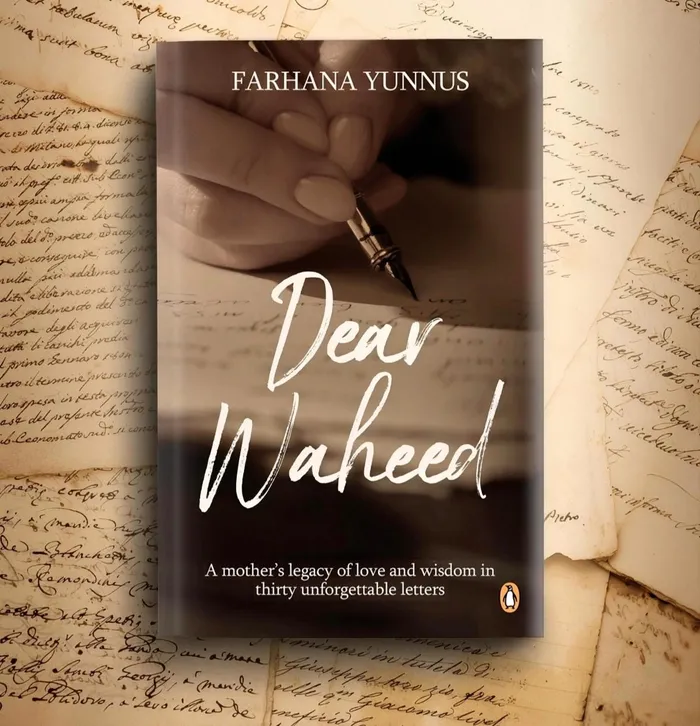
"'Dear Waheed' is about love, longing, faith and the quiet ways we try to hold on to the people and moments that matter to us." says author Farhana Yunnus.
Image: Supplied.
The motivation to write wasn't sparked by a single event, but by the cumulative weight of quiet, unsettling moments.
"I remember thinking how easily words can be left unsaid… how quickly time can shift without warning. That was the nudge," said Yunnus during an interview with "Independent Media Lifestyle".
"I began writing because I needed a way to feel close to my child, despite the distance. The letters became my way of reaching across cities, of holding onto him at a time when I physically could not."
Writing during Ramadaan added a layer of spiritual stillness to the process. The sacred month invited a deeper introspection, turning her letters into an anchor of faith amidst global panic.
While her initial goal was simply to connect with her son, Farhana soon discovered a surprising byproduct: she was beginning to heal herself.
By confronting her own fears on the page, she found a quiet space to be honest without the need to be strong.
"They also became something deeper, a way to process fear, to anchor myself in faith and to preserve love in the middle of so much uncertainty."
The pandemic stripped away the usual routines that many people associate with resilience. For Farhana, this forced stillness refined her understanding of faith.
"What surprised me was how much quieter faith had become. It was not always in words or certainty; it was in small, almost imperceptible acts of surrender. In choosing to trust without needing to understand. In sitting with discomfort and not rushing to escape it.
"Resilience, too, took on a different shape. It was not about holding everything together; it was about allowing things to fall apart without losing myself in the process. It became softer, more internal, less about endurance and more about honesty.
"That stillness did not weaken those themes for me; it refined them. It showed me that both faith and resilience are not fixed states, but living, evolving experiences, ones that become most real when everything else is stripped away," Farhana shared.
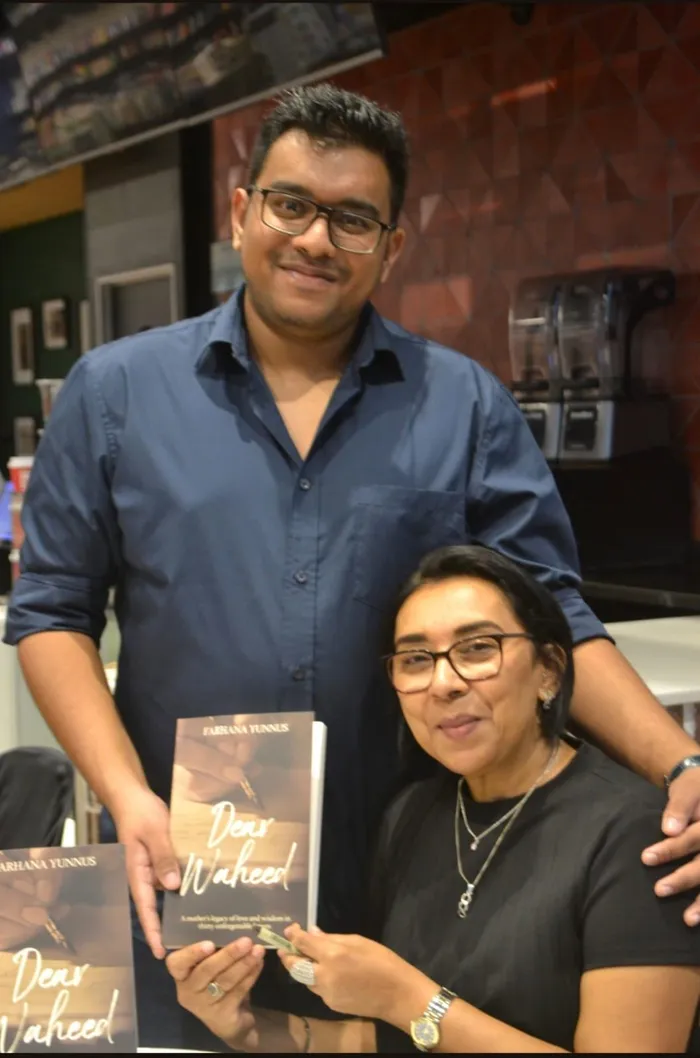
Farhana Yunnus began writing "Dear Waheed" because she needed a way to feel close to her child, Waheed (pictured).
Image: Supplied.
Though the book is a personal correspondence, its themes of longing and resilience are universal. Yunnus chose the structure of thirty letters to mirror the rhythm of Ramadaan, suggesting that growth happens in gentle, daily increments rather than all at once.
More importantly, she chose not to write as an all-knowing authority.
"Perfection is not something Waheed will ever live inside of, and I did not want my words to become something he feels he has to measure himself against and inevitably fall short of. I wrote to my child as I am: flawed, learning and sometimes uncertain.
"Not because I lacked answers, but because I understand that life is not lived through perfectly packaged wisdom.
"It is lived through moments of doubt, mistakes, repair and return. If I had only given Waheed 'perfect' advice, I would have given him something distant, something polished, but not something he could truly recognise himself in.
"Vulnerability, to me, is a form of honesty. It tells my child: you are allowed to be human. You are allowed to struggle; you are allowed to question and to get it wrong, but still find your way back. And more than that, it shows Waheed that strength is not the absence of fragility, but the courage to hold both at once."
Yunnus said she wanted her son to inherit "something real".
"Not a manual for perfection, but a language for navigating life as it is. Because one day, when he faces his own uncertainties, I do not want him searching for unattainable ideals; I want him to remember that even in his imperfection, he is still enough, he is still growing and still becoming.
"And perhaps most importantly, I wanted him to know that he does not need to hide parts of himself to be worthy of love, not from the world, and never from me."
Ultimately, the journey of writing "Dear Waheed" transformed Farhana.
The woman who wrote the first letter felt a pressure to provide answers, the woman who finished the thirtieth realised that her greatest gift was her willingness to sit with the questions.
"The Farhana who wrote the first letter still believed she needed to have clarity before she could offer it. There was a quiet pressure to make the words meaningful, to ensure they carried enough wisdom, enough certainty. She stepped into the process as a mother trying to teach.
"But by the thirtieth letter, something had softened. She understood that her role was not to present a finished version of herself, but an honest one. That her strength did not lie in having all the answers, but in her willingness to sit with the questions.
"Writing became less about shaping her son, and more about uncovering herself, her fears, her hopes, her faith and her becoming.
"She began to see that she, too, was still growing. Still learning how to return, how to trust and how to surrender. She started by trying to leave something behind for her son, and ended by finding a deeper sense of herself within the words she gave him."
When asked for the best piece of wisdom she has gathered to navigate life's storms, Farhana offers a simple yet profound concept.
"Return, again and again, to Allah (God), to yourself, and to the quiet truth that steadies you. Return to Allah (God), even when you feel distant. Return to yourself, even when you feel lost. Return to what is right, even after you have fallen short.
"I used to think that strength meant getting it right the first time, that certainty was something you either had or did not have. But over time, I came to understand that life is not a straight path; it is a continuous returning.
"That no matter how far you feel, or how uncertain the season, there is always a way back, and that returning is, in itself, a form of grace," she ended.