


The changing economic dynamics have seen women being more assertive giving them more options to either leave or stay in a dysfunctional marriage. The majority of divorces are initiated by women, while men seem to be more reluctant to call time on marriage.
Image: Gemini/ AI generated
Marriage, once seen as the cornerstone of social stability in South Africa, is quietly losing its hold. New figures from Statistics South Africa paint a picture of a society undergoing a gradual but unmistakable transformation: fewer people are getting married, and more marriages are ending in divorce, with women increasingly taking the lead in ending them.
Women increasingly calling time on marriage
In 2024, courts granted 24 202 divorces, an 8.9% increase from the 22 230 recorded in 2023.
Behind that number lies a striking trend: women initiated the majority of these separations.
Wives filed for 57.2% of all divorces granted last year, continuing a pattern that has been visible for several years.
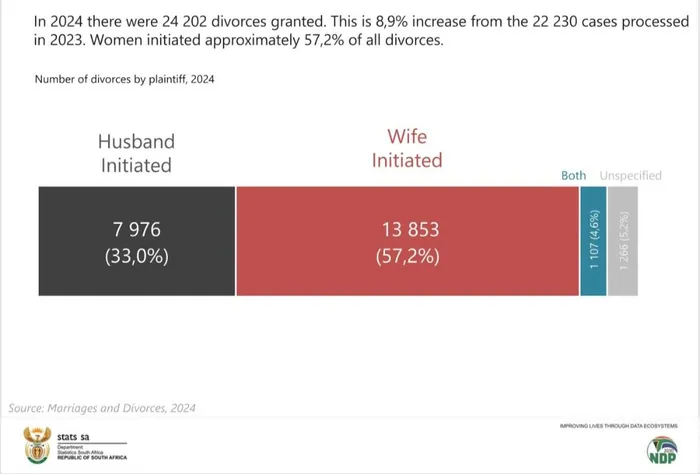
Women lead men by 24,2% when it comes to initiating divorce in South Africa according to Statistics South Africa. The number of divorces is also increasing while the number of marriages registered has gone down.
Image: StatsSA
A steady retreat from the altar
At the same time, marriage itself appears to be in retreat. South Africa recorded 102 373 marriages and unions in 2024, a 2.6% drop from the 105 123 registered in 2023.
Over the longer term, the decline is even more dramatic. Since 2015, marriages have fallen by 40 906, a drop of 28.5% in less than a decade.
Civil marriages accounted for the bulk of unions in 2024, with 97 510 recorded. But even that figure represents a 1.8% decline from the previous year.
The numbers suggest that what was once a near-universal institution is slowly becoming a more cautious and selective choice.
Economic independence reshaping decisions
For many women, the shift appears to reflect growing autonomy and economic independence.
In 2024, nearly half of the women who filed for divorce, 10 804 in total, were employed. Many worked in professional, technical or semi-professional occupations, with others occupying managerial, administrative and clerical roles.
Economic stability often translates into personal agency. The ability to earn an income can make it easier to leave a relationship that is no longer working, something that was historically far more difficult for women who were financially dependent on their spouses.
Where divorces are happening most
Geography also tells part of the story. Gauteng recorded the highest number of divorces initiated by women, with 4 289 cases accounting for nearly a third of the national total. The Western Cape followed with 2 579 cases, while KwaZulu-Natal recorded 1 910.
Divorce still largely the end of a first marriage
Beyond the statistics, the demographic profile of divorce is also evolving. Most women initiating divorce were ending their first marriage.
In 2024, 89.1% of female plaintiffs had been married only once before filing for divorce.
Very few had been married multiple times, suggesting that divorce in South Africa is still largely the end of a first long-term union rather than a recurring cycle of marriages.
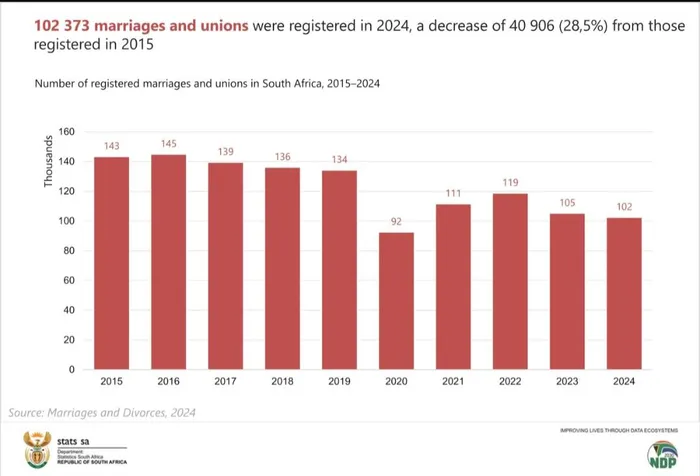
The number of registered marriages in South Africa between 2015 and 2014 is decreasing while the number of divorces has increased.
Image: StatsSA
Separating later in life
Age patterns also reveal a subtle shift. The largest share of divorces occurred among women aged between 40 and 44, followed closely by those aged 35 to 39.
Meanwhile, divorces involving women younger than 25 were rare. Couples are also separating later in life. Over the past five years, the median age for male divorcees has risen from 45 to 46, while the median age for women has increased from 41 to 42.
This suggests that many couples are entering marriage later and remaining in those unions for longer before deciding to end them.
Marriage under quiet reconsideration
Marriage duration data reinforces that point. The largest proportion of divorces, 26.7%, occurred in marriages lasting between five and nine years.
Another 21.3% involved couples who had been married for 10 to 14 years. Overall, four in every ten divorces in 2024 involved marriages that had lasted less than a decade.
Taken together, the numbers tell a broader story about the changing character of relationships in South Africa.